“Mumma, why is the sky blue?” Have you ever been walking or playing with your child when suddenly they look up and ask this..!!!
It seems like such a simple question. But the answer is actually a beautiful piece of science happening above us every single day!
Let’s understand why is the sky blue in the easiest way possible
Why Is the Sky Blue? Let’s Understand Step by Step
Sunlight Is Not Just White Light
We see sunlight as white light. We also call sunlight as white light. But did you know that sunlight is actually made up of many colors?
If you’ve ever seen a rainbow, you’ve already seen proof! A rainbow shows us that sunlight contains 7 colors — Violet, Indigo, Blue, Green, Yellow, Orange and Red (VIBGYOR).
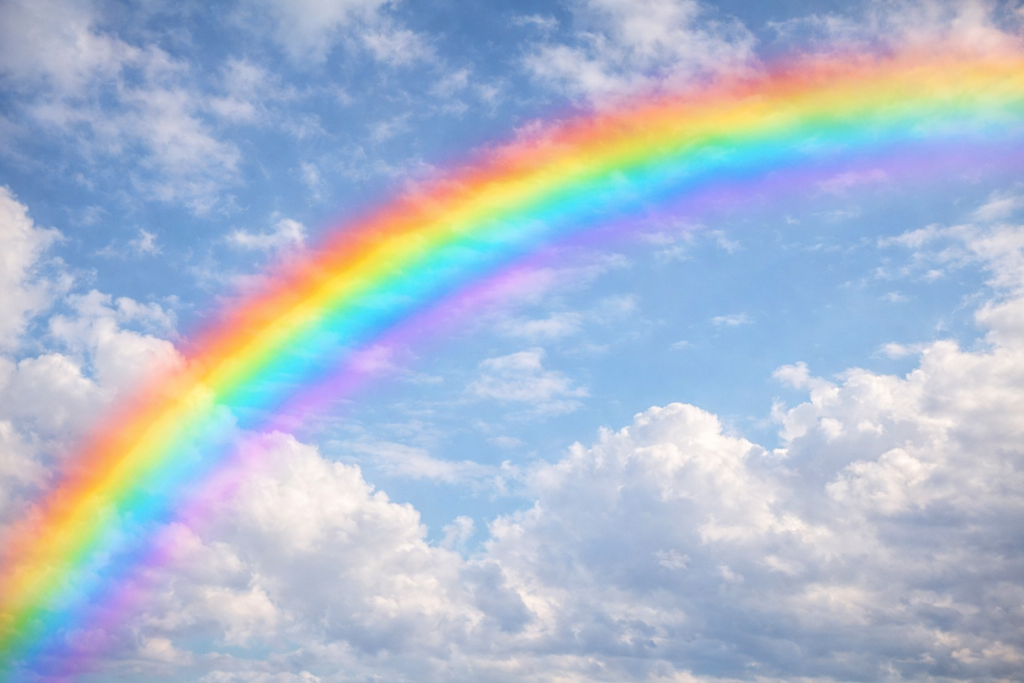
So sunlight is not just one color. It’s a mix of many colors together.
Think of it like this:
Sunlight is like a box of crayons mixed together into one bright white light.
The Sky Is Full of Tiny Particles
We think the sky is empty. But it is actually filled with tiny air particles. We cannot see them, but they are there, everywhere.
When sunlight enters Earth’s atmosphere, it hits these tiny particles.
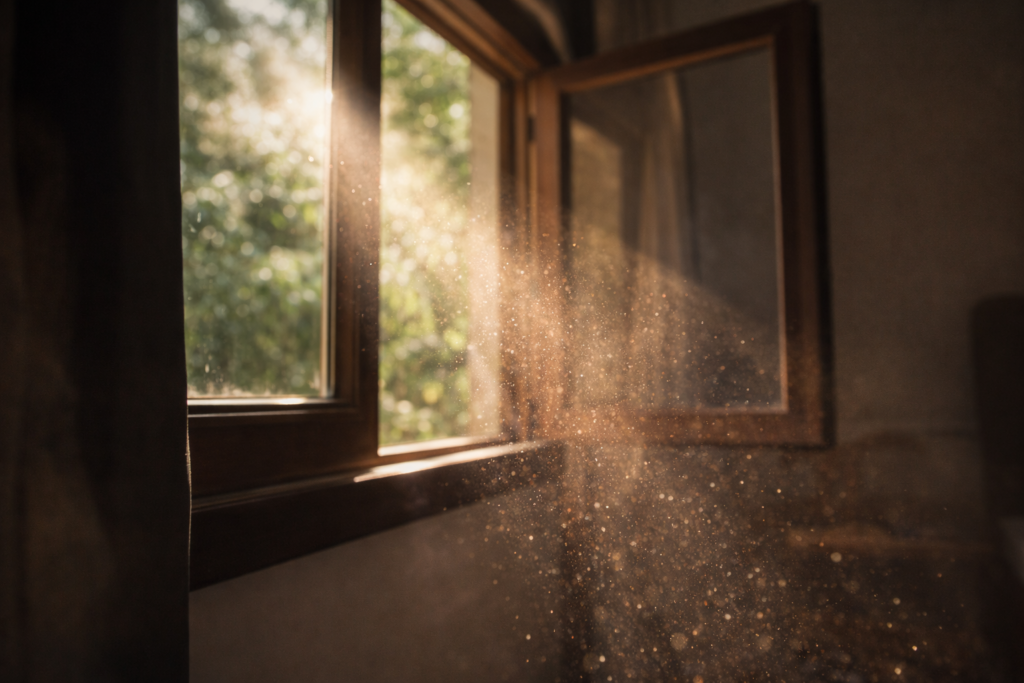
Imagine entering a room where sunlight is coming through the window. If there is dust in the room, you can see tiny particles floating in the light. The same thing happens in the sky — just on a much bigger scale.
Blue Light Spreads the Most
Here is the most interesting part.
When sunlight hits air particles, different colors behave differently.
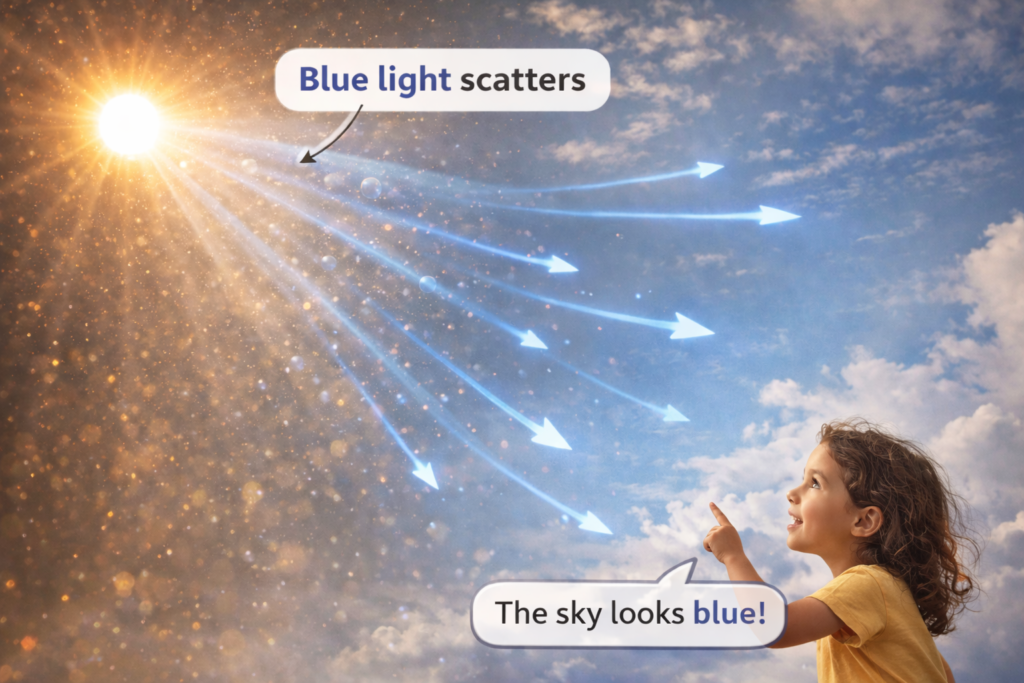
Blue light spreads in all directions more than other colors.
Because blue light spreads everywhere in the sky, our eyes see the sky as blue!
“Out of all the colors in sunlight, blue likes to travel around the most. So it spreads everywhere in the sky, and that’s why we see blue.”
Simple. Clear. Magical.
Then Why Is the Sky Orange During Sunset you ask?
Have you noticed how the sky turns orange or red in the evening?
That’s because during sunset, sunlight has to travel a longer distance to reach us.
Most of the blue light has already spread away by then. The red and orange colors remain, and that’s what we see.
Nature is basically painting the sky every evening.
Try This Easy Experiment at Home
You will need:
- A glass of water
- 1-2 drops of milk
- A torch
Steps:
- Fill the glass with water
- Add 1-2 drops of milk and mix
- Turn off the lights
- Shine the torch from one side
You may notice a slight bluish glow from the side. The milk particles act like air particles in the sky spreading light just like the atmosphere does.
Conclusion
Sunlight contains many colors. When it enters Earth’s atmosphere, it hits tiny air particles. Blue light spreads more than the other colors, so the sky looks blue. During sunset, most blue light spreads away, leaving red and orange colors behind.
Hopefully now you understand why is the sky blue.
Have you noticed how the sky sometimes looks a lighter blue and sometimes a darker blue? On a very clear day, the sky looks deep blue. But on a hazy or dusty day, it may look pale or even whitish. That’s because more dust and pollution in the air changes how light scatters.
When there are more particles in the air, light spreads differently, and the sky may not look as bright blue.
So the next time you step outside, look up and observe — what kind of blue do you see today?
Food for Thought !!!
- What color would the sky be if there was no air?
- Why does space look black?
- Why are clouds white?
Read more simple science questions on Kyunaurkaise