
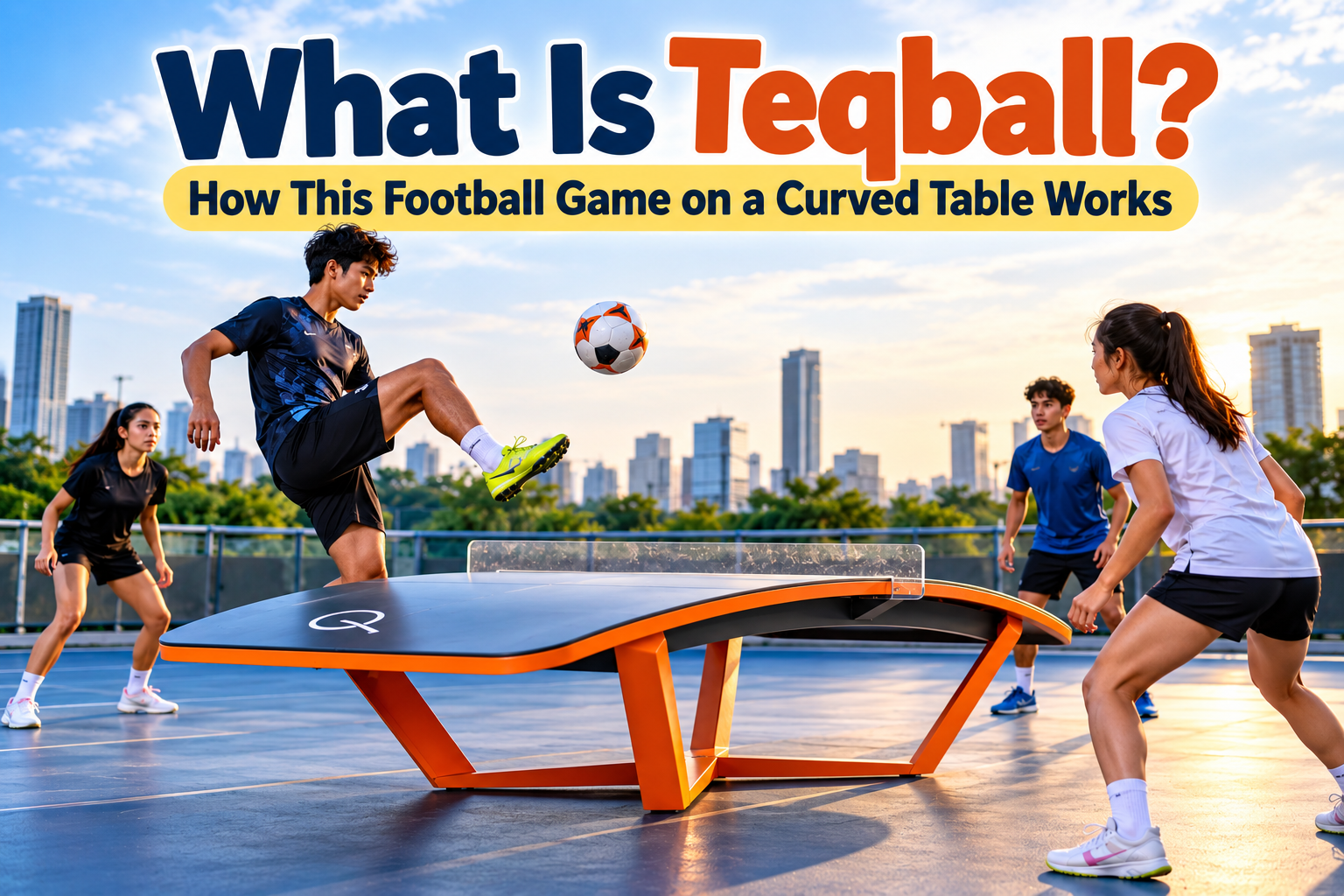
Imagine playing football without running across a football field.
Instead, you stand on opposite sides of a curved table and use your feet, thighs, chest, shoulders and even your head to send a football over a net.
Sounds unusual, right?
That is Teqball.
Teqball is a relatively new sport that combines skills from football with the precision and structure of table tennis. It is played on a specially designed curved table and has become increasingly popular around the world.
And in 2026, Teqball reached an important milestone: it became a medal sport at the Asian Games in Aichi-Nagoya, Japan, bringing the unusual game to one of Asia’s biggest sporting stages.
So, what exactly is Teqball, how do you play it, and why does the table have a curve?
Let’s find out.
What Is Teqball?
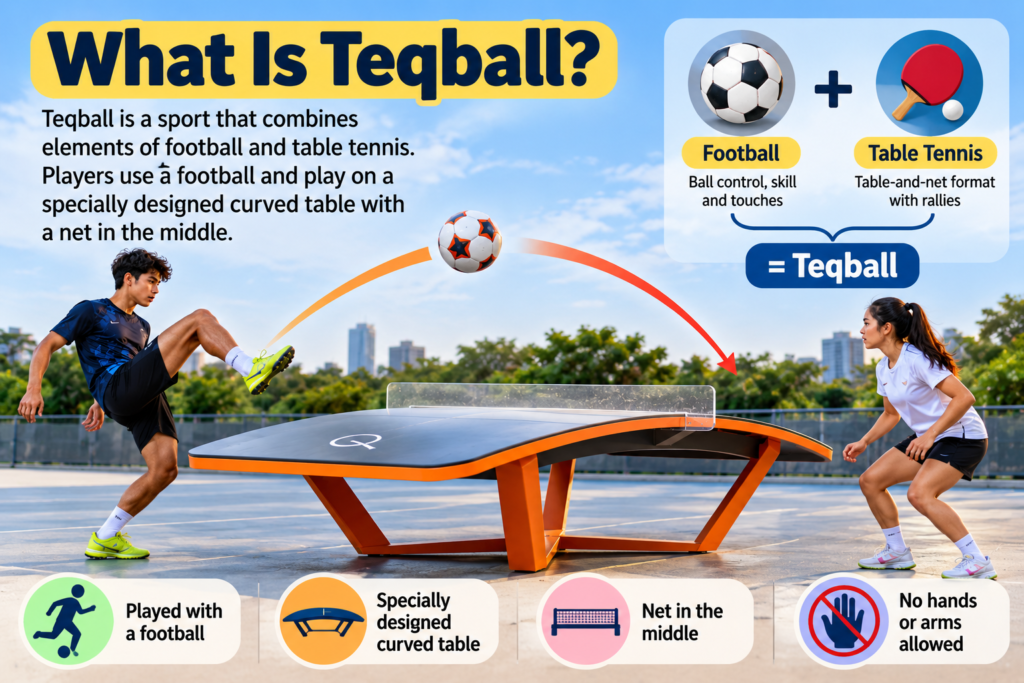
Teqball is a sport developed in Hungary that combines elements of football and table tennis.
Players use a football and compete on a specially designed curved table with a net in the middle. They must control the ball and return it to the opponent’s side without using their hands or arms.
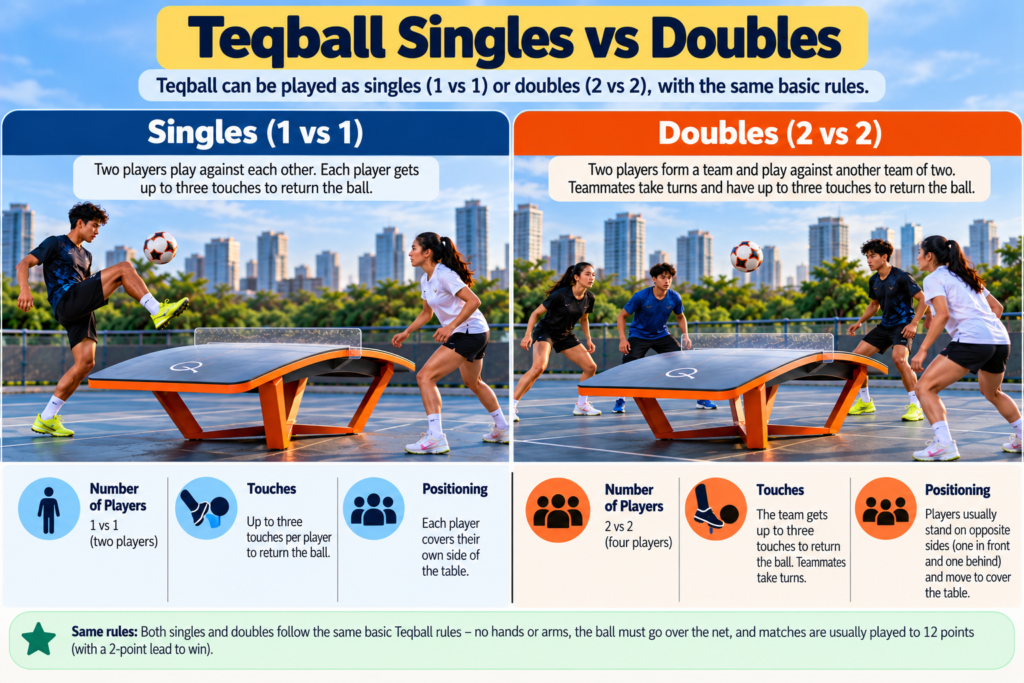
A game can be played between two players in singles or between two teams of two players in doubles.
The basic idea is simple:
Control the ball → use up to three touches → send it over the net → make it difficult for your opponent to return it.
But actually doing this is much harder than it sounds.
The curved surface changes the way the ball bounces and forces players to constantly predict where the ball will go next.
Who Invented Teqball?
Teqball was created in Hungary in 2012 by a group including former professional footballer Gábor Borsányi and engineer Viktor Huszár, along with entrepreneur György Gattyán.
The idea grew from a simple problem.
Borsányi had played football on ordinary table-tennis tables as a child. But a flat table did not produce the kind of ball movement he wanted.
The solution was surprisingly simple:
What if the table were curved?
The curved surface helped the ball bounce back toward the player, making it easier to keep a rally going.
The sport was publicly introduced in 2014, and its popularity began to grow from there.
Today, Teqball is governed internationally by the Fédération Internationale de Teqball (FITEQ), which was established in 2017
What Does a Teqball Table Look Like?
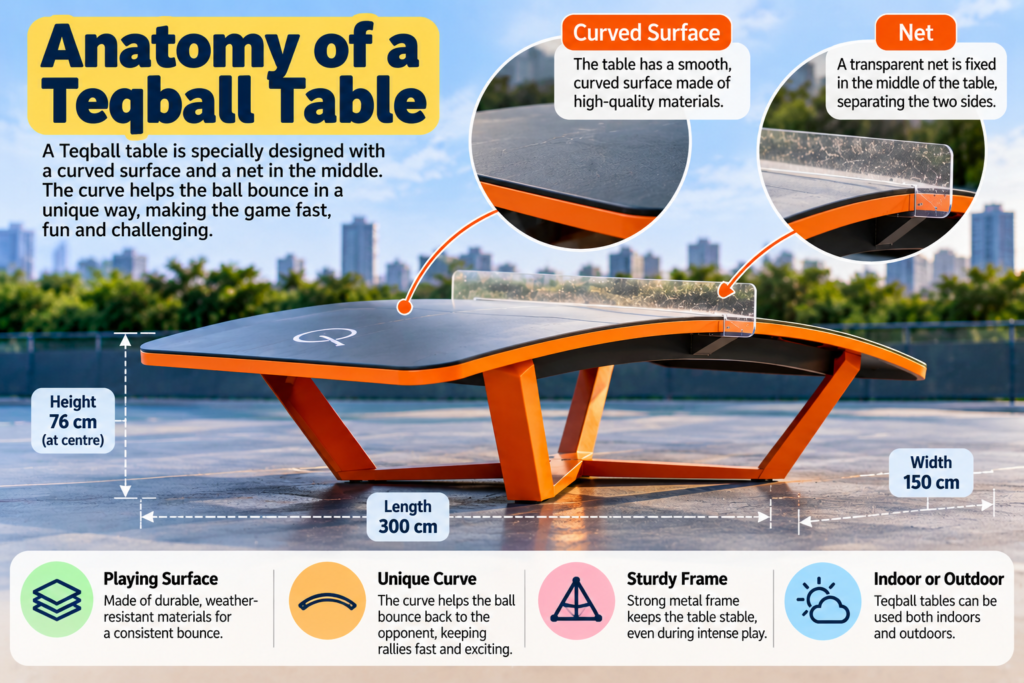
At first glance, a Teqball table looks like a table-tennis table that has been gently bent upward.
But the curve is not just for appearance.
It is one of the most important parts of the sport.
The curved surface affects the direction and angle at which the ball rebounds. Instead of simply bouncing straight back like it might from a flat surface, the ball moves in a way that challenges the player to control its speed, height and direction.
There is also a net separating the two sides.
Players stand behind the table and try to return the ball to the other side without touching the table or their opponent.
This creates a game where ball control is more important than simply kicking the ball hard.
How Is Teqball Played?
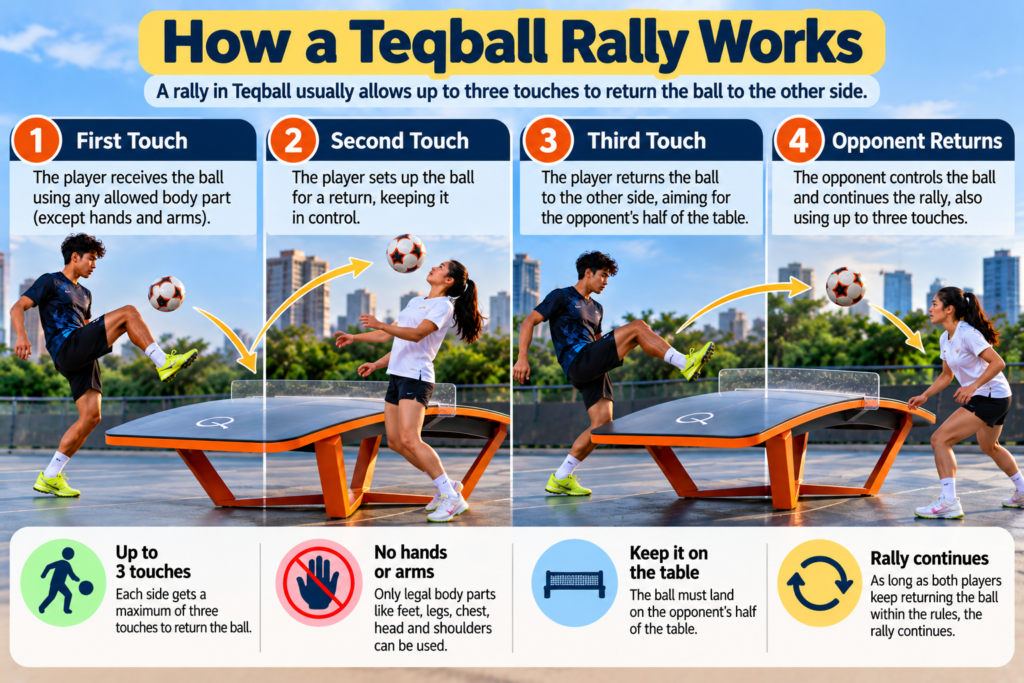
The basic rules are easier to understand if you imagine a rally.
Suppose Player A serves the ball.
Player B must receive it and control it using a legal body part.
The player can then use another touch, if needed, before returning the ball over the net.
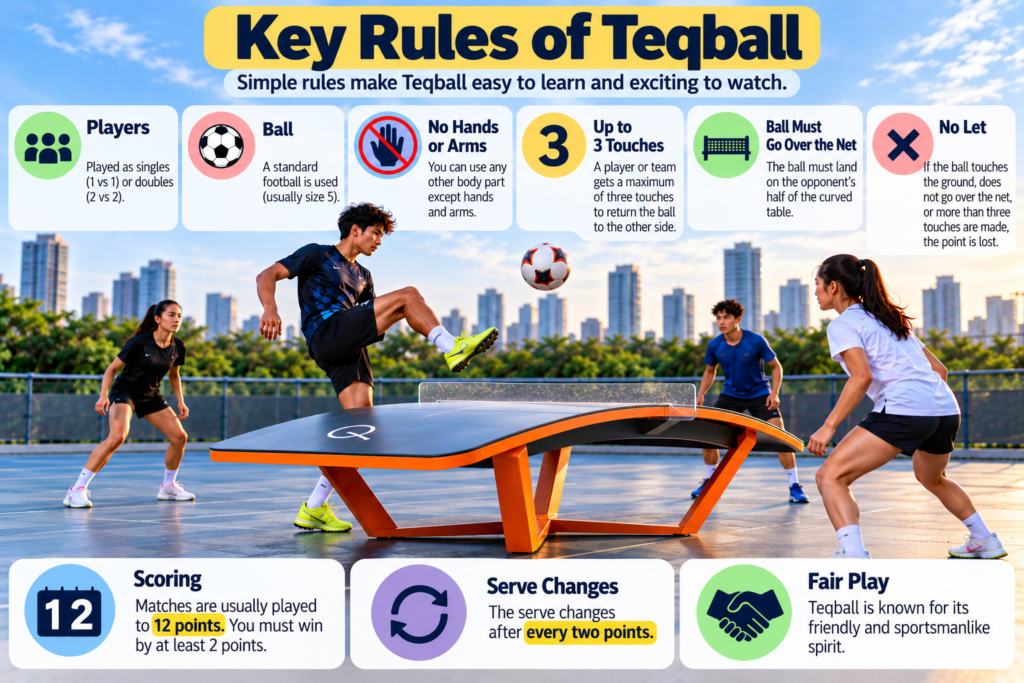
A player or team can use a maximum of three touches to return the ball.
The ball can be played using almost any part of the body except the hands and arms. Players can use their feet, thighs, chest, shoulders and head.
There is one interesting restriction:
A player cannot use the same body part repeatedly in consecutive touches during a rally.
So you cannot simply keep kicking the ball with the same foot again and again.
You have to be creative.
For example, a player might use:
right foot → left thigh → chest → return
That combination requires excellent coordination.
What Are the Basic Rules of Teqball?
Although the game looks complicated when professional players perform spectacular tricks, its basic rules are fairly straightforward.
1. You cannot use your hands or arms
Teqball is played with a football, but it is not football as we normally know it.
Players cannot deliberately use their hands or arms to control the ball.
2. You get a maximum of three touches
A player or team has up to three touches before returning the ball over the net.
They do not have to use all three.
Sometimes a skilled player can return the ball with just one touch.
3. You cannot keep using the same body part
During a rally, the same body part cannot be used for consecutive returns.
This prevents players from simply repeating the same movement.
It also makes the game much more demanding because players have to think about their next touch while controlling the current one.
4. You cannot touch the table
Players must control the ball without using the table for support.
They also cannot touch their opponent during play to gain an advantage.
These rules help keep the game focused on ball control, movement and skill.
5. Doubles requires teamwork
In doubles, there are two players on each side.
Both teammates must be involved in the rally before the ball is returned to the opponent.
That means doubles Teqball is not simply about having two talented players. They have to communicate and coordinate their movements as well.
Teqball has a specific set of rules covering touches, serving, scoring and how players can return the ball. You can find the complete rules on the official FITEQ rules page.
How Does Teqball Scoring Work?
A standard Teqball match is played as a best-of-three sets contest.
A set is played to 12 points.
If the score reaches 11–11, players need a two-point advantage to win the set.
The sport’s 12-point scoring system has been used since FITEQ returned to it in 2020.
There is also an important current rule that changed in 2026:
Service changes after every two points.
This replaced the previous service rotation and was introduced to create a more balanced distribution of serving opportunities and a faster rhythm of play.
Because Teqball rules can evolve as the sport develops, players competing in official events need to follow the latest FITEQ regulations.
Why Is the Teqball Table Curved?
This is probably the most interesting question about Teqball.
Why not simply use a flat table?
The curve changes the way the ball behaves.
When the ball hits the curved surface, it is directed back toward the player instead of simply bouncing away unpredictably.
This helps create longer rallies while also demanding greater control.
Imagine trying to receive a football that has bounced from a curved surface and is travelling toward you at an angle.
You have to judge:
How high the ball will come
How fast it is travelling
Which direction it will move
Which part of your body you should use
Where you want to send it next
That is why professional Teqball players often make extremely difficult movements look easy.
What Skills Do You Need to Play Teqball?
You don’t need to be a professional footballer to try Teqball.
But having good football skills certainly helps.
Some of the most important skills include:
Ball control
Players need to control the ball accurately using different parts of their body.
Balance
The ball can arrive from different angles, so players need excellent balance while moving around the table.
Coordination
A player may need to move their leg, body or head into exactly the right position within a fraction of a second.
Concentration
A small mistake can end a rally.
Players need to continuously watch the ball and anticipate where it will go next.
Reaction speed
Professional rallies can become extremely fast.
Players need quick reactions to return difficult shots.
Creativity
Teqball is not only about power.
Players can use different angles, spins, heights and body parts to make their returns difficult to predict.
Teqball vs Football vs Table Tennis
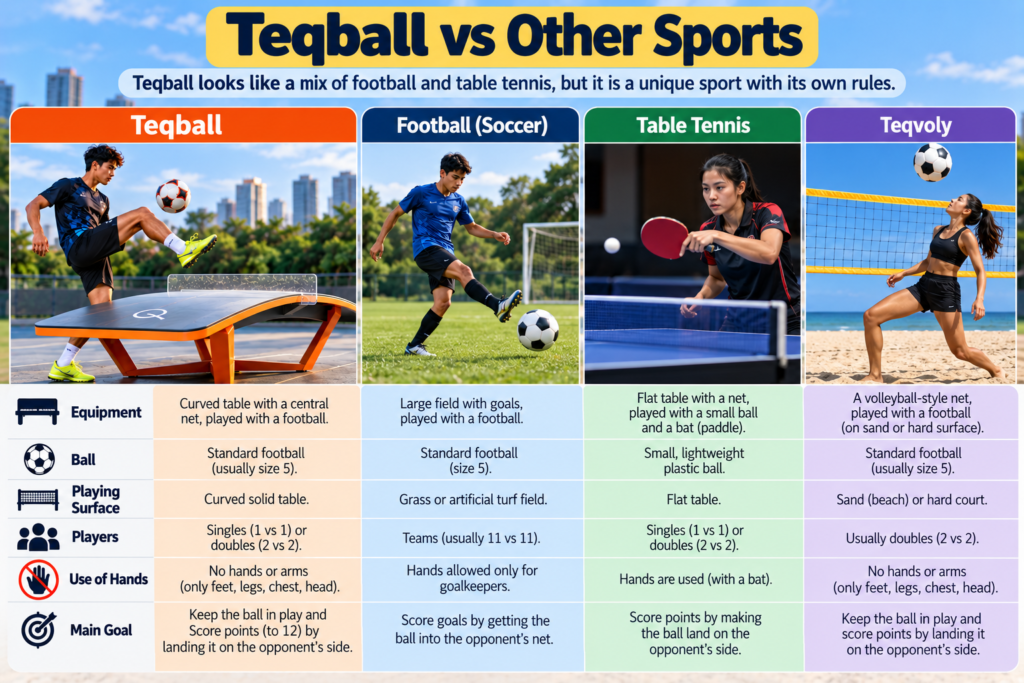
Teqball may look like a combination of football and table tennis, but it is quite different from both.
| Feature | Teqball | Football | Table Tennis |
|---|---|---|---|
| Main equipment | Football + curved table | Football + field | Table + paddle + small ball |
| Hands allowed? | No | Usually no, except goalkeeper | Yes, through paddle |
| Playing area | Small table area | Large field | Table |
| Main skill | Ball control and precision | Passing, shooting and movement | Paddle control and reaction |
| Players | Singles or doubles | Usually teams | Singles or doubles |
| Physical contact | Not allowed | Common | Not applicable |
Teqball therefore sits in an interesting space.
It uses the ball-control skills of football but the structured, net-based format of table tennis.
Can Children Play Teqball?
Teqball can be adapted for younger players.
FITEQ has published youth guidance with modified rules designed to make the sport more suitable for children, including changes to the service distance and certain ball-control rules for younger age groups.
For children learning the sport, the goal does not have to be competition.
Simply learning to control a football with different parts of the body can improve coordination, concentration and ball skills.
As with any sport, children should use age-appropriate equipment and learn under suitable supervision.
Teqball at the 2026 Asian Games
This is where Teqball’s story becomes particularly interesting.
In 2026, Teqball was officially added as a medal sport at the 20th Asian Games in Aichi-Nagoya, Japan.
The Asian Games featured five Teqball events:
Men’s singles
Women’s singles
Men’s doubles
Women’s doubles
Mixed doubles
The competition took place at the Nagoya City Higashi Sports Center.
This was a major milestone because Teqball is still a young sport compared with sports such as football, athletics or swimming.
The 2026 Asian Games marked the sport’s first appearance as a medal sport at the Asian Games.
Did You Know?
Teqball is only about a decade old.
The sport was created in Hungary in 2012, making it much younger than most internationally recognised sports.
Its rapid growth is unusual because many major sports have developed over hundreds of years.
Teqball has gone from an idea involving a curved table to becoming a medal sport at the Asian Games in just over a decade.
Why Is Teqball Becoming Popular?
One reason is that Teqball is relatively easy to understand once you see it being played.
Another is that it rewards football skills without requiring a huge playing field.
A football player can use Teqball to practise touch, control, balance and coordination.
But you don’t necessarily need to be a footballer.
The sport can also be played simply for fun.
Its compact playing area makes it possible to set up a game in places where a full football field would not be practical.
And there is another reason it attracts attention:
It looks spectacular.
Professional players can perform difficult shots involving their feet, heads, chests and legs while moving around a curved table.
That combination of athleticism and skill makes Teqball interesting both to play and watch.
Teqball is also part of a growing interest in unusual sports that combine familiar skills with unique rules and equipment. Sepak Takraw, for example, combines football-style ball control with volleyball-like gameplay, but players use their feet, head and other parts of the body instead of their hands.
So, Is Teqball Just Football on a Table?
Not quite.
Football is one of its biggest influences, but Teqball has developed its own rules, equipment and style of play.
The curved table, three-touch limit, restrictions on repeated body-part use and absence of physical contact create a very different experience.
Think of it this way:
Football gives Teqball the ball.
Table tennis gives it the table-and-net idea.
Teqball adds its own rules, skills and tactics.
That combination is what makes the sport unique.
The Future of Teqball
Teqball has already travelled a long way in a short time.
Its inclusion in the 2026 Asian Games is another major step in that journey. FITEQ says the sport now has a network of national federations across all five continents, while it continues to pursue broader international recognition.
Whether Teqball eventually becomes an Olympic sport remains to be seen.
But its rapid growth shows that new sports can still emerge in the modern era.
And perhaps that is one of the most interesting things about Teqball.
It started with a simple question:
What if you bent a table-tennis table and played football on it?
More than a decade later, that unusual idea has become an international sport played on a major Asian sporting stage.
And who knows?
The next time you see a strange curved table at a sports centre, it might not be a table at all.
It might be a Teqball table.