
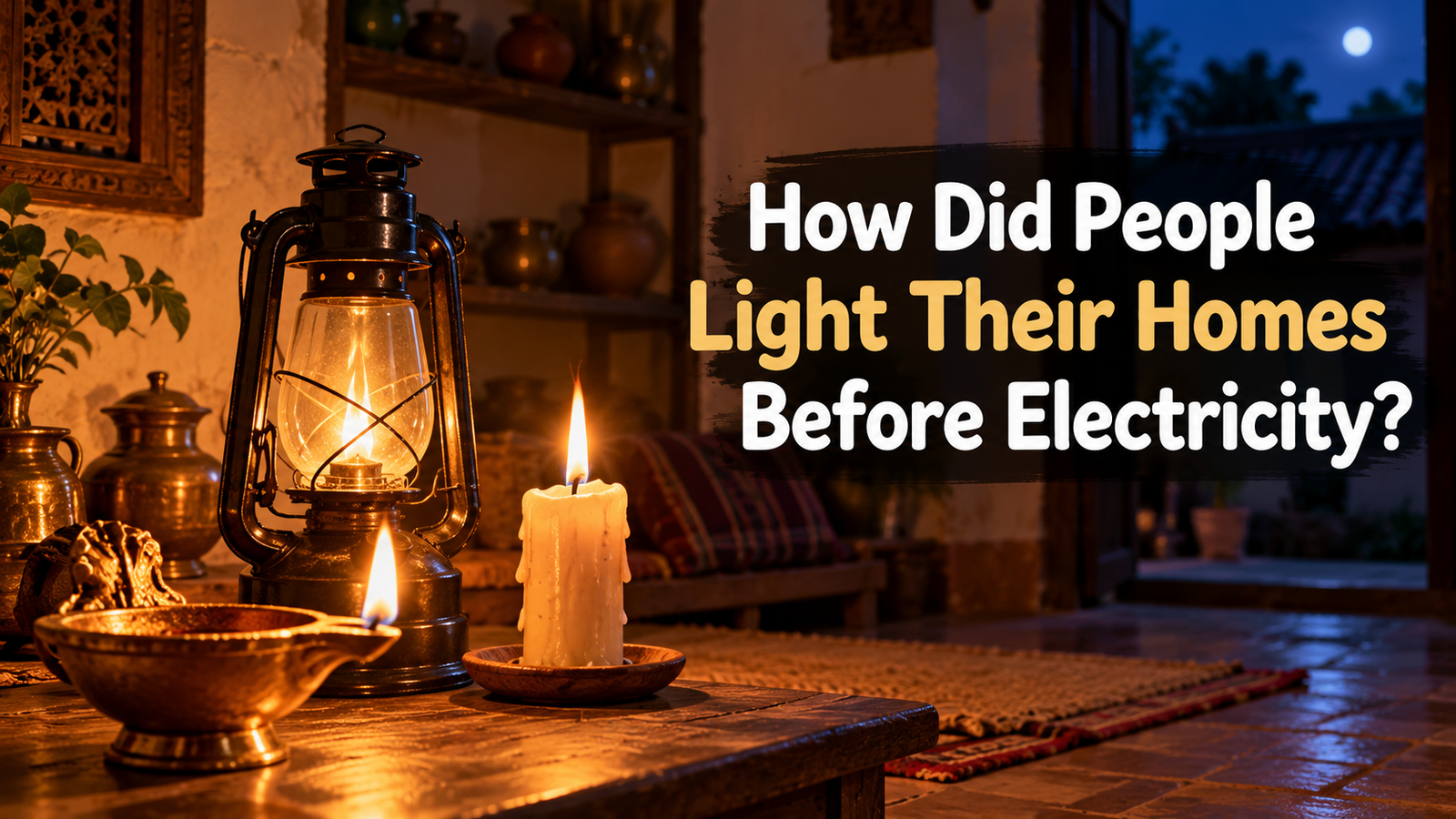
Today, lighting a room is almost effortless.
You flip a switch, press a button, or simply say a command—and a light comes on.
But imagine living in a world without electricity.
There were no light bulbs, switches, LED lamps, or emergency lights. When the Sun went down, homes became dark unless people had another way to create light.
So, how did people light their homes before electricity?
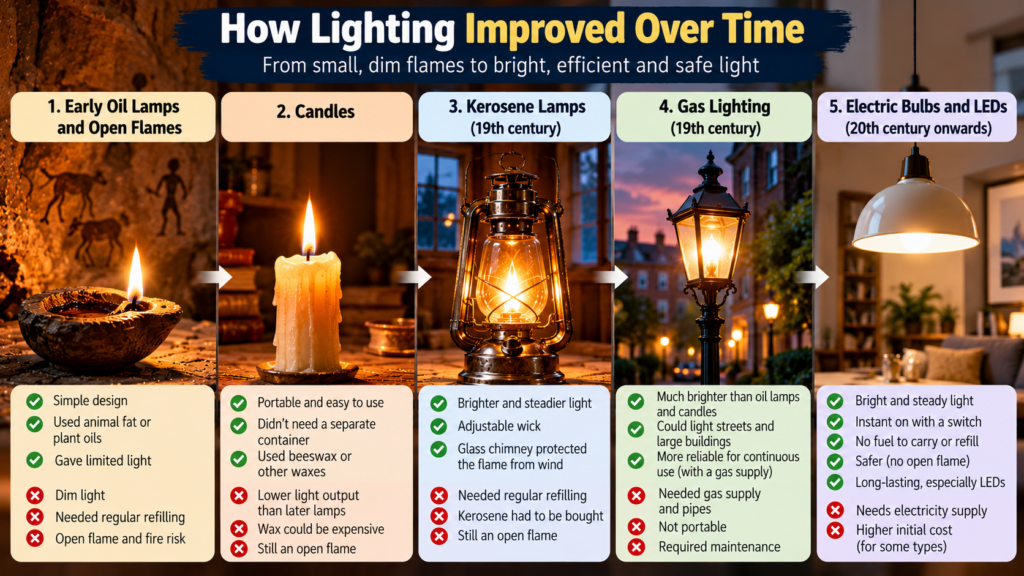
For thousands of years, people used fire, burning fuels, candles, and oil lamps to create artificial light. Over time, these simple methods became more sophisticated, eventually leading to gas lighting and then electric lighting.
The story of lighting is really a story of humans learning how to control energy and turn it into useful light.
 1. How Did People Light Their Homes Before Electricity? From Fire to Lamps
Long before lamps or candles, humans used fire.
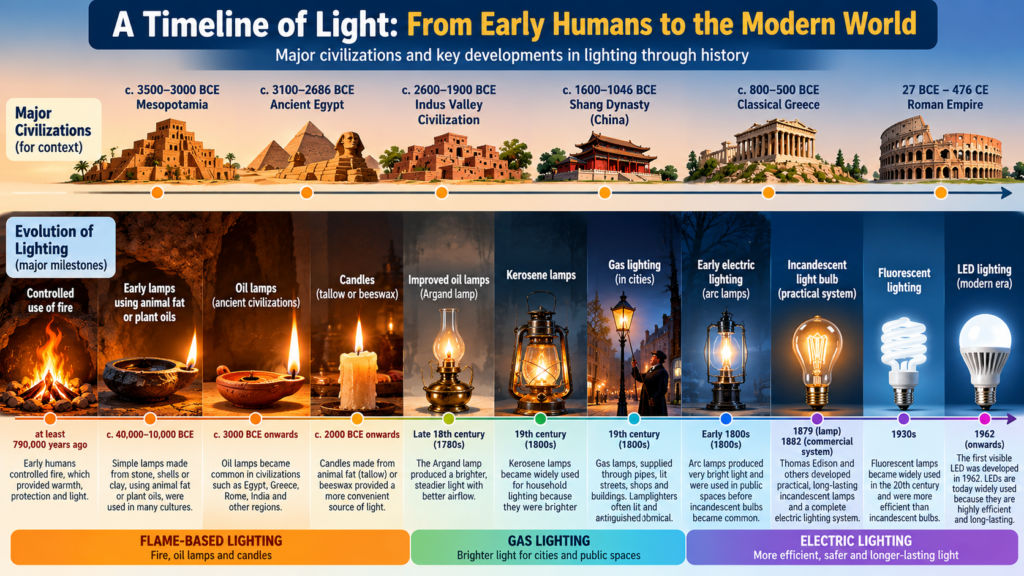
Archaeological evidence shows that early humans were controlling and using fire at least 790,000 years ago. At sites such as Gesher Benot Ya’aqov in present-day Israel, scientists have found evidence of ancient hearths containing burned wood, seeds, and fire-altered stone.
Fire had many uses. It provided warmth, helped people cook food, and may have offered protection from predators. It also provided something else that became extremely valuable after sunset:
light.
But an open fire wasn’t an ideal way to light a home.
It produced smoke and heat, needed fuel, and could be difficult to control. People eventually found ways to make light from smaller, more manageable flames.
That led to lamps.
🪔 2. Early Lamps Used Animal Fat and Plant Oils
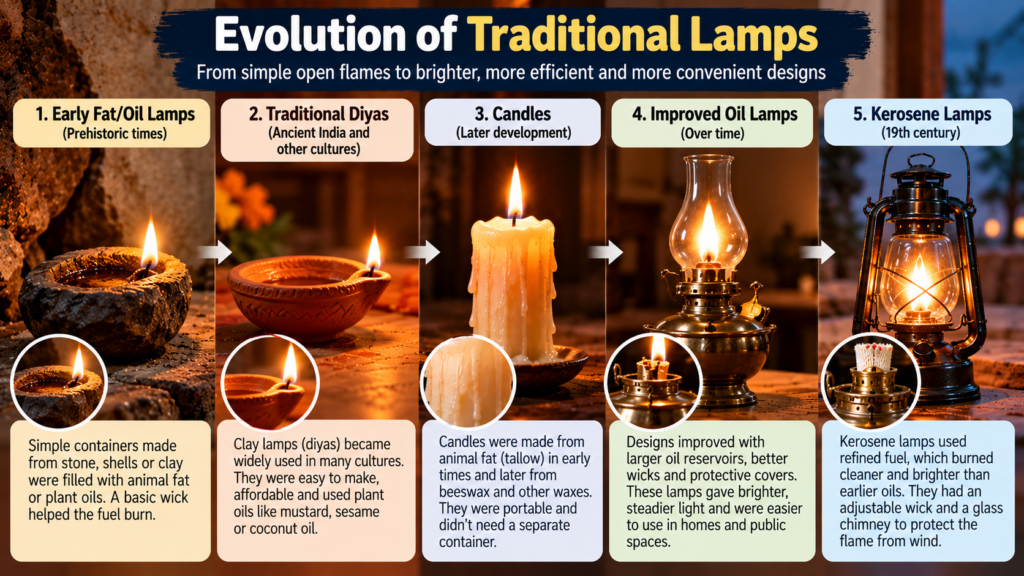
Some of the earliest portable lamps were very simple.
A container held a fuel such as animal fat or plant oil, and a wick carried the fuel toward a flame.
Different cultures developed their own forms of lamps using whatever materials were available locally.
The basic idea, however, was similar:
Store a fuel → bring it to a wick → burn the fuel → produce light.
Ancient lamps were made from materials such as stone, shells, pottery, and other locally available materials.
In India, the traditional diya is a familiar example of a small oil lamp. It typically consists of a small container holding oil or ghee and a cotton wick.
💧 3. How Does an Oil Lamp Work?
The science behind an oil lamp is surprisingly clever.
You might think the flame simply burns the oil sitting in the container.
It doesn’t.
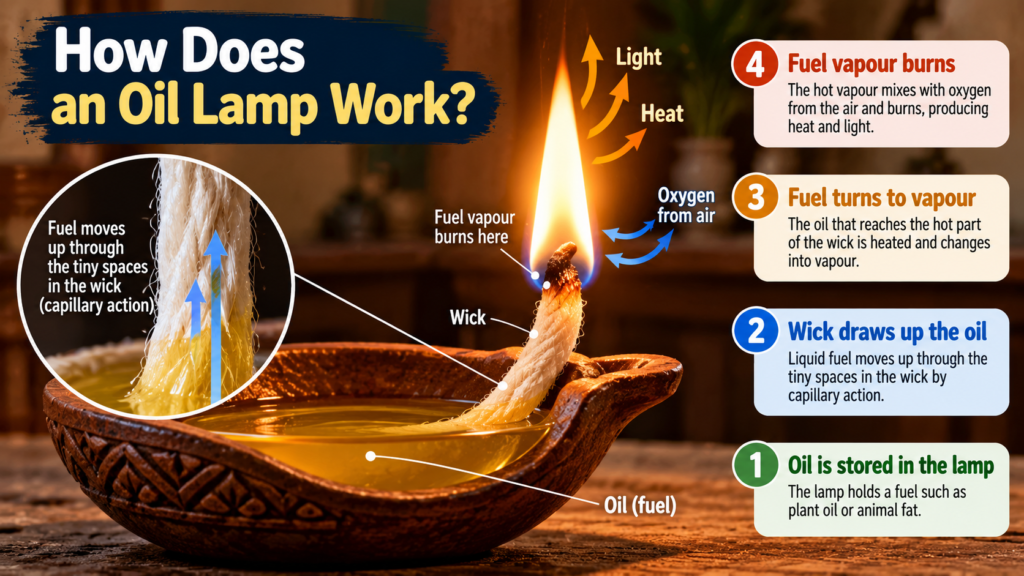
The wick acts like a tiny fuel-delivery system.
Liquid fuel moves upward through the small spaces between the fibers of the wick through a process called capillary action.
As the fuel reaches the hot part of the wick, it is heated and turns into vapour.
That vapour mixes with oxygen from the surrounding air and burns.
So the flame is mainly burning fuel vapour, while the wick continuously brings more liquid fuel toward it.
This same basic principle is also important in a candle.
🕯️ 4. Candles Put the Fuel Inside the Light
Candles made lighting more convenient because the fuel was built into the candle itself.
Traditional candles were made from materials such as tallow—a form of animal fat—and beeswax.
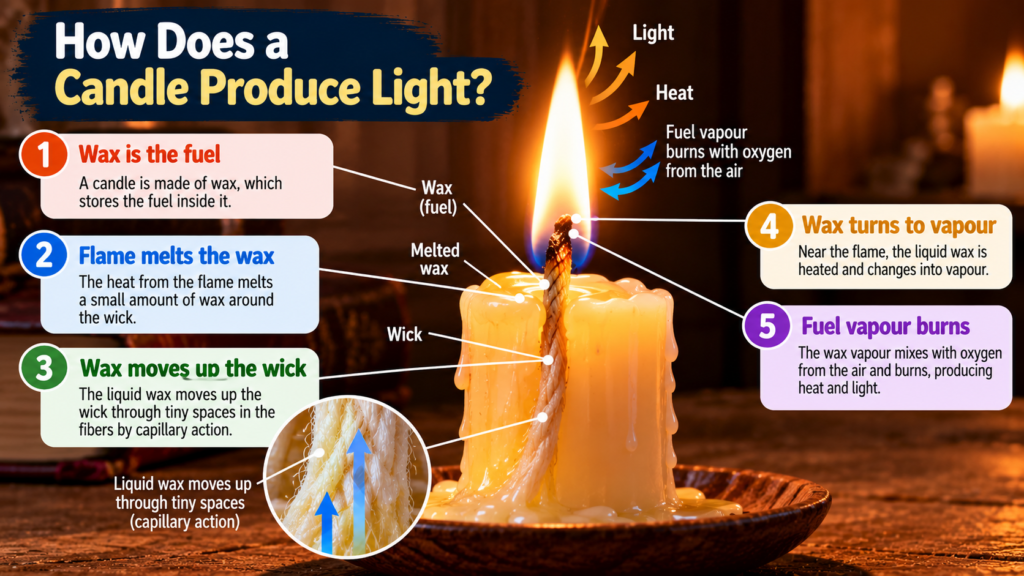
A candle has three important components:
Fuel: wax or another combustible material
Wick: usually made from twisted or braided fibers
Flame: where the fuel vapour burns
When you light a candle, the flame melts a small amount of wax around the wick.
The melted wax travels upward through the wick by capillary action.
Near the flame, the wax becomes hot enough to vaporize.
The wax vapour then burns and produces heat and light.
So the wick isn’t simply there to burn.
Its important job is to deliver fuel to the flame.
🏮 5. People Used Different Fuels in Different Places
There was never just one fuel used for lighting around the world.
People used whatever suitable materials were available.
Depending on the place and time, lamps could burn:
Animal fats
Vegetable oils
Fish oils
Beeswax
Whale oil
Later, mineral oils such as kerosene
The fuel made a difference.
Some fuels burned more brightly than others. Some produced more smoke or unpleasant smells. Others were expensive or difficult to obtain.
This meant that improving lighting wasn’t simply about inventing a better lamp.
People also needed better fuels and better ways of burning them.
🏮 6. Oil Lamps Became Brighter and More Efficient
Over time, people improved lamps by changing the shape of the burner, the wick, and the way air reached the flame.
One important development was the Argand lamp, introduced in the late 18th century. Its design allowed more air to reach the flame and produced a brighter, steadier light than many earlier oil lamps.
Later, fuels such as kerosene became important for household lighting.
Kerosene lamps became popular because they could provide a relatively bright and economical flame. The Smithsonian notes that kerosene lamps allowed people to carry out work after dark much more easily than with many earlier forms of lighting.
Suddenly, artificial light wasn’t just a tiny flame beside you.
It could provide enough illumination to make evening work, reading, and other activities much easier.
💨 7. Gas Lighting Changed the Night
Then another major change arrived:
gas lighting.
Instead of carrying oil to every lamp, gas could be supplied through pipes to burners.
Gas lighting became increasingly important in cities during the 19th century.
It was particularly useful for streets, shops, public buildings, theatres, and other urban spaces.
Some homes also used gas lighting.
Gas lamps were brighter and more convenient for large-scale lighting than many older flame-based systems, although they still had disadvantages such as heat, smell, flickering, and the danger associated with open flames.
And there was an unusual job created by this technology.
The Lamplighter
Before automatic street lighting, someone had to light many gas lamps manually.
These workers became known as lamplighters.
They would go around the city lighting lamps as darkness approached and later return to extinguish them.
Imagine that being your evening job!
Why Didn't People Simply Make Their Homes Very Bright?
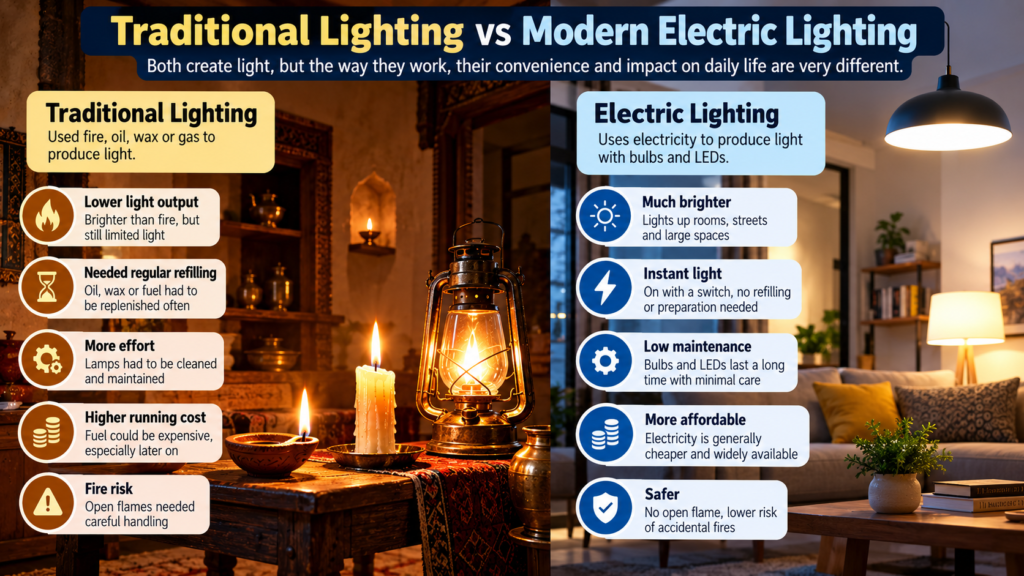
One big reason was cost.
Before electricity, producing artificial light required fuel.
More light generally meant burning more candles, oil, gas, or another fuel.
That made bright lighting expensive.
People therefore made good use of natural daylight.
During the day, sunlight provided most of the illumination inside homes. After sunset, families might gather around a single lamp or candle rather than lighting every room.
Artificial light was something to be used carefully.
This also meant that people’s daily routines were much more closely connected to the natural cycle of daylight and darkness.
How Did People Read at Night?
They could read after sunset—but it wasn’t nearly as easy as it is today.
A candle or oil lamp could provide enough light for reading, writing, sewing, or other detailed work, but the illumination was much weaker than that produced by modern electric lights.
People had to position their light carefully.
Too far away, and the page became difficult to see.
Too close, and the flame could create shadows, heat, smoke, or even a fire hazard.
Artificial lighting therefore changed more than just how people saw at night.
It changed what people could comfortably do after sunset.
The Smithsonian notes that improved artificial lighting in the 1800s helped extend working hours and changed patterns of work, leisure, and consumption.
⚡ 8. Electricity Changed Everything
Electric lighting did not appear suddenly with one inventor.
Scientists and inventors had been experimenting with electric light for decades. Arc lamps, for example, were already being demonstrated before Thomas Edison worked on his incandescent lighting system.
The challenge was to create an electric light that was:
Bright enough
Long-lasting
Safe
Practical for homes
Affordable enough to use widely
This was where Thomas Edison and his team made an important contribution.
Rather than simply creating a bulb, Edison worked on a complete electric lighting system—including the lamp, electrical generation, wiring, meters, and other equipment needed to supply electricity to users.
In 1879, Edison demonstrated a practical incandescent lamp at Menlo Park.
Then, in 1882, his Pearl Street Station in New York began operating a commercial electric lighting system.
That was a huge change.
For the first time, useful artificial light could be delivered through wires and controlled with a switch instead of requiring a flame.
💡 Edison Didn't Invent the First Electric Light
This is an important part of the story.
It is often said that Thomas Edison invented the light bulb.
That’s an oversimplification.
Electric lighting experiments and earlier incandescent lamps existed before Edison’s work. The U.S. Department of Energy specifically notes that the modern light bulb was the result of many inventors and improvements rather than the work of one person.
Edison’s major achievement was developing a practical incandescent lighting system that could be commercially used.
In other words, the breakthrough wasn’t simply:
“Here’s a light bulb.”
It was:
“Here’s a system that can generate electricity, distribute it, and safely light buildings with electric lamps.”
That distinction is important because major technological changes usually happen through many improvements rather than one magical invention.
🌟 9. From Incandescent Bulbs to LEDs
Electric lighting continued to improve.
Incandescent bulbs were followed by technologies such as fluorescent lighting and eventually LEDs.
LED stands for light-emitting diode.
Unlike a candle or oil lamp, an LED doesn’t need to burn anything.
Instead, it uses a semiconductor to convert electrical energy into light.
The first visible-spectrum LED was developed by Nick Holonyak Jr. in 1962, when he was working at General Electric.
LED technology has continued to improve and is now widely used because LEDs can produce a lot of light while using relatively little electricity compared with traditional incandescent bulbs.
🔬 The Science Behind the Journey
The history of lighting may look like a collection of unrelated inventions.
But there is a simple idea connecting them all.
Humans kept finding better ways to convert energy into useful light.
With a fire:
Chemical energy → heat + light
With an oil lamp:
Chemical energy in fuel → heat + light
With a candle:
Chemical energy in wax → heat + light
With a gas lamp:
Chemical energy in gas → heat + light
With an incandescent bulb:
Electrical energy → heat → visible light
With an LED:
Electrical energy → light through a semiconductor
The technology became progressively more controllable, convenient, and efficient.
💡 Did You Know?
For most of human history, darkness was a normal part of everyday life.
People didn’t simply have a weaker version of today’s lighting.
They organized much of their lives around the natural cycle of daylight and darkness.
The spread of artificial lighting gradually changed that.
The Smithsonian notes that electric lighting eventually gave people much greater control over indoor light, allowing homes and workplaces to remain illuminated independently of the time of day.
From Fire to LED
The next time you switch on a light, think about how unusual that simple action really is.
Hundreds of thousands of years ago, controlled fire provided early humans with warmth, protection, and light. Much later, people developed lamps using animal fats and plant oils. Candles made portable lighting easier. Improved oil lamps and fuels made artificial light brighter. Gas lighting transformed cities.
Then electricity changed the entire system.
Today, an LED can illuminate a room at the press of a switch while using a fraction of the energy required by many older lighting technologies.
The journey can be summarized like this:
Fire → Oil Lamps → Candles → Improved Oil Lamps → Gas Lighting → Electric Lighting → LEDs
What began with controlling a flame eventually became a technology that allows us to light an entire building with almost no effort.
And that’s one of the fascinating things about technology: the inventions we now take for granted are often the result of thousands of years of small improvements.