
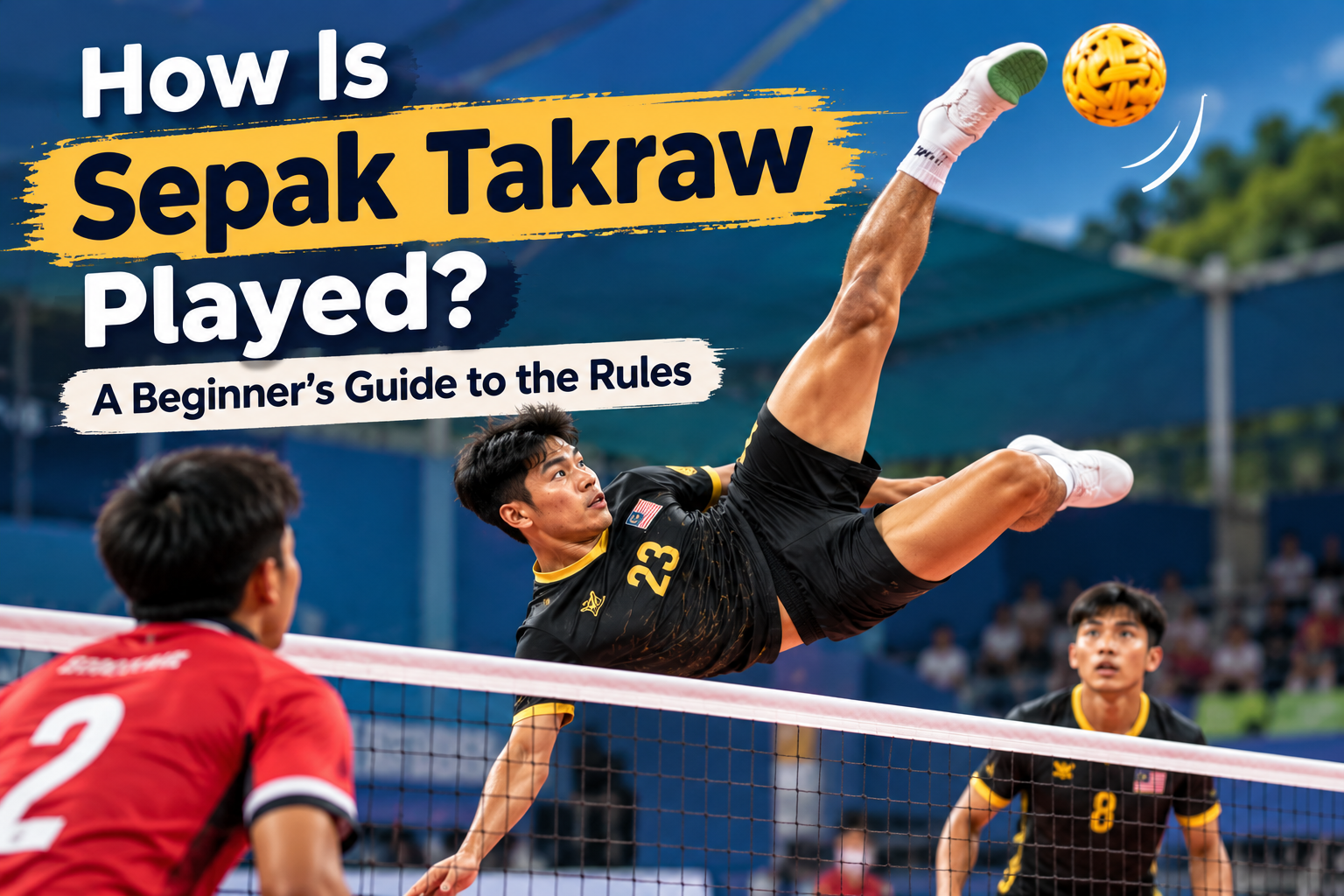
How is Sepak Takraw played? Imagine playing volleyball without using your hands. Instead, you have to kick, head and control the ball with your feet and body—sometimes while jumping several feet into the air.
That’s Sepak Takraw.
Often described as a combination of volleyball, football and gymnastics, Sepak Takraw is a fast and highly acrobatic sport that originated in Southeast Asia. But how is Sepak Takraw actually played?
In this beginner’s guide, we’ll look at the rules, players, court, scoring system, equipment and the incredible techniques that make this sport so unusual.
Note: Sepak Takraw has several formats, and rules can vary between formats and competitions. This article explains the Regu format, the traditional 3-versus-3 version used in international competition. Some older websites still describe a 21-point scoring system, so make sure you check which ruleset they are referring to.
What Is Sepak Takraw?
Sepak Takraw is a net sport that originated in Southeast Asia.
The basic objective is simple:
Send the ball over the net and make it difficult for the other team to return it.
That sounds a lot like volleyball—but there is one huge difference.
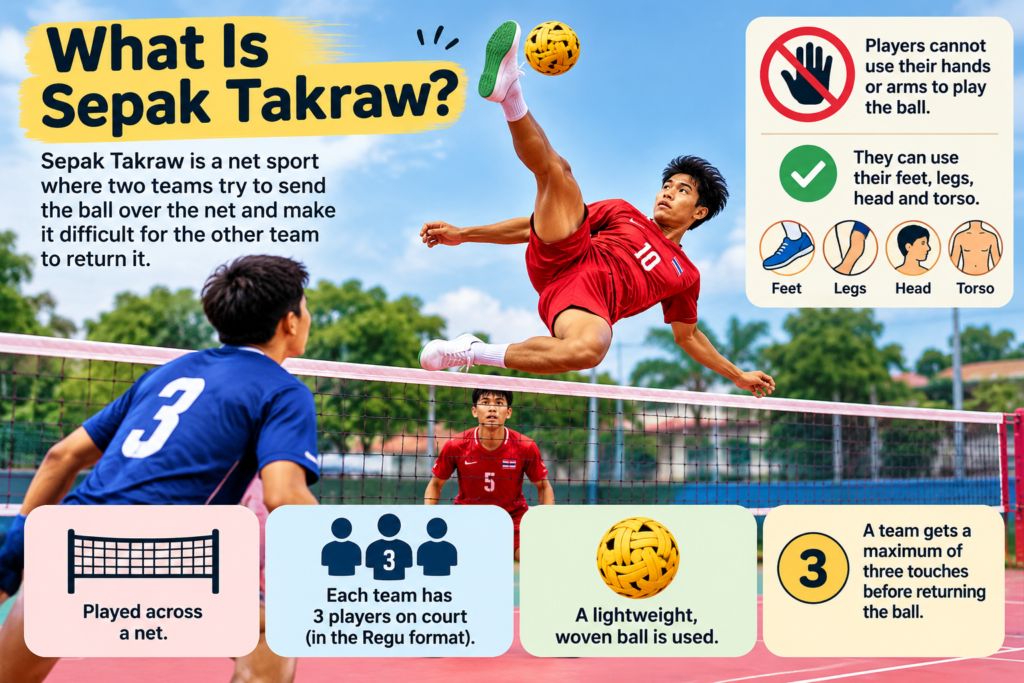
Players cannot use their hands or arms to control the ball.
Instead, they use their:
- Feet
- Legs
- Head
- Torso
A team has up to three touches to return the ball to the opponent’s side.
The result is a sport that requires a combination of flexibility, balance, coordination, jumping ability and extremely precise ball control.
The name itself reflects the sport’s Southeast Asian roots. “Sepak” is associated with kicking, while “takraw” refers to the ball.
How Many Players Are There in Sepak Takraw?
In the Regu format, two teams—called Regus—play against each other.
Each Regu has three players on court.
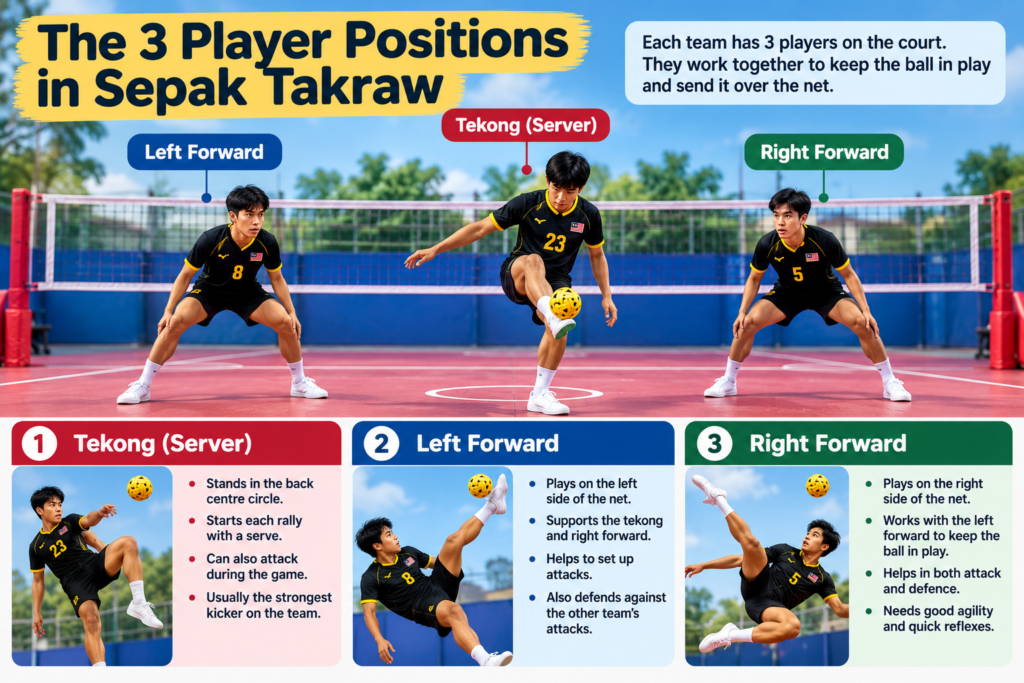
One player stays toward the back of the court and is called the Tekong, or server.
The other two players play toward the front, closer to the net. Under the current international Regu rules, they are called the Left Forward and Right Forward.
A Regu can have up to five registered players, allowing two reserve players in addition to the three players on court.
The three main positions
1. Tekong
The Tekong is the back player and serves the ball.
This player needs excellent kicking ability because the serve is performed using the feet rather than the hands.
2. Left Forward
This player operates near the net on the left side and helps set up attacks and defend against the opponent.
3. Right Forward
The Right Forward performs a similar role on the opposite side.
You may also see older or informal descriptions using terms such as striker, feeder and server. Terminology can vary between coaching systems and sources.
What Does the Sepak Takraw Court Look Like?
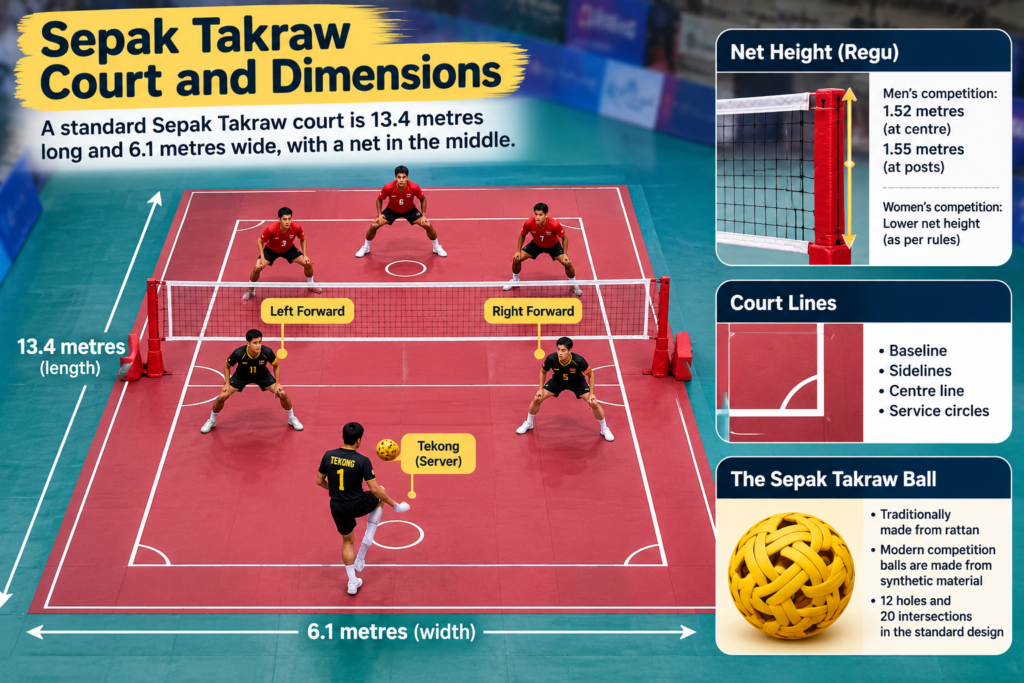
A standard Sepak Takraw court is 13.4 metres long and 6.1 metres wide—roughly the size of a doubles badminton court.
A net divides the court into two halves.
For men’s Regu competition, the net is approximately:
1.52 metres high at the centre
1.55 metres high at the posts
Women’s competition uses lower net specifications.
The court has a centre line, sidelines and baselines, with space around the court kept clear for safety.
What does the ball look like?
The Sepak Takraw ball is one of the sport’s most recognisable features.
Traditional balls were made from woven natural materials such as rattan. Modern competition balls are generally made from woven synthetic fibre or another material approved for competition.
The ball has a distinctive woven appearance, with 12 holes and 20 intersections in the standard design.
And despite looking light, it can move extremely quickly when struck by an experienced player.
How Does a Sepak Takraw Rally Work?
This is where the sport starts to look very different from volleyball.
So, how is Sepak Takraw played?
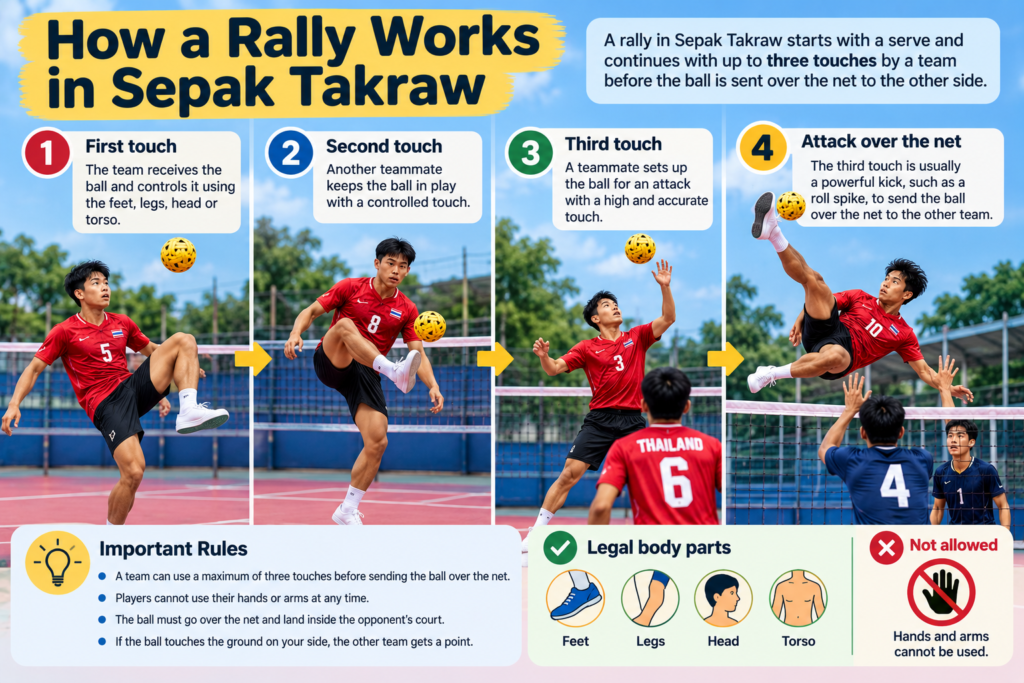
When the ball comes onto your side, your team can use up to three touches to return it across the net.
For example:
Player 1 → Player 2 → Player 3 → over the net
The players can use different parts of their bodies to control the ball.
A player might:
-
Receive the ball with a foot.
-
Lift or set it toward a teammate.
-
Have another player attack it over the net.
But the team does not have to use all three touches.
If a player can attack the ball successfully with the first or second touch, they can do so.
The key is that the ball must cross the net within the allowed three contacts.
How Does Serving Work?
The serve begins with the Tekong at the back of the court.
Unlike volleyball, the server does not simply throw the ball upward and hit it with their hand.
The service is performed using the foot.
The serve is extremely important because a well-placed or powerful serve can immediately put the receiving team under pressure.
The current Regu rules also include a change-of-service system. A change of service occurs when the serving Regu commits a fault or when the receiving Regu successfully kills the return.
Because rules have changed over time and different Sepak Takraw formats use different service systems, older articles may describe the service rotation differently.
How Is a Point Scored?
This is one of the most important areas where older information can be confusing.
Under the current Regu rules reflected in the latest international rule material used by Sepak Takraw Association of Canada, a point is awarded whenever either side commits a fault. The Regu that did not commit the fault receives the point
Current Regu scoring
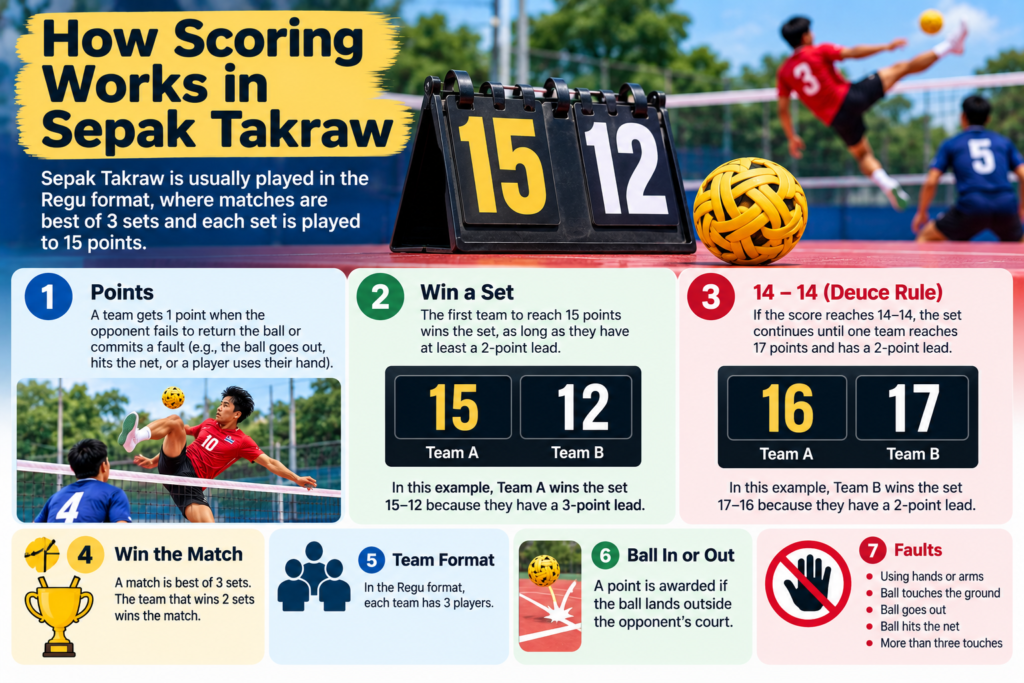
A set is played to 15 points.
Unlike the older system, the current Regu rules do not require a two-point lead at 15.
If the score reaches 14–14, the referee announces:
“Deuce, playing up to 17 points.”
The first Regu to reach 17 wins the set.
The current Regu rules specify a best-of-three-sets match: the first Regu to win two sets wins the match. There is a two-minute break between sets.
Why do you sometimes see 21 points online?
Because Sepak Takraw’s rules have changed over time—and different formats can have different rules.
Older rule documents and some current pages for other formats still describe 21-point sets. For example, the STAC rules for beach Sepak Takraw use a different scoring structure.
So if you see an article saying that every Sepak Takraw set goes to 21 points, don’t automatically assume it is describing the current Regu rules.
Always check the format and the ruleset being discussed.
What Counts as a Fault?
A fault means something happened that breaks the rules.
Some common faults include:
The ball touches a player’s hand or arm during play.
A team uses more than three contacts.
The ball fails to cross the net within three touches.
The ball crosses the net but lands outside the opponent’s court.
A player touches the net or post.
The ball touches the ground.
A player uses an outside object for support while attempting a kick.
A player deliberately stalls or delays play.
When a fault occurs, the other Regu receives the point.
Why Can't Players Use Their Hands?
This is probably the question that makes Sepak Takraw so interesting.
In volleyball, players use their hands and arms to control the ball.
In Sepak Takraw, those body parts are essentially taken out of the equation.
That means players have to develop extraordinary control over their feet, legs, head and body.
A simple pass that would be easy with your hands suddenly becomes much harder.
Think about trying to stop a football with your foot.
Now imagine the ball is coming quickly, you have an opponent standing across the net, and you need to control it accurately enough for a teammate to attack.
That is the challenge of Sepak Takraw.
What Is a Spike in Sepak Takraw?
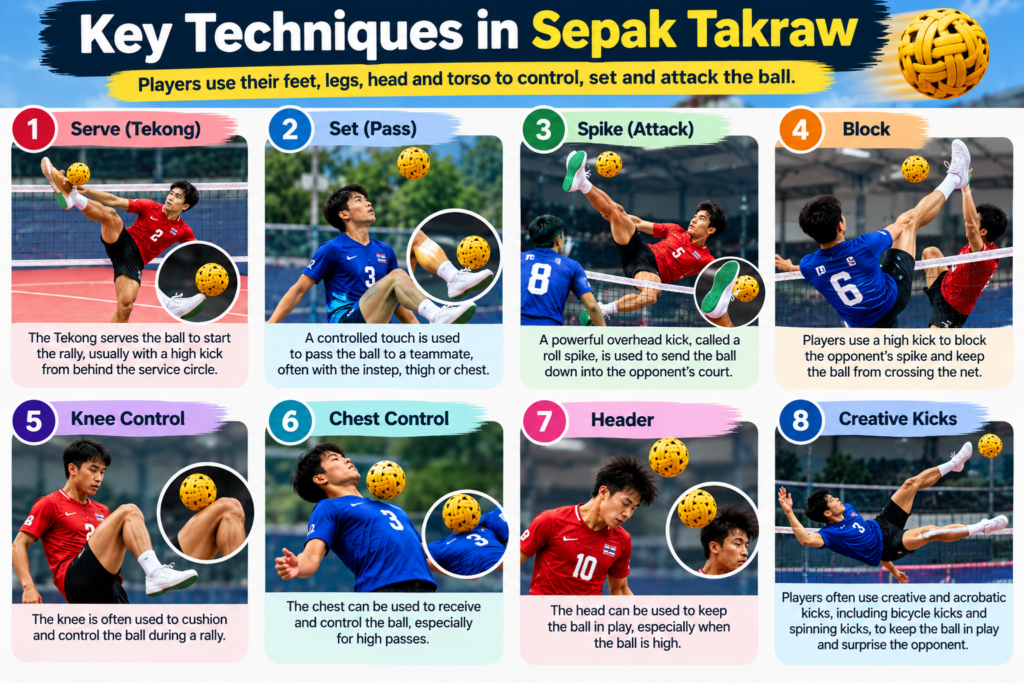
One of the most spectacular moves is the spike, where a player attacks the ball forcefully toward the opponent’s court.
But instead of jumping and swinging an arm like a volleyball player, Sepak Takraw players can use spectacular kicking techniques.
One famous technique is the roll spike, sometimes called a bicycle kick.
The player jumps, rotates backward or sideways, and strikes the ball while airborne.
It can look almost like a football bicycle kick—but performed over a net.
The technique requires incredible timing because the player must coordinate the jump, body rotation, leg movement and contact with the ball.
Why Are Sepak Takraw Players So Flexible?
You don’t need to be a gymnast to understand the challenge.
Imagine trying to kick a ball above your head while keeping your balance.
Now imagine doing it while jumping.
Elite players train their flexibility, leg strength, balance, reaction speed and coordination because many techniques require the leg to travel much higher than it normally would during everyday movement.
This is also why some Sepak Takraw attacks look almost impossible when you first see them.
Sepak Takraw vs Volleyball: What's the Difference?
The two sports share some basic ideas, but the way they are played is very different.
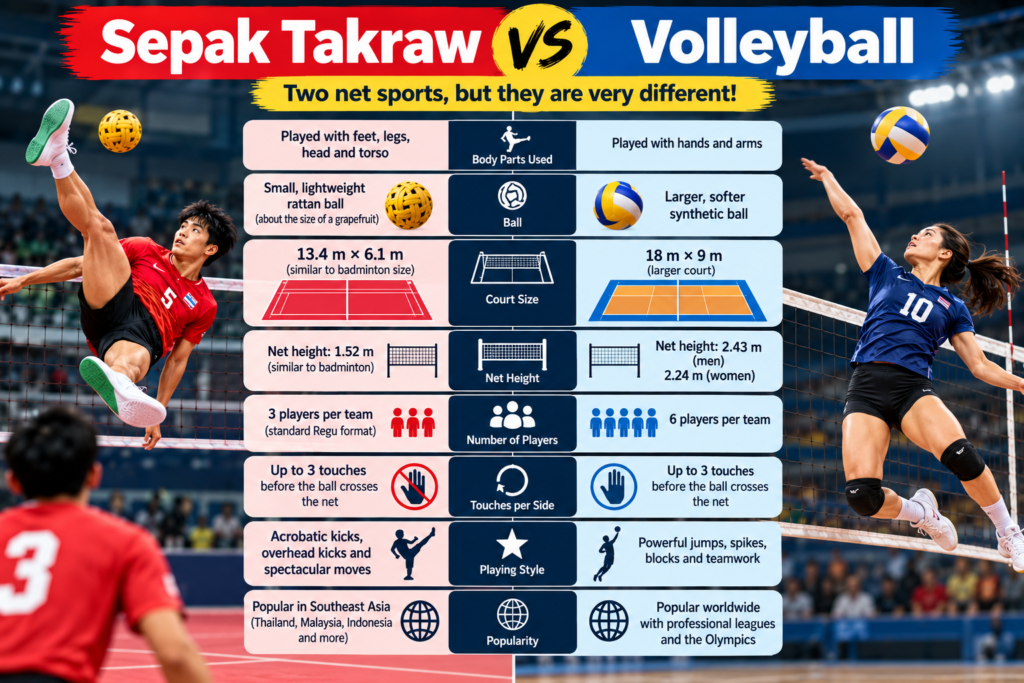
| Feature | Sepak Takraw | Volleyball |
|---|---|---|
| Players in standard format | 3 per Regu | 6 per team indoors |
| Net | Yes | Yes |
| Hands allowed during normal play | No | Yes |
| Maximum team contacts | 3 | 3 |
| Main body parts used | Feet, legs, head, torso | Mainly hands and arms |
| Famous attacking technique | Spikes and aerial kicks | Spikes |
| Ball | Small woven synthetic ball | Larger inflated ball |
The biggest difference is what players can do with their bodies.
Volleyball is largely a hand-and-arm sport.
Sepak Takraw turns the challenge upside down.
Is Sepak Takraw an Olympic Sport?
Sepak Takraw is an established international sport and has been featured at major multi-sport events, including the Asian Games.
It is also included in the programme for the 2026 Asian Games in Aichi-Nagoya, with several Sepak Takraw events scheduled.
Sepak Takraw is an Asian Games sport
However, being part of the Asian Games does not mean a sport is automatically part of the Olympic Games.
Sepak Takraw is not currently an Olympic sport.
That makes it particularly interesting for people discovering sports beyond the biggest global games.
Did You Know?
🟢 Sepak Takraw is sometimes called “kick volleyball”
The comparison makes sense because both sports involve sending a ball over a net and limiting the number of contacts a team can make.
The huge difference is that Sepak Takraw players cannot use their hands or arms during normal play.
🟢 The court is similar in size to a badminton doubles court
The standard court measures 13.4 metres × 6.1 metres, making it surprisingly compact considering how much movement and jumping happens during a rally.
🟢 The ball is not a traditional rattan ball in modern competition
You may see Sepak Takraw described as a sport played with a “rattan ball.”
That describes the sport’s traditional equipment and history.
Modern competition balls are generally made from approved synthetic materials.
🟢 The rules have evolved
If you search for Sepak Takraw rules online, you may find different scoring systems.
That is not necessarily because someone got the rules wrong.
The sport has gone through rule changes, and different formats—such as Regu, Doubles and Beach Sepak Takraw—can have different regulations.
So, How Do You Play Sepak Takraw?
The basic idea is actually quite simple:
Three players try to send a ball over a net using their feet, legs, head and body—without using their hands or arms.
Each team has up to three contacts to return the ball.
Serve.
Receive.
Set.
Attack.
Defend.
And repeat until one side commits a fault.
What makes Sepak Takraw difficult is not understanding the rules.
It is controlling the ball without your hands.
And that is exactly what makes the sport so fascinating.
Once you watch an experienced player perform a jumping spike or a perfectly controlled kick, it becomes obvious why Sepak Takraw has developed such a passionate following across Southeast Asia and beyond.
It may not receive the same worldwide attention as football, basketball or tennis, but if you enjoy discovering unusual sports, Sepak Takraw is definitely one to put on your list.
And the next time someone tells you that volleyball is played with your hands, you can tell them about the version where your feet do most of the work.
1 thought on “How Is Sepak Takraw Played? Rules, Scoring & More”