
How does ChatGPT work? Have you ever typed a question into ChatGPT and wondered how it seems to understand what you mean?
You might type:
“Why does the Moon not fall to Earth?”
ChatGPT does not read those words in the same way a human does. It does not have a pair of eyes looking at your sentence and a brain thinking about the answer.
Instead, your message goes through several steps. The words are broken into smaller pieces called tokens, the model looks at how those tokens relate to one another, and then it generates a response one piece at a time.
So, what exactly happens between pressing Send and seeing the answer?
Let’s follow the journey of a message through ChatGPT.
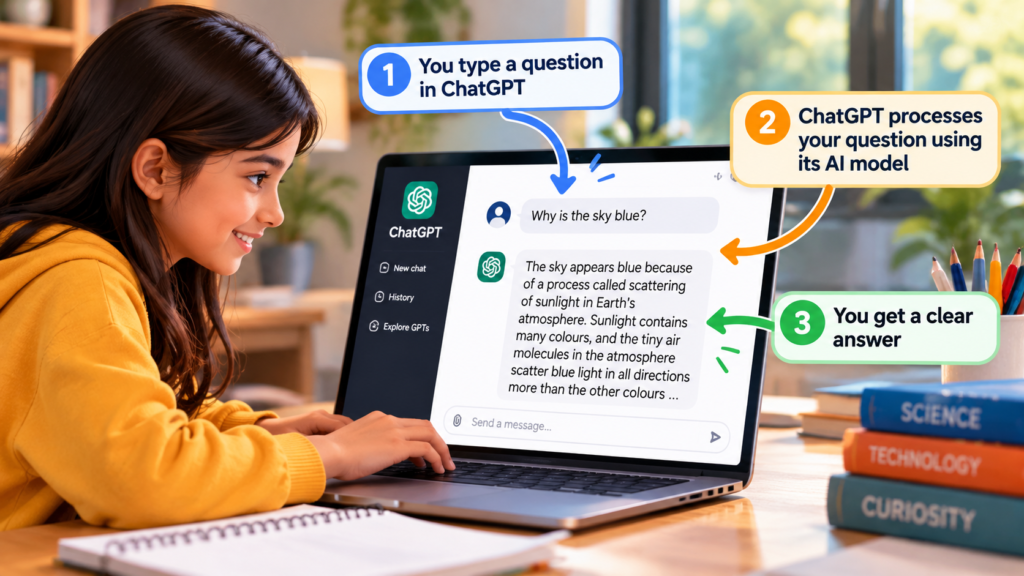
1. First, You Type a Message
Everything starts with your message.
For example:
When you press Send, the text is sent to the AI system running ChatGPT.
But the language model cannot directly work with letters and words the way we do. Computers work with numbers, so the first important step is to turn your text into a form the model can process.
This is where tokens come in.
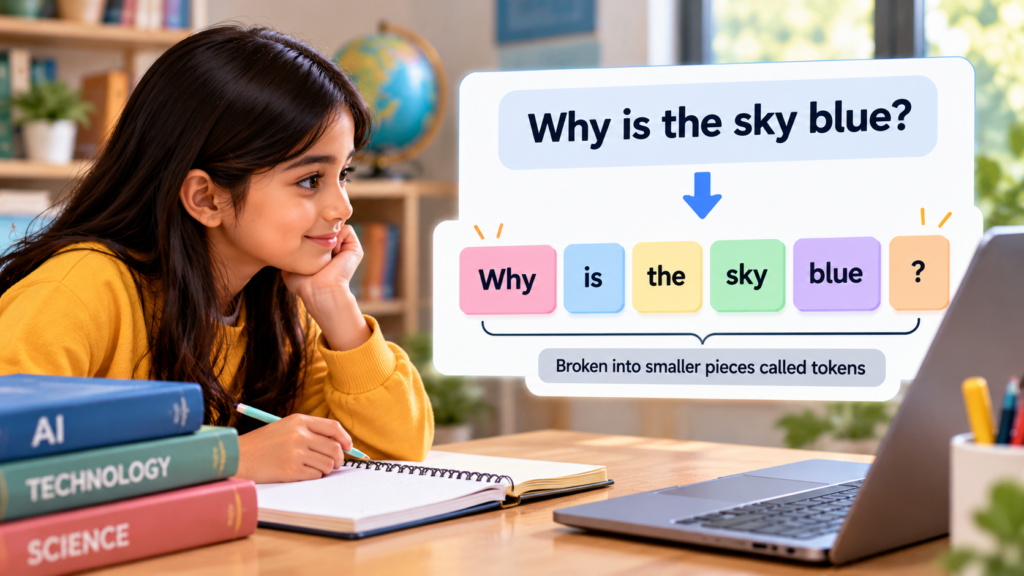
2. Your Message Is Broken Into Tokens
A token is a small piece of text.
Sometimes a token can be a complete word:
sky
Sometimes it can be part of a word, punctuation, or another small piece of text.
For example, a sentence such as:
“Why is the sky blue?”
might be divided into several tokens.
The exact way a sentence is split depends on the tokenizer being used.
Each token is then converted into numbers that the model can process.
Think of it like translating a sentence into a special numerical language that the AI can work with.
Did You Know?
A token is not always the same thing as a word.
That is why AI systems often talk about the number of tokens in a conversation rather than simply counting words.
We explored tokens in more detail in our article on how large language models work.
3. ChatGPT Looks at the Context
Now comes one of the most important parts.
ChatGPT doesn’t simply look at each word separately. It considers the context around the words.
Consider this sentence:
“The boy put the book on the table because it was heavy.”
What does “it” refer to?
A human reader can use the surrounding information to work that out.
A language model also examines the relationships between the different tokens to determine what meaning makes sense in context.
This is where the Transformer architecture and its attention mechanisms become important.
Attention helps the model determine which parts of the input are more relevant to one another.
So when you ask:
“Why is the sky blue?”
the model does not treat why, sky, and blue as completely separate pieces. It processes their relationships and the context of the entire question.
4. ChatGPT Uses What It Learned During Training
This is an important point:
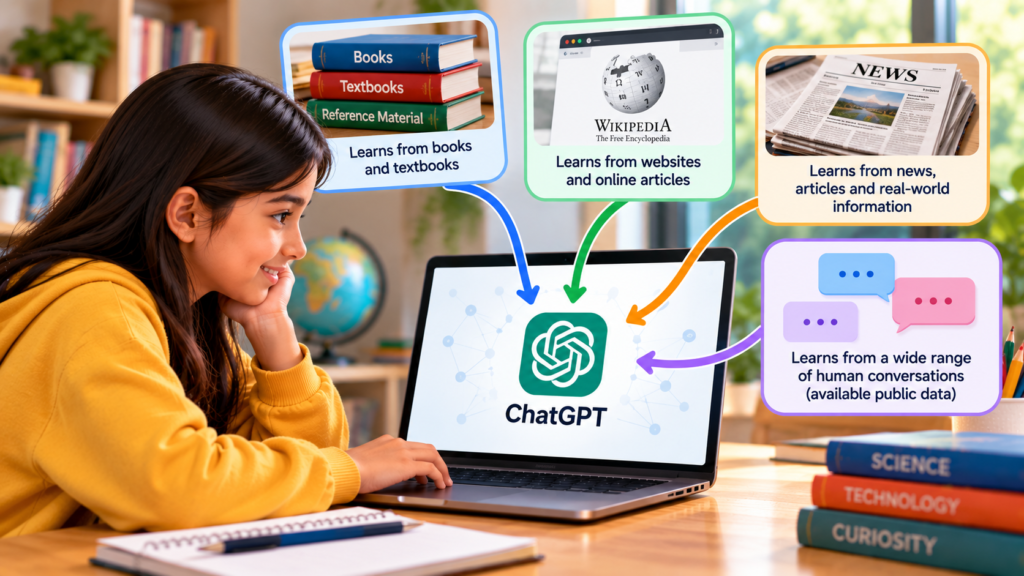
ChatGPT does not search through a giant book of ready-made answers every time you ask a question.
A language model is trained using very large amounts of data. During training, it learns patterns in language.
It learns things such as:
how words and phrases are related
how sentences are structured
how ideas are commonly expressed
patterns found in different types of text
relationships between concepts
The model stores what it has learned in the form of numerical parameters.
You can think of these parameters as a huge collection of learned patterns inside the model.
When you ask a question, the model uses those learned patterns to generate a response.
5. It Predicts What Should Come Next
This is the fascinating part.
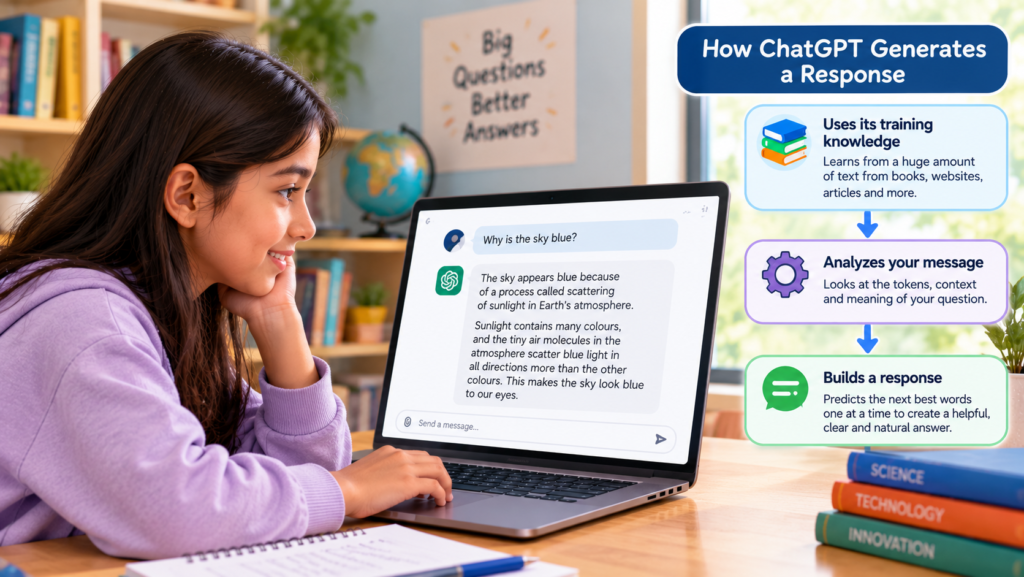
A large language model generates text by predicting what token should come next.
Suppose the model has generated:
“The sky appears blue because…”
It considers many possible next tokens.
Perhaps the next token could be related to:
sunlight
atmosphere
scattering
and many other possibilities.
The model assigns probabilities to possible next tokens and selects one according to its generation process.
Then it looks at the updated text and predicts the next token again.
And again.
And again.
Very quickly, these individual predictions become a complete sentence, paragraph, or answer.
So an answer that looks like one complete thought to us is actually produced step by step.
6. It Doesn't Write the Whole Answer at Once
This is one of the easiest ways to understand how ChatGPT works.
Imagine you ask:
“Why does the Moon not fall to Earth?”
The model doesn’t first write the entire answer somewhere in its mind and then show it to you.
Instead, it generates the response progressively.
It might begin with something like:
“The Moon is actually…”
Then another token is generated.
Then another.
The growing sequence gives the model more context for predicting what should come next.
Eventually, these predictions form a complete explanation.
This is also why you can sometimes see ChatGPT’s answer appearing on your screen gradually rather than all at once.
7. What Happens When You Have a Conversation?
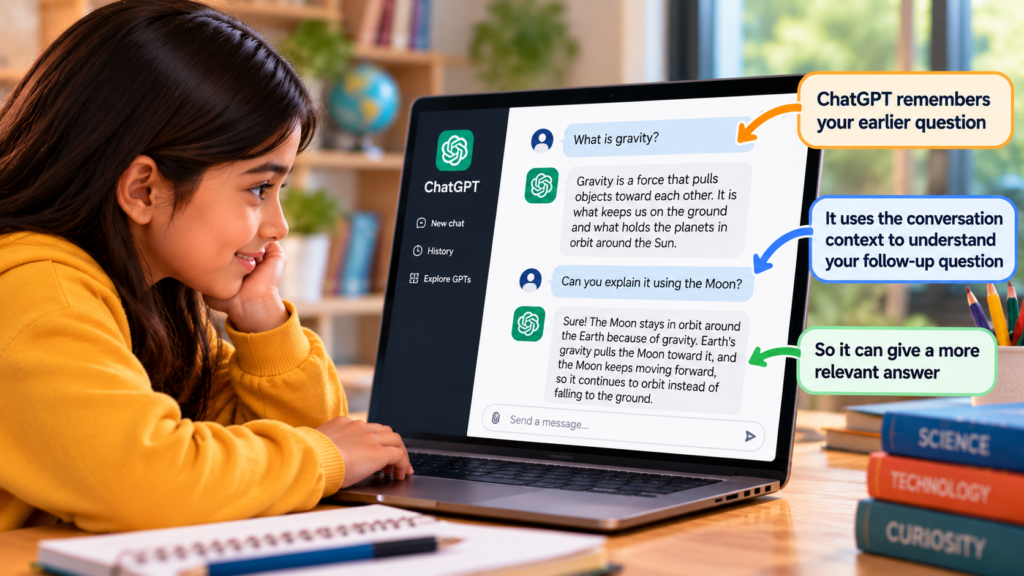
ChatGPT becomes even more interesting when you ask follow-up questions.
Suppose you ask:
“What is gravity?”
Then you ask:
“Can you explain it with an example?”
The second question doesn’t contain all the information from the first one.
Yet ChatGPT can usually understand that “it” refers to gravity.
Why?
Because the conversation provides context.
Instead of looking only at your latest sentence, the system can use relevant parts of the conversation available to the model.
This gives the model information about what you have been discussing.
For example:
You: What is gravity?
ChatGPT: Gravity is the force that attracts objects with mass toward one another.
You: Can you explain it using the Moon?
The second question makes much more sense because the earlier conversation provides the context.
8. Does ChatGPT Actually Understand Like a Human?
This is where things get tricky.
ChatGPT can produce remarkably natural language, but that does not mean it understands the world exactly like a human does.
A person can have physical experiences, emotions, memories and observations of the real world.
A language model works very differently.
It processes information mathematically and generates text based on patterns learned during training and the context available to it.
This distinction is important because fluent language can sometimes make an AI system appear more certain or knowledgeable than it really is.
9. Why Can ChatGPT Give a Wrong Answer?
If ChatGPT is so good at generating language, why can it sometimes make mistakes?
Because generating convincing text is not the same thing as guaranteeing that every statement is true.
A language model is fundamentally designed to generate useful sequences of text based on its training and context.
Sometimes it may:
misunderstand a question
make an incorrect calculation
mix up two facts
provide outdated information
confidently state something that isn’t true
These incorrect AI-generated answers are often called hallucinations.
The important lesson is:
A confident-sounding answer is not automatically a correct answer.
For important subjects such as health, money, law or safety, information from AI should be checked against reliable sources.
10. Does ChatGPT Search the Internet for Every Question?
Not necessarily.
A language model can generate an answer using what it has learned and the information available in the current conversation.
Some AI systems and features can also use external tools, such as web search, databases, calculators or other software.
When an external tool is used, the system can bring additional information into the process before producing a response.
This is different from the basic language-model process itself.
The important idea is that an LLM does not need to perform a web search simply to generate text.
11. How Does ChatGPT Work Behind the Scenes?
We can simplify the whole process into a few steps:
You type a message
↓
Your text is divided into tokens
↓
The tokens are converted into numerical representations
↓
The model examines the context and relationships between them
↓
The model uses patterns learned during training
↓
It predicts the next token
↓
It repeats the process
↓
A complete response appears
What looks like a simple conversation is actually the result of many mathematical operations happening extremely quickly.
ChatGPT Is More Than Just an LLM
There is one more important distinction.
An LLM is the underlying language model. ChatGPT is an application built around AI models and other supporting systems.
You can think of it like a car.
The engine provides the power, while the rest of the car provides everything needed to use that power safely and conveniently.
Similarly, an LLM provides the language-generation capability, while a conversational AI application can add things such as the chat interface, conversation context, safety systems, tools and other features.
This is why LLM and ChatGPT are not exactly the same thing.
The Big Picture
So, how does ChatGPT understand what you type?
It doesn’t understand a sentence in exactly the same way a human brain does.
Instead, your message is converted into tokens and numerical representations. The language model processes those tokens using patterns learned during training, paying attention to their relationships and context.
It then predicts one token after another until a complete response is generated.
The process is incredibly fast, which makes it feel like you are having a conversation with another person.
But underneath that friendly conversation is a powerful combination of tokens, mathematics, neural networks, Transformer architecture, attention and next-token prediction.
And that is what makes modern conversational AI possible.
In Simple Words
You type → ChatGPT processes the tokens → it uses context and learned patterns → predicts what comes next → and generates the response one piece at a time.
Once you understand this process, ChatGPT becomes much less mysterious.
It isn’t a machine secretly thinking like a human.
It is a sophisticated language model using patterns, context and computation to generate the most useful response it can.