๐ Hello, Curious Explorer! How Do Mobile Phones Make Calls?
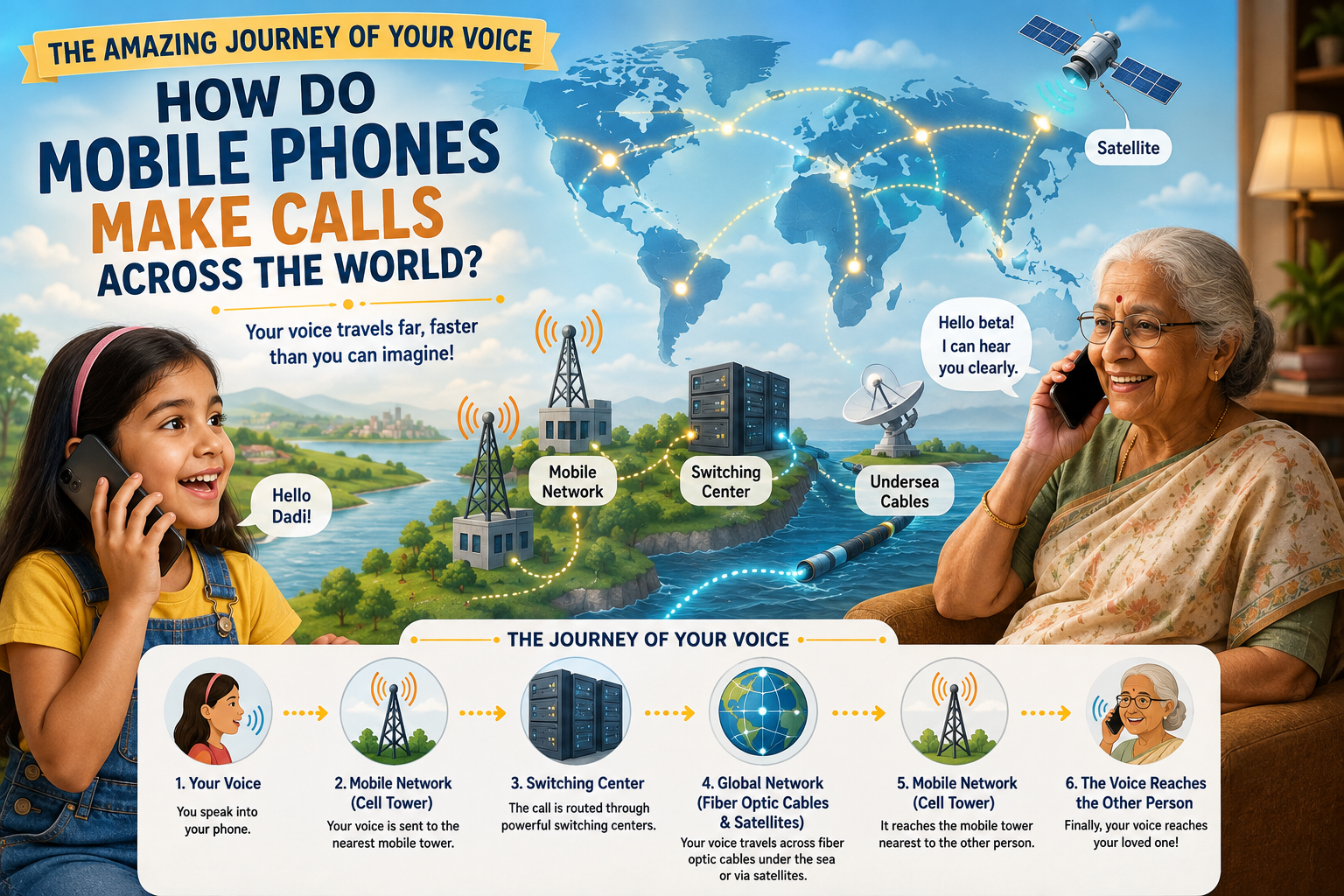
How do mobile phones make calls across the world? It seems almost instant when you call someone, but behind that simple tap is an amazing journey involving radio waves, mobile networks, computers, and even cables running deep beneath the oceans.
Imagine you’re in Lucknow, India, and you call your grandmother in Australia.
You simply tap the Call button and say,
“Hello, Grandma!”
A second later, your grandmother smiles because she heard your voice.
Sounds simple, doesn’t it?
But behind that tiny word “Hello!” is one of the fastest and most amazing journeys in the world.
Your voice travels through your mobile phone, flies through the air to a nearby cell tower, races across powerful mobile networks, zooms through underground and undersea fibre-optic cables, crosses oceans and countries, and finally reaches another phoneโall in less than a second!
Today, you’ll become an explorer and travel alongside your own voice to discover how this incredible journey happens.
Adventure Goal: By the end of this adventure, you’ll know exactly how mobile phones connect people anywhere on Earth.
Let’s begin!
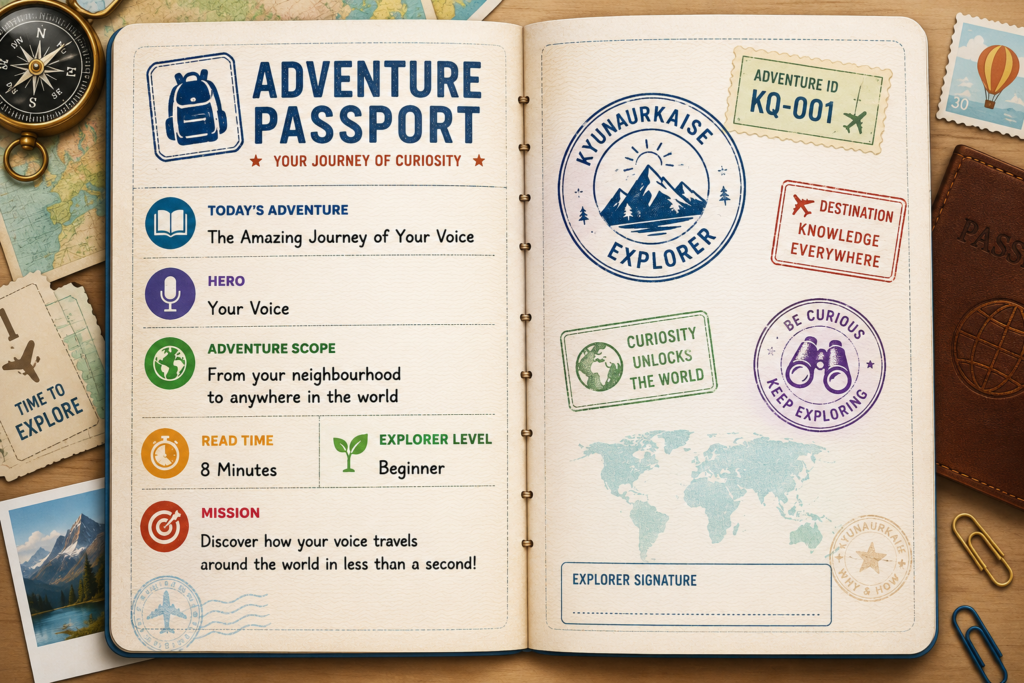
Meet Today's Hero: How Do Mobile Phones Carry Your Voice?
Every great adventure needs a hero.
Today’s hero isn’t a superhero or a famous explorer.
It’s your voice!
When you speak into your mobile phone, your voice begins an incredible journey that covers thousands of kilometres in less than a second.
But before your voice can travel, your phone has an important job to do.
Let’s peek inside your phone to see what happens first.
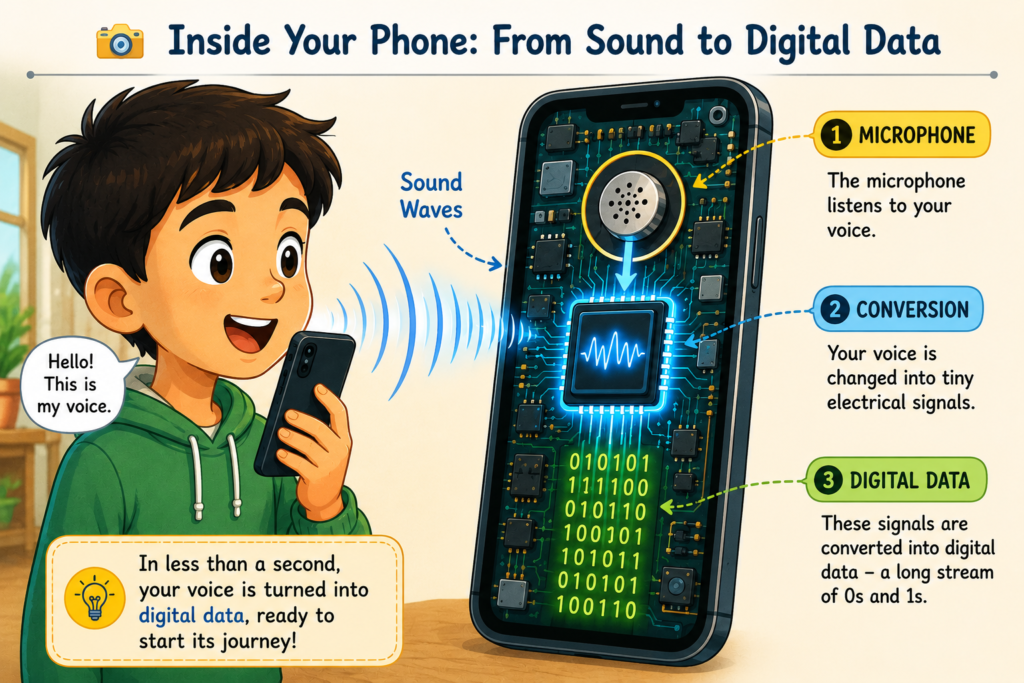
๐ฑ Stop 1: Inside Your Mobile Phone
Imagine shouting across a playground.
Your voice travels through the air as sound waves.
Your phone cannot send sound waves across the world.
Instead, it needs to convert your voice into a language that computers understand.
That language is made up of tiny numbers called digital data.
Inside your phone is a tiny part called the microphone.
The microphone listens carefully to your voice and changes the sound into millions of tiny electrical signals.
A special chip inside your phone then converts these signals into digital dataโa long stream of 0s and 1s.
Think of it like translating English into a secret computer language.
Your voice hasn’t disappeared.
It has simply been packed into a form that can travel very quickly.
๐ก Did You Know?
When you make a phone call, your phone converts your voice into digital data thousands of times every second!
๐ก Stop 2: Your Voice Takes Flight โ The Cell Tower
Your phone has now packed your voice into tiny pieces of digital data.
But here’s a question…
How does your phone send that data without using any wires?
The answer is radio waves.
No, not the kind you listen to on the radio!
These are invisible electromagnetic waves that can carry information through the air at the speed of light.
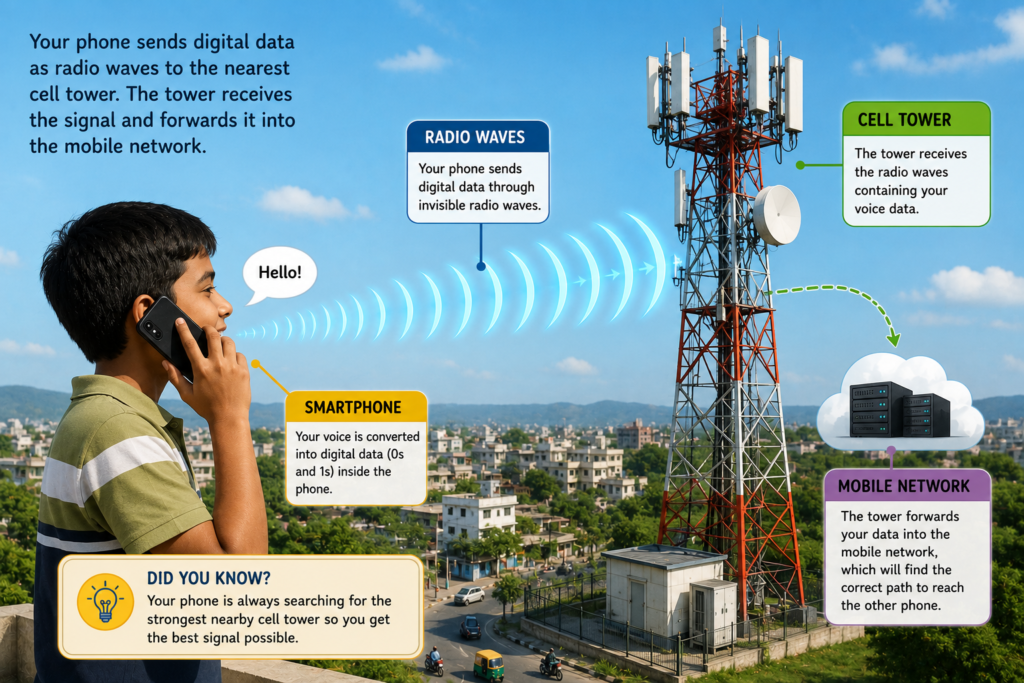
As soon as your phone is ready, it uses its tiny antenna to send your digital data as radio waves to the nearest cell tower.
Think of the cell tower as the first relay station on your voice’s journey.
Instead of trying to send your voice all the way across the world by itself, your phone simply hands the message to the closest tower, which is specially built to receive and forward millions of phone calls every day.
If you’re movingโperhaps travelling in a car or on a trainโyour phone can even switch from one cell tower to another without ending your call.
That’s why you can continue talking while travelling!
Want to understand how your phone communicates wirelessly? Check out our guide on [How Does Wi-Fi Reach Your Phone Without Any Wires?].
๐ก Did You Know?
Your phone is always searching for the strongest nearby cell tower so you get the best signal possible. That’s why your signal bars change as you move from one place to another.
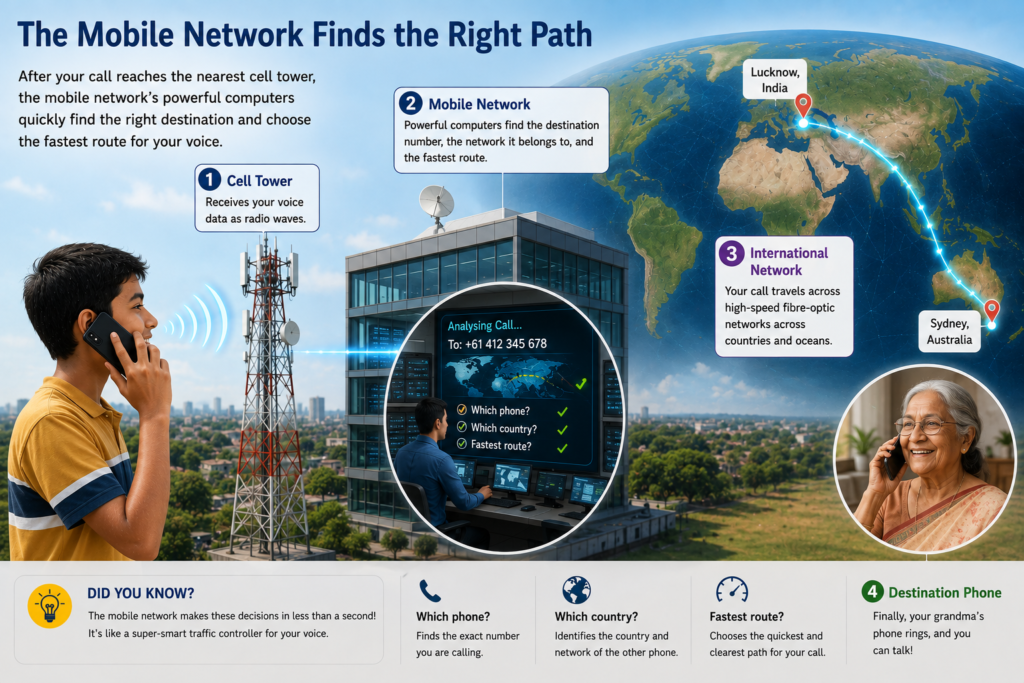
๐ Stop 3: The Mobile Network Finds the Right Path
Your voice has safely reached the nearest cell tower.
But now there’s a new challenge.
Imagine you’re sending a birthday gift to your friend in another country.
Would you simply hand it to the nearest post office and hope it somehow reaches the right house?
Of course not!
The post office needs to know:
- ๐ Who is the gift for?
- ๐ Which country do they live in?
- ๐ What is their exact address?
A mobile network works in a very similar way.
When the cell tower receives your call, it doesn’t send it randomly. Instead, it forwards your digital voice data to the mobile network, a giant system of computers, switches, and high-speed routers that work together like the world’s smartest traffic controllers.
These powerful computers quickly answer questions like:
- ๐ฑ Which phone number are you calling?
- ๐ Which mobile network is that phone connected to?
- ๐ก Which cell tower is closest to the person you’re calling?
- ๐ Is the call staying in the same city, travelling across India, or going to another country?
Within a tiny fraction of a second, the mobile network calculates the best and fastest route for your voice.
It’s very similar to how Google Maps finds the quickest route for a carโbut instead of roads, the network uses high-speed communication links to guide your voice.
All of this happens so quickly that you don’t even notice it.
๐ก Did You Know?
Every mobile phone has a unique identity on the network. This allows the mobile system to know where your phone was last connected, making it much easier to deliver calls to the correct device.
๐ Stop 4: Beneath the Ocean โ The Fibre-Optic Highwayding Text Here
Your voice has travelled from your phone โ cell tower โ mobile network.
The network has now decided where your call needs to go.
But there’s a BIG problem.
Your grandmother is in Australia.
You’re in Lucknow, India.
So how does your voice cross thousands of kilometres of land and ocean?
It doesn’t fly through the sky.
It doesn’t travel through space.
And most importantly, there isn’t a giant telephone wire floating on the ocean! ๐
Instead, your voice can travel through one of the most amazing pieces of technology humans have ever built:
Undersea Fibre-Optic Cables
Thousands of kilometres of special cables lie on the seabed, connecting countries and continents.
Inside these cables are incredibly thin strands of glass called optical fibres.
And these tiny strands can carry enormous amounts of information using pulses of light.
๐ก But waitโฆ your voice isn’t light!
Excellent question.
Remember what happened at the beginning of our adventure?
Your voice was first turned into digital dataโa stream of 0s and 1s.
Now something remarkable happens.
The electronic digital data is converted into rapid pulses of light.
Think of it like this:
Digital data โ Light pulses โ Fibre-optic cable
A tiny device called an optical transmitter uses a very fast laser or light source to represent the data with changes in the light signal.
The light then travels through the glass fibre.
So your voice isn’t literally travelling as sound anymore.
Instead, the information that represents your voice is travelling as light.
๐ฆ Imagine a Tiny Flashlight
Let’s make this super simple.
Imagine I give you a tiny flashlight.
If I say:
Flash โ ON โ OFF โ ON โ ON โ OFF
we could agree that these flashes represent a particular message.
The actual system is vastly faster and more sophisticated, but the basic idea is similar.
The light changes according to the digital information being transmitted.
So somewhere inside the network:
๐๏ธ Your voice
โ
๐ป Digital information
โ
๐ฆ Rapid changes in light
โ
๐ Fibre-optic cable
โ
๐ Another country
And all of this happens incredibly quickly.
๐ Now Our Explorer Goes Underwater!
Our Curious Explorer has reached the coast.
The digital information carrying your voice enters an international fibre-optic network.
It travels through a cable that disappears into the ocean.
Imagine following that cableโฆ
Down through the blue water.
Past ships.
Past fish.
Past the dark ocean floor.
And eventuallyโฆ
๐ฆ๐บ Australia!
Your voice has crossed an entire ocean.
๐ Are These Cables Really Just Lying on the Ocean Floor?
Yes!
But they’re not simply thrown into the sea.
Special ships install submarine communication cables along carefully planned routes.
In deeper ocean areas, the cable generally rests on the seabed.
Near the coast, where human activity and fishing can pose greater risks, cables may be buried beneath the seabed for protection.
And despite looking incredibly delicate, these cables are specially designed to survive the harsh underwater environment.
โก What Happens If the Signal Gets Weak?
Here’s another amazing part.
Your voice may have to travel thousands of kilometres.
The light signal can gradually weaken as it travels.
So submarine cables contain special equipment called repeaters at intervals along the route.
Think of them as tiny underwater helpers.
They receive the optical signal, restore it, and send it onward.
Light signal โ Repeater โ Restored signal โ More cable โ Another repeater โ โฆ โ Australia
This allows information to travel enormous distances.
๐ง Did You Know?
Modern submarine communication cables can carry huge amounts of information simultaneously.
That’s why the same undersea cable network can carry:
๐ Phone calls
๐ฌ Messages
๐ฅ Video calls
๐บ Streaming video
๐ฎ Online games
๐ Websites
โ๏ธ Cloud data
โall at the same time.
Your phone call is just one tiny stream of information travelling alongside an enormous amount of other internet and communication traffic.
๐ฑ STOP 5 โ The Other Phone: Turning Data Back Into Your Voice
When the signal reaches Australia, it eventually reaches your Grandma’s mobile network and phone.
Inside the phone, the process happens in reverse:
Light pulses โ
Digital data โ
Electrical signal โ
Speaker โ
Grandma’s ears
The phone’s speaker moves back and forth extremely quickly. These movements create sound waves in the air.
And suddenly…
“Hello!”
Grandma hears your voice almost as if you were standing right beside them!
The amazing part
Your actual voice didn’t travel all the way from India to Australia as sound.
Sound travelled only a tiny distance:
Your mouth โ Your phone’s microphone
After that, your voice became digital information and travelled through the network.
At the other end, the phone reconstructed the sound so that Grandma could hear it.
Now you know how mobile phones make calls โ from the moment your voice becomes digital data to its journey through networks around the world.
2 thoughts on “The Amazing Journey of Your Voice: How Do Mobile Phones Make Calls Across the World?”