
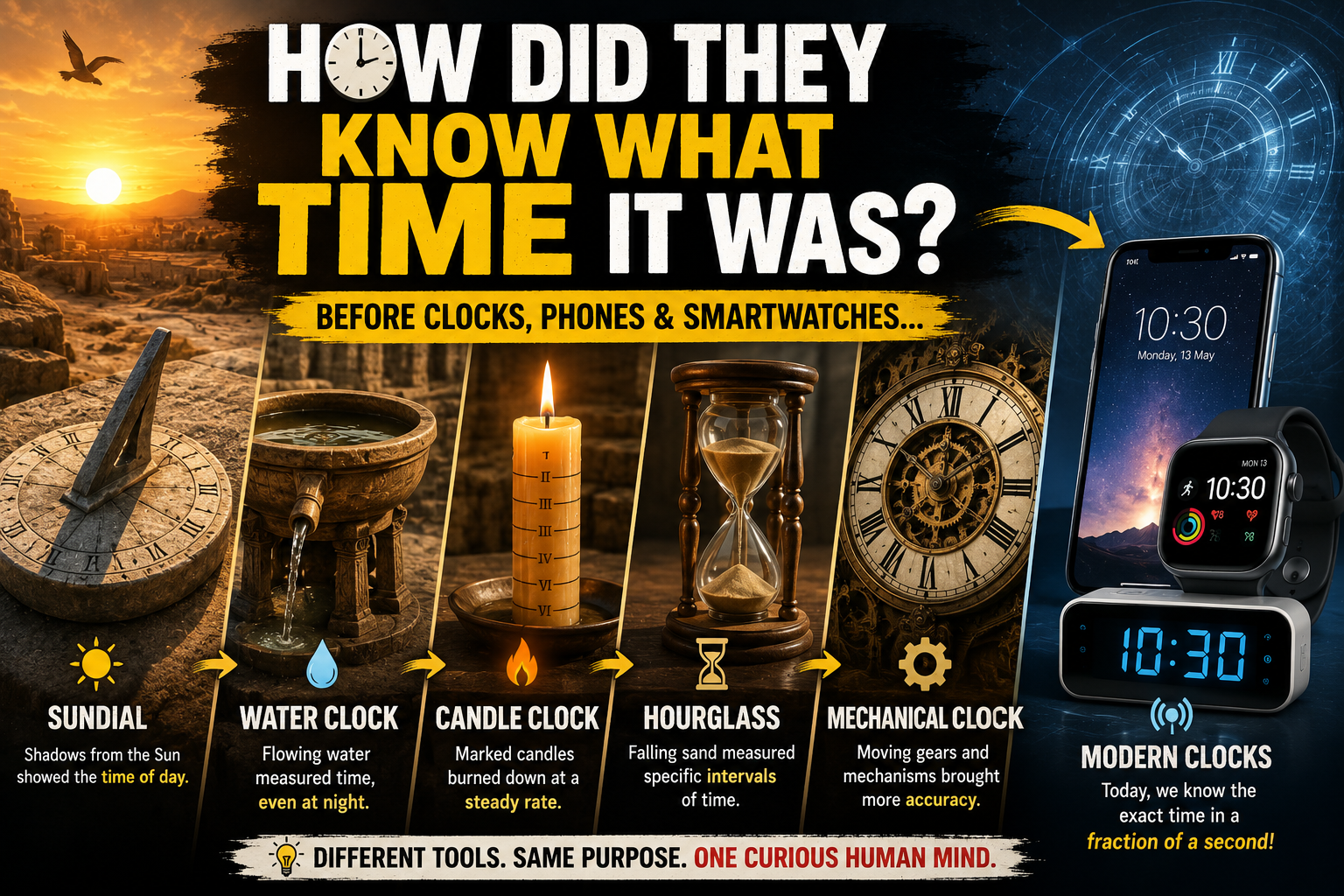
How did people tell time before clocks, watches, and smartphones existed?
For thousands of years, people had no way to check whether it was exactly 10:30 in the morning or 6:45 in the evening. Instead, they learned to measure time by observing the Sun, shadows, water, fire, sand, and stars.
They noticed that the world around them followed predictable patterns. The Sun moved across the sky, shadows changed direction and length, water slowly flowed, candles burned down, and stars appeared to move across the night sky.
But how did these observations actually help people tell time?
From ancient sundials and water clocks to candle clocks and hourglasses, humans developed surprisingly clever ways to measure the passing of time long before the modern clock was invented.
How Did People Tell Time Before Clocks Without Modern Technology?
The simplest timekeeper was the Sun itself.
As Earth rotates, the Sun appears to move across the sky from east to west. Its position changes throughout the day.
Early people learned to recognize these changes.
When the Sun was low in the eastern sky, it was morning. When it was high overhead, it was around the middle of the day. When it moved toward the western horizon, evening was approaching.
Of course, this wasn’t a very precise way to tell time.
The position of the Sun also changes depending on the season and where you are on Earth.
So, how did people tell time before clocks when they needed something more reliable than simply watching the Sun?
That led to the sundial.
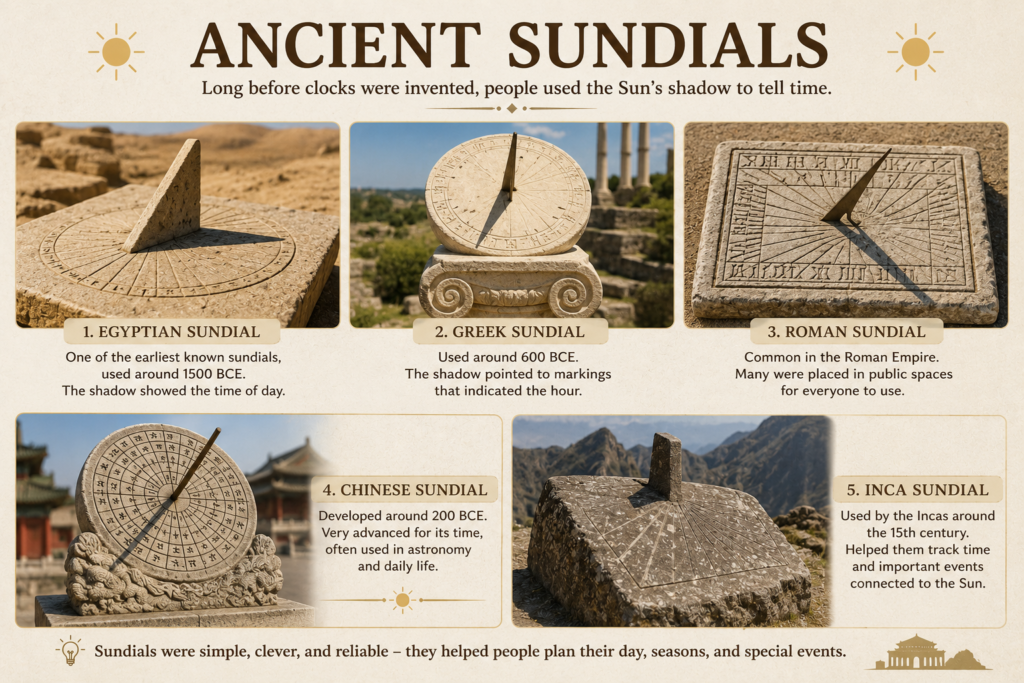
1. Sundials — Turning Shadows Into Time
A sundial is one of the oldest known instruments for measuring time.
It works using something very simple:
a shadow.
A basic sundial has a raised object, often called a gnomon, that casts a shadow onto a marked surface.
As the Sun appears to move across the sky, the shadow changes position.
In the morning, the shadow points in one direction. As the Sun rises higher, the shadow becomes shorter. Around midday, it is usually at its shortest. Later in the afternoon, the shadow becomes longer again, pointing in another direction.
The markings on the sundial allow people to estimate the time from the position of the shadow.
But why does the shadow move?
This is where the science gets interesting.
It may look as though the Sun is travelling around Earth, but the apparent movement of the Sun is mainly caused by Earth rotating on its axis.
As Earth turns, our position relative to the Sun changes. This changes the angle at which sunlight reaches the ground, causing the shadow to move.
So, in a way, a sundial turns Earth’s rotation into a visible clock.
Were sundials perfectly accurate?
Not really.
A sundial’s reading depends on the season, location, and the design of the sundial. It also doesn’t work at night or when the Sun is hidden by clouds.
Still, for thousands of years, sundials were remarkably useful.
2. Water Clocks — Measuring Time With Water
But what if you needed to measure time after sunset?
People came up with another clever idea: use water.
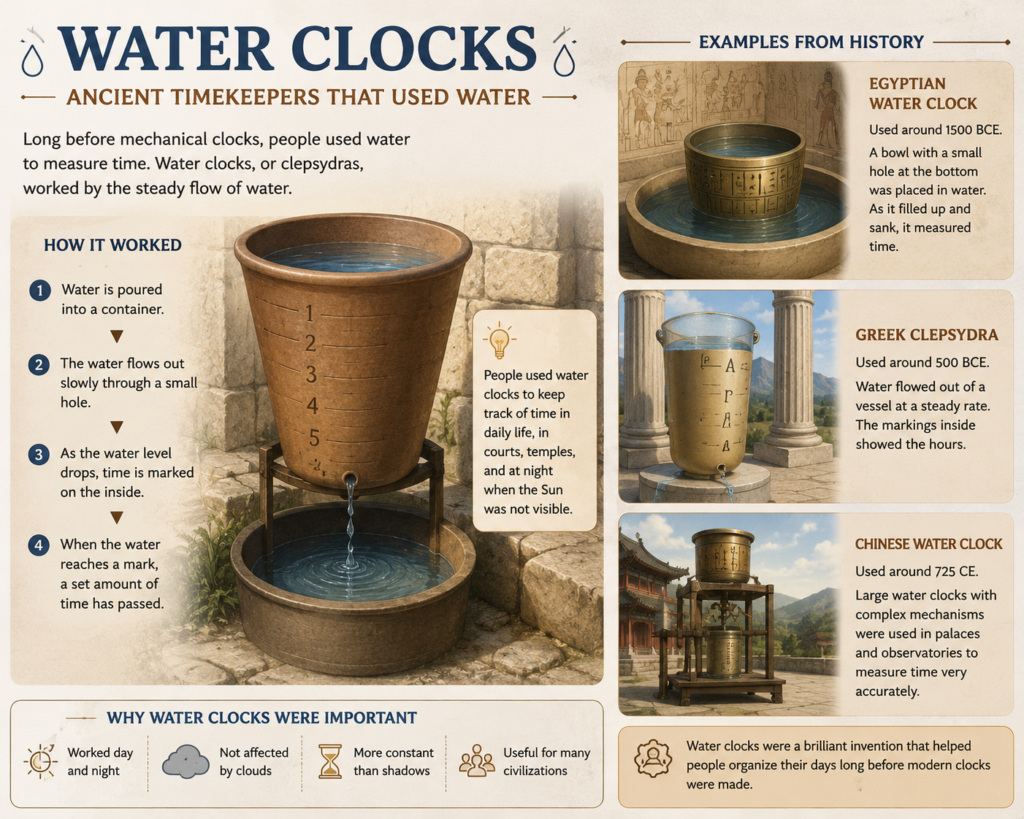
Ancient water clocks, sometimes called clepsydrae, measured time by allowing water to flow into or out of a container at a controlled rate.
One simple design had a container with a small opening. Water slowly escaped through the opening, and markings on the container showed how much time had passed.
Another design allowed water to collect in a container. As the water level rose, it could be compared with markings showing the passage of time.
Water clocks had an important advantage over sundials:
They could work during the night.
They were used in several ancient civilizations, including ancient Egypt, Greece, China, and other parts of the world.
However, they also had a problem. Water does not always flow at exactly the same rate. The pressure changes as the water level changes, and temperature can also affect how water behaves.
So water clocks were useful for measuring intervals of time, but they were not as precise as modern clocks.
3. Candle Clocks — Time Measured by Fire
Another clever method was to use something that slowly disappeared at a predictable rate: a candle.
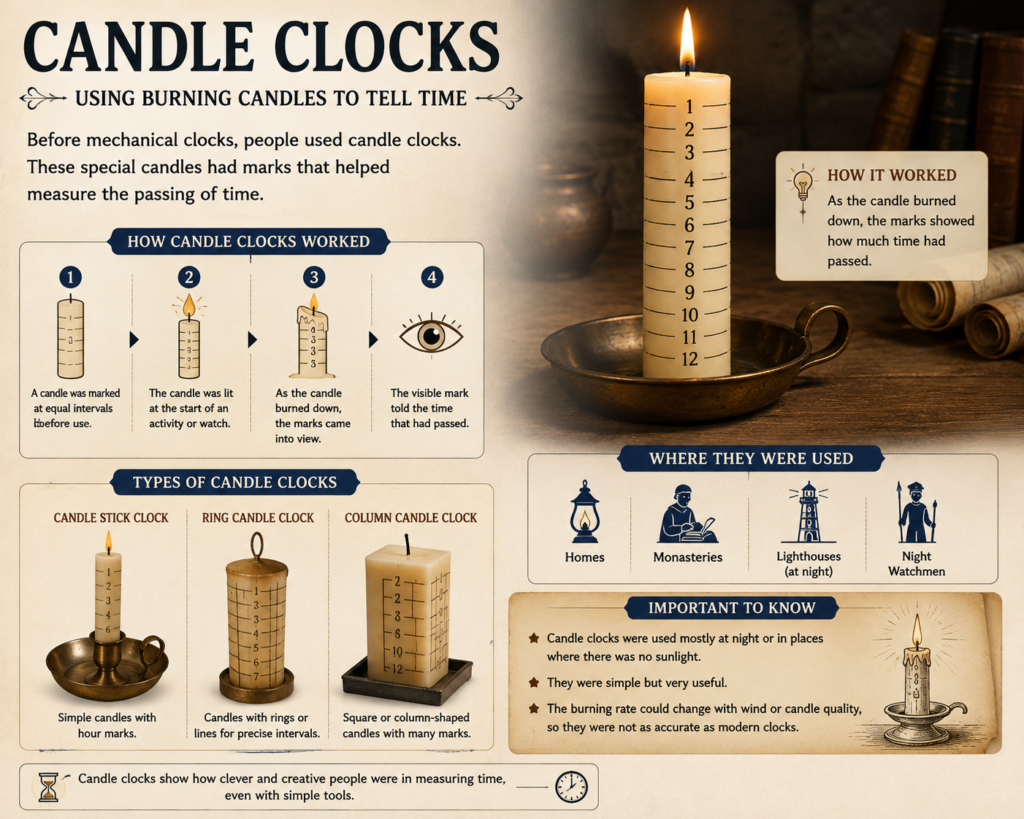
A candle could be marked at regular intervals.
As the candle burned down, the markings provided an estimate of how much time had passed.
For example, if a candle had several marks along its length, someone could tell that a certain amount of time had passed when the flame reached the next mark.
Candle clocks were particularly useful when there was no sunlight.
But, like water clocks, they weren’t perfectly accurate.
A candle’s burning rate can change because of its composition, the wick, temperature, or airflow.
Still, the basic idea was brilliant:
Instead of watching a clock move, watch something change at a predictable rate.
4. Hourglasses — Letting Sand Tell Time
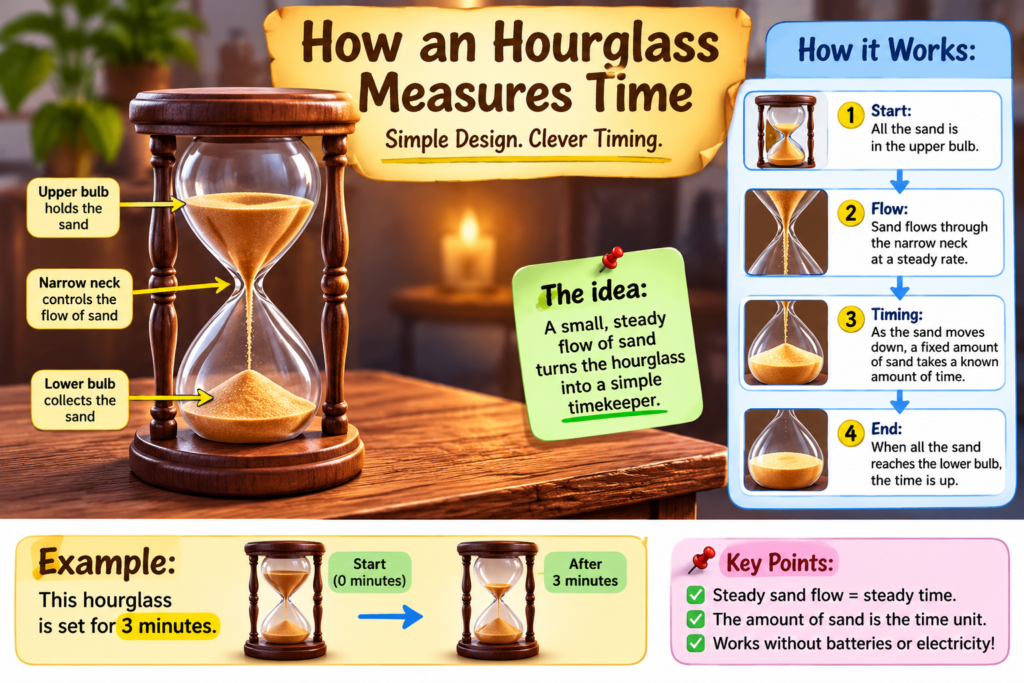
You have probably seen an hourglass.
It consists of two glass chambers connected by a narrow opening. Sand flows from the upper chamber into the lower one.
If the amount and type of sand, the size of the opening, and the shape of the glass are carefully designed, the sand can take a fairly predictable amount of time to pass through.
When all the sand reaches the bottom, a specific interval has passed.
Unlike a sundial, an hourglass doesn’t tell you the current time of day.
Instead, it answers a different question:
“How much time has passed?”
That made hourglasses useful for activities such as timing tasks, speeches, cooking, and other activities that required a known duration.
5. The Stars Were a Clock Too
The Sun wasn’t the only thing people watched in the sky.
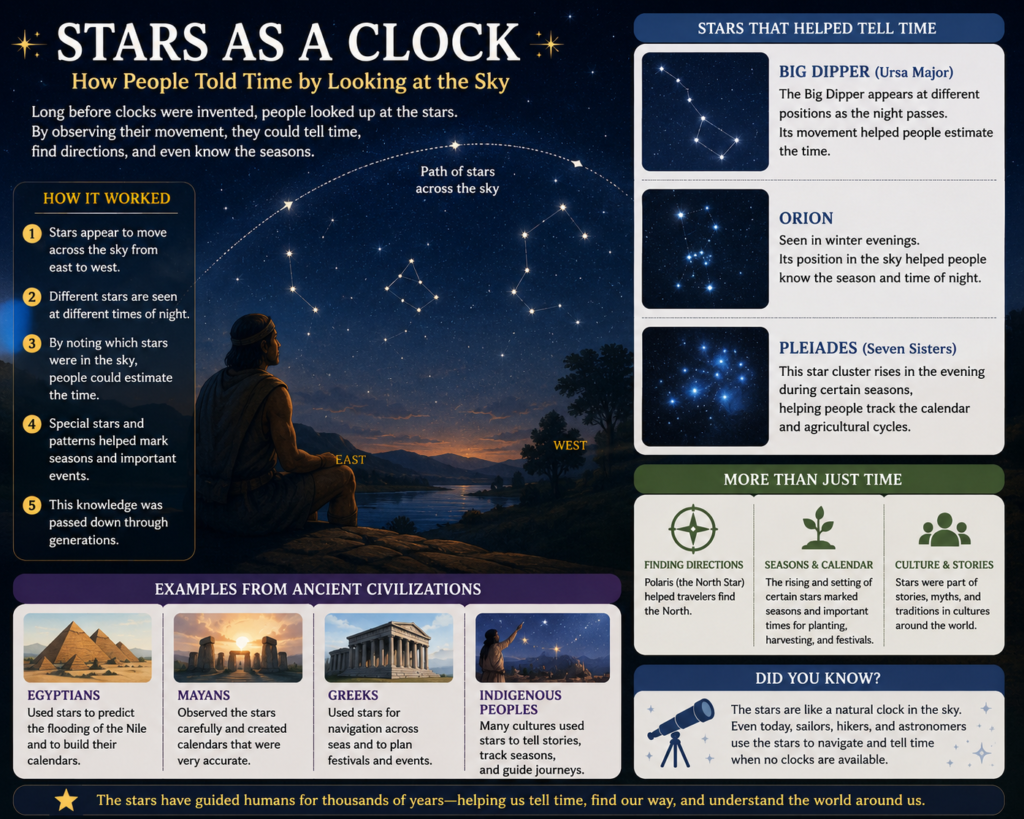
At night, people could use the stars.
The night sky appears to change in a regular pattern because Earth is rotating. Certain stars and constellations appear at particular positions at different times of night and different times of the year.
People who regularly observed the sky could recognize these patterns.
The stars were especially important for travelers and sailors because they could provide information about both direction and the passage of time.
For example, the position of certain stars could help a person estimate where they were and roughly what time it was.
This required considerable knowledge and experience.
It wasn’t as simple as looking at a digital clock, but for people who understood the night sky, it was a remarkably useful natural system.
6. Nature Was Their Daily Calendar
So, how did people tell time before clocks? They paid close attention to the patterns already happening around them. The Sun moved across the sky, shadows changed position, stars appeared to travel through the night, and natural cycles repeated with surprising regularity. By observing these patterns, people could estimate the passage of time without needing a clock.
The sounds of birds could signal the approach of morning. Certain flowers opened or closed at particular times. Shadows changed length. Animals followed regular daily patterns.
Farmers paid close attention to the changing position of the Sun and the seasons because agriculture depended on timing.
The sky itself was full of clues about the natural world. If you’ve ever wondered why the sky looks blue during the day, we’ve explored that science too.
They needed to know when to prepare the soil, sow seeds, harvest crops, and prepare for seasonal changes.
In many traditional societies, time was therefore connected closely to nature and daily activities, rather than to exact numbers on a clock.
So, How Did People Know the Exact Time?
The interesting part is that they often didn’t need to.
Today, we are used to dividing the day into precise units: hours, minutes, and seconds.
But everyday life did not always require that level of precision.
Someone might say:
“Meet me after sunrise.”
Or:
“Come when the Sun is overhead.”
Or:
“We will leave at sunset.”
These were useful instructions even without knowing the exact time.
As cities grew, trade expanded, armies needed coordination, religious ceremonies followed schedules, and people began working according to shared timetables, more precise timekeeping became increasingly important.
That created a need for better clocks.
From Shadows to Mechanical Clocks
Humans gradually developed more sophisticated ways to measure time.
Sundials measured the position of the Sun. Water clocks measured the movement of water. Candle clocks measured burning. Hourglasses measured falling sand.
Eventually, mechanical clocks appeared, using carefully designed moving parts to measure regular intervals.
Over time, clocks became more accurate and eventually small enough to carry.
Today, an atomic clock can measure time with extraordinary precision.
Yet the basic idea has remained the same for thousands of years:
Find something that changes in a predictable way, and use that change to measure time.
Try It Yourself: Make a Simple Sundial
You don’t need an ancient civilization to experiment with timekeeping.
You can make a simple sundial at home.
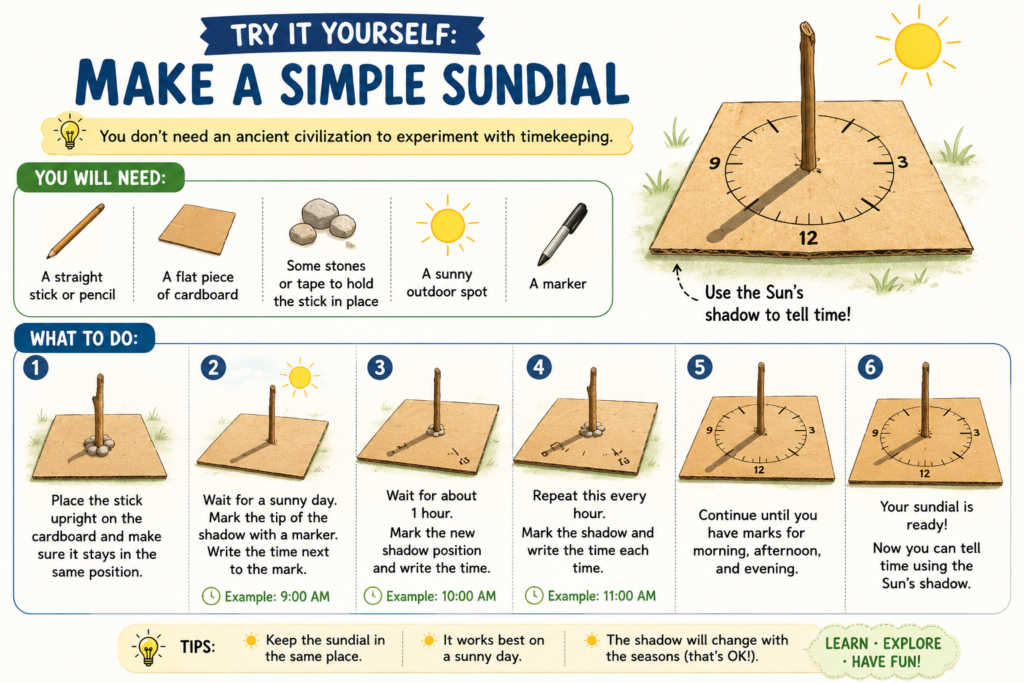
You will need:
- A straight stick or pencil
- A flat piece of cardboard
- Some stones or tape to hold the stick in place
- A sunny outdoor spot
- A marker
What to do:
Place the stick upright on the cardboard and make sure it stays in the same position.
At a particular time, mark the position of the stick’s shadow.
Come back after an hour and mark the new position.
Keep repeating this for several hours.
You’ll notice that the shadow moves and changes length as the Sun’s apparent position changes.
You have just built a very simple timekeeping device using the same basic principle that people used thousands of years ago.
Just remember that your sundial won’t necessarily match the exact time shown on your phone. That’s because modern clock time and solar time are not always exactly the same.
The Amazing Thing About Timekeeping
So, how did people tell time before clocks? They watched the world around them and learned to measure predictable changes in nature.
They were using a different kind of clock.
The sky was their clock.
The Sun was their clock hand.
Shadows were their numbers.
And nature was their calendar.
Modern clocks have made time incredibly precise, but the basic challenge hasn’t changed.
We are still trying to measure something we cannot see, touch, or stop:
time itself.
Did You Know?
The word “clock” comes from the medieval Latin clocca, meaning bell. Early clocks often used bells to announce the passing of a particular hour.
So the next time you glance at your phone to check the time, remember: humans once looked at a shadow on the ground and asked the same question.