
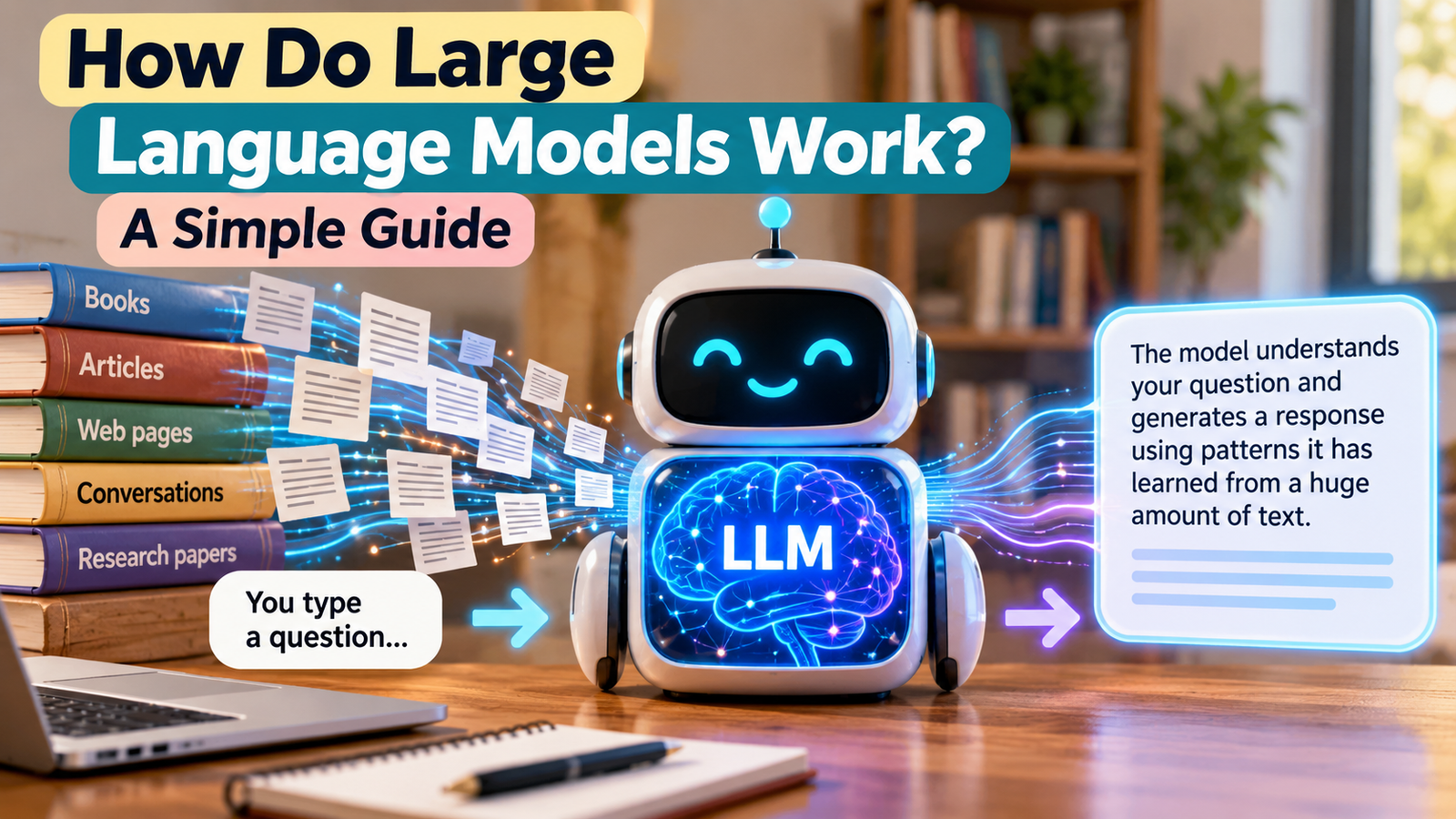
Have you ever wondered how ChatGPT can read a question, understand what you are asking, and produce an answer that sounds remarkably human?
The technology behind many of these systems is called a Large Language Model, or LLM.
LLMs are a type of AI model trained on enormous amounts of text so they can learn patterns in language and generate text of their own. Modern LLMs are typically built using deep-learning architectures called Transformers.
But an LLM does not work like a digital dictionary that stores every possible answer.
So, how do large language models work?
Let’s break it down.
What Is a Large Language Model?
A Large Language Model (LLM) is an AI model designed to work with human language.
It can learn patterns from huge collections of text and then use those patterns to perform tasks such as:
answering questions
writing and summarizing text
translating languages
explaining concepts
generating computer code
completing sentences
having conversations
The word large refers to the scale of the model and the amount of data and computing used to train it.
The word language tells us that the model is designed primarily to work with language.
And model simply means a mathematical system that has learned patterns from data.
In simple terms:
An LLM learns patterns in language and uses those patterns to predict and generate text.
How Is an LLM Related to Generative AI?
An LLM is one type of technology used in generative AI.
Generative AI is the broader idea of AI systems that can create new content.
For example, generative AI can create:
text
images
audio
video
code
LLMs specialize mainly in language and text.
This means the relationship can be thought of like this:
Artificial Intelligence → Machine Learning → Deep Learning → Generative AI → Large Language Models
Not every generative AI system is an LLM, and not every AI system is generative AI.
If you want to understand this bigger picture first, see our guide on [what is artificial intelligence] and our article on [how does generative AI work].
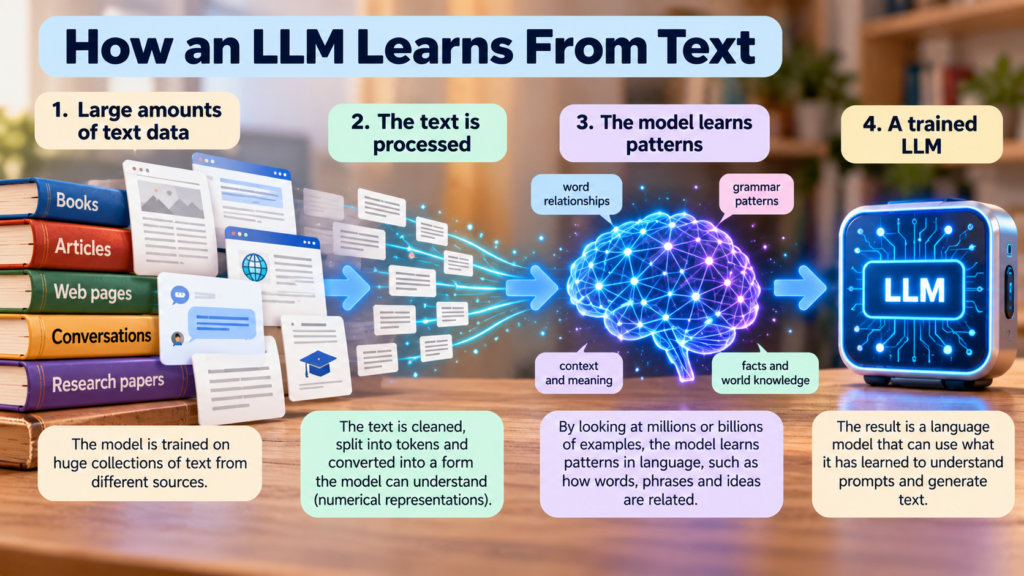
What Does an LLM Learn?
An LLM is not simply taught a list of facts.
Instead, during training, it processes enormous amounts of text and gradually learns statistical patterns and relationships within that data.
For example, imagine the model repeatedly encounters sentences such as:
The sun rises in the ___.
It may learn that words such as east are strongly associated with that sentence.
It can also learn much more complicated relationships.
For example:
Marie Curie was a ___.
The model may learn that words such as scientist, physicist and chemist are strongly associated with Marie Curie.
Over millions or billions of examples, the model learns increasingly complex relationships between words, phrases and pieces of information.
💡 Did You Know?
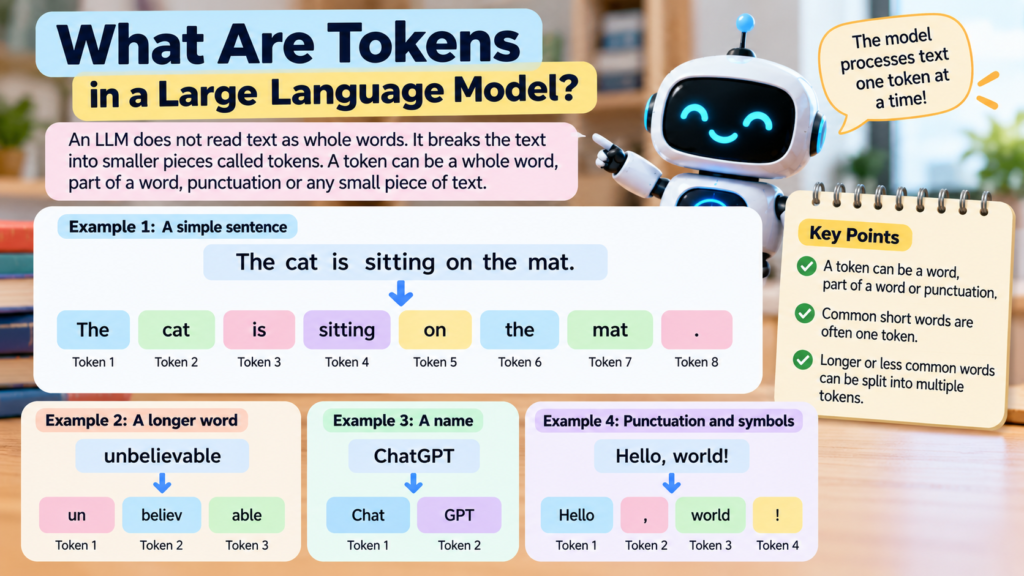
An LLM doesn’t usually process text as complete words.
It breaks text into smaller pieces called tokens.
A token can be a complete word, part of a word, punctuation or another small piece of text. For example, a longer word may be split into several tokens depending on the tokenizer being used.
So when you type a sentence into an AI chatbot, the model first converts that text into tokens that it can process.
This is one reason why AI systems often talk about things like token limits and context windows.
How Does an LLM Learn During Training?
The basic training process can be simplified into a fascinating game of prediction.
Suppose the model sees:
The cat is sitting on the ___
The training data might tell it that the missing word is mat.
The model makes a prediction.
If its prediction is wrong, the difference between its prediction and the correct answer is measured.
The model then adjusts its internal parameters slightly so that it can make better predictions in the future.
This process happens again and again across enormous amounts of training data.
Over time, the model becomes much better at predicting what is likely to come next.
This type of next-token prediction is a fundamental part of how many modern language models are trained.
What Is a Transformer?
Here’s where things get really interesting.
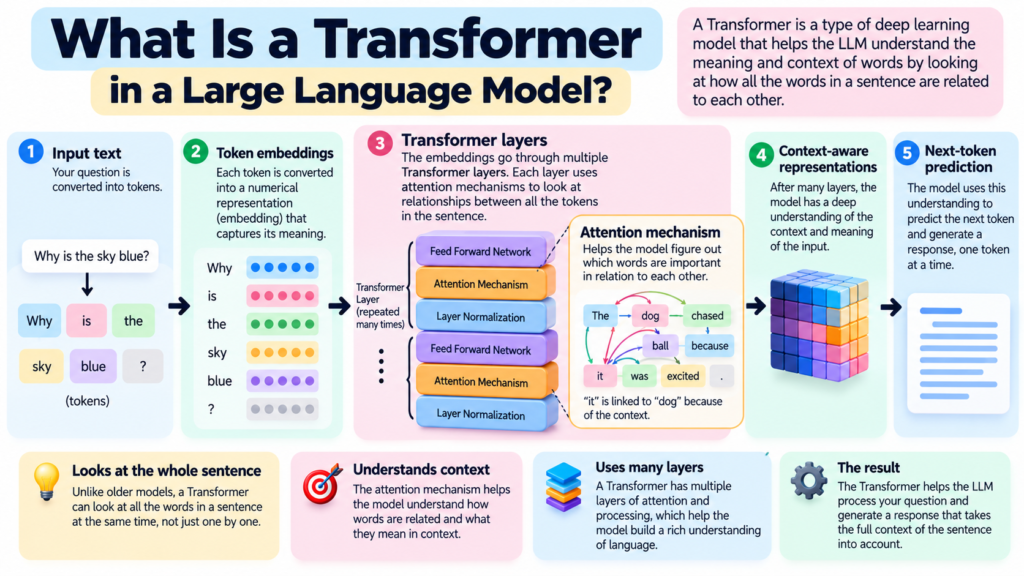
Most modern LLMs are based on a neural-network architecture called the Transformer.
The Transformer architecture was introduced in the 2017 research paper Attention Is All You Need. It introduced an architecture based heavily on a mechanism called attention, allowing the model to examine relationships between different parts of a sequence.
But what does that actually mean?
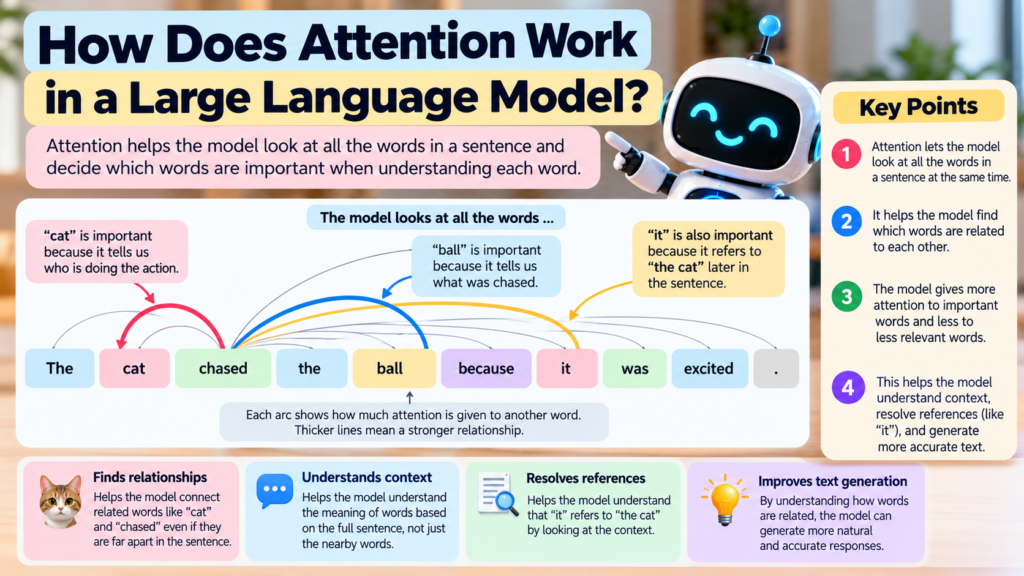
Imagine this sentence:
The dog chased the ball because it was excited.
What does it refer to?
A useful language model needs to consider the surrounding words to work out whether “it” refers to the dog or the ball.
The Transformer’s attention mechanism helps the model determine which parts of the input are important in relation to one another.
What Is Attention in an LLM?
Think of attention as the model asking:
“Which other words should I pay attention to when understanding this word?”
Consider:
The bank was beside the river.
The word bank could mean a financial institution or the land beside a river.
The surrounding words help determine the meaning.
The Transformer uses attention mechanisms to examine relationships between tokens and build a more useful representation of the context.
This is one of the major reasons Transformers became so important for modern language models.
What Happens When You Ask an LLM a Question?
Now let’s look at what happens when you type something like:
The process can be simplified into several steps.
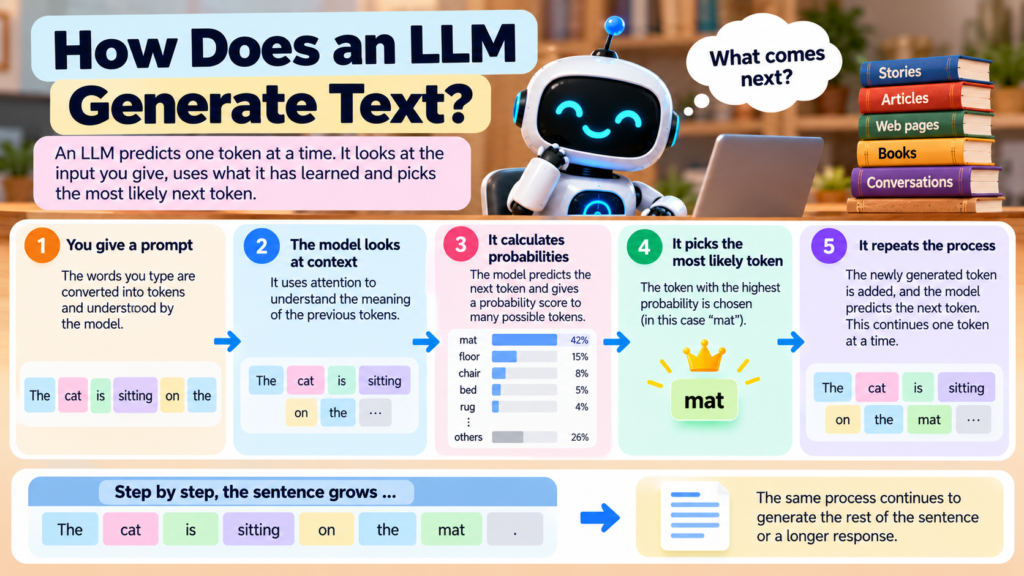
Step 1: Your text is converted into tokens
The words in your question are broken into tokens that the model can process.
Step 2: The tokens are converted into numerical representations
Computers work with numbers, so the tokens are represented mathematically in a form the neural network can process.
Step 3: The Transformer processes the context
The model’s Transformer layers examine relationships between the tokens and use attention mechanisms to understand their context.
Step 4: The model predicts what should come next
The model calculates probabilities for possible next tokens.
It doesn’t simply look up a stored paragraph and paste it into the answer.
Instead, it generates the response step by step, predicting one token and then using the growing response as context for the next prediction.
Step 5: The process continues
The model keeps predicting additional tokens until it reaches the end of its response.
Those tokens are then converted back into readable text.
So, in simplified form:
Your question → Tokens → Transformer → Next-token prediction → More tokens → Complete response
Does an LLM Know the Answer Before It Starts Writing?
Not in the way a human might.
An LLM generally generates its response progressively.
For an autoregressive language model, the system predicts the next token based on the input and the tokens that have already been generated. This process repeats until the response is complete.
Imagine writing:
The capital of France is…
The model may assign a very high probability to:
Paris
It generates that token.
Then it considers the new sequence and predicts what should come next.
This happens extremely quickly, making the process appear almost instantaneous to us.
Why Is It Called a "Large" Language Model?
There are two important ideas behind the word large.
First, modern LLMs can contain very large numbers of learned parameters.
Parameters are numerical values inside the neural network that are adjusted during training.
Second, these models can be trained using enormous amounts of data and substantial computing resources.
For example, some modern models have been trained using trillions of tokens.
That scale allows the model to encounter an enormous variety of language patterns, although simply making a model larger does not automatically make it correct or intelligent.
💡 Did You Know?
For example, a short word might be represented as one token, while a longer or less common word could be split into several tokens.
That’s why saying an AI model was trained on “trillions of words” when the actual figure refers to trillions of tokens can be misleading.
The distinction becomes especially important when discussing the scale of modern AI training.
Why Can LLMs Write in Different Styles?
During training, an LLM encounters many different forms of language.
It can encounter things such as:
conversations
explanations
stories
technical writing
news-style writing
programming code
questions and answers
As the model learns patterns in this data, it can generate text that follows different styles and structures.
This is why you can ask an LLM to explain something like a teacher, summarize it in simple language, write a poem, or produce computer code.
The model isn’t necessarily switching to a completely different brain each time.
It is using the patterns it learned to generate different kinds of responses.
Why Do LLMs Sometimes Give Wrong Answers?
This is one of the most important things to understand.
An LLM is fundamentally designed to generate likely sequences of tokens. It is not a perfect fact-checking machine.
That means it can sometimes produce information that sounds convincing but is incorrect.
These errors are often called hallucinations.
For example, an LLM might confidently provide:
an incorrect date
a made-up citation
a wrong calculation
a fictional person or event
an inaccurate explanation
The answer can sound extremely confident even when it is wrong.
That’s why important information should be checked against reliable sources.
Are LLMs Actually Thinking Like Humans?
Not in the human sense.
An LLM can produce remarkably sophisticated language, but that does not mean it has human experiences, emotions or consciousness.
When an LLM answers a question, it is processing numerical representations of the input and generating an output using patterns learned during training.
This distinction is important.
An AI can produce an explanation of sadness without actually feeling sad.
It can write about a holiday without having travelled anywhere.
It can describe curiosity without experiencing curiosity in the human sense.
Where Are LLMs Used?
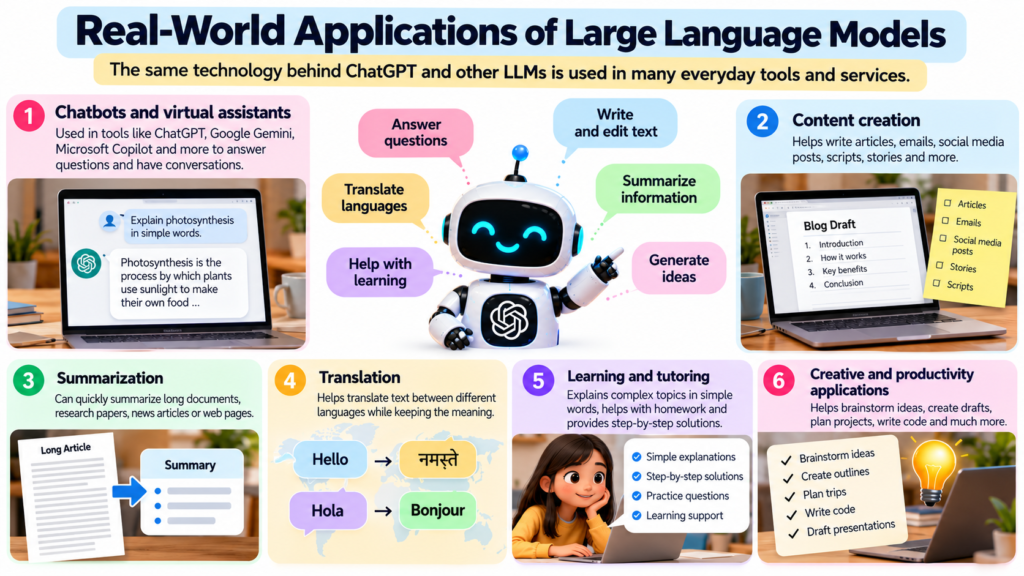
LLMs are now used in many kinds of applications.
Chatbots
They can power conversational systems that answer questions and help users complete tasks.
Writing and summarization
They can draft, rewrite and summarize text.
Translation
They can help translate between languages.
Coding
LLMs can generate, explain and modify computer code.
Search and information tools
LLMs can be combined with search and external data sources to help users find and understand information.
Education
They can explain concepts, create examples and help students explore subjects.
Business applications
Companies use language models for tasks such as document processing, customer support and knowledge management.
LLM vs Chatbot: Are They the Same Thing?
No.
An LLM is the underlying AI model.
A chatbot is an application or interface that allows people to interact with an AI system.
Think of it like this:
LLM = engine
Chatbot = vehicle built around the engine
A chatbot may use an LLM, but the complete application can also include other technologies such as a user interface, databases, search tools, safety systems and external tools.
This distinction will become especially useful when we look at how ChatGPT understands what you type.
How Do LLMs Connect to Generative AI?
This brings us back to our previous article.
Generative AI is the larger category.
LLMs are one important type of generative AI model focused on language.
So when an LLM generates an answer to your question, it is using the same basic idea we discussed in generative AI:
learn patterns → receive input → generate new content
But the “content” here is primarily language.
So, How Do Large Language Models Work?
In simple terms, an LLM works through a combination of:
Huge amounts of training data
↓
Tokenization
↓
Deep neural network
↓
Transformer architecture
↓
Attention mechanisms
↓
Learning language patterns
↓
Predicting the next token
↓
Generating a complete response
The remarkable part is that this relatively simple idea—predicting what comes next—can produce surprisingly sophisticated results when combined with enormous amounts of data, large neural networks and powerful computing.
But remember: predicting language well is not the same as understanding the world exactly like a human does.
What's Next?
Now that we understand what an LLM is and how it generates text, we can take the next step:
How Does ChatGPT Understand What You Type?
That article will look more closely at what happens between the moment you type a message and the moment an AI chatbot produces its response—including tokens, context, attention and conversation history.
And that’s where things get even more interesting.