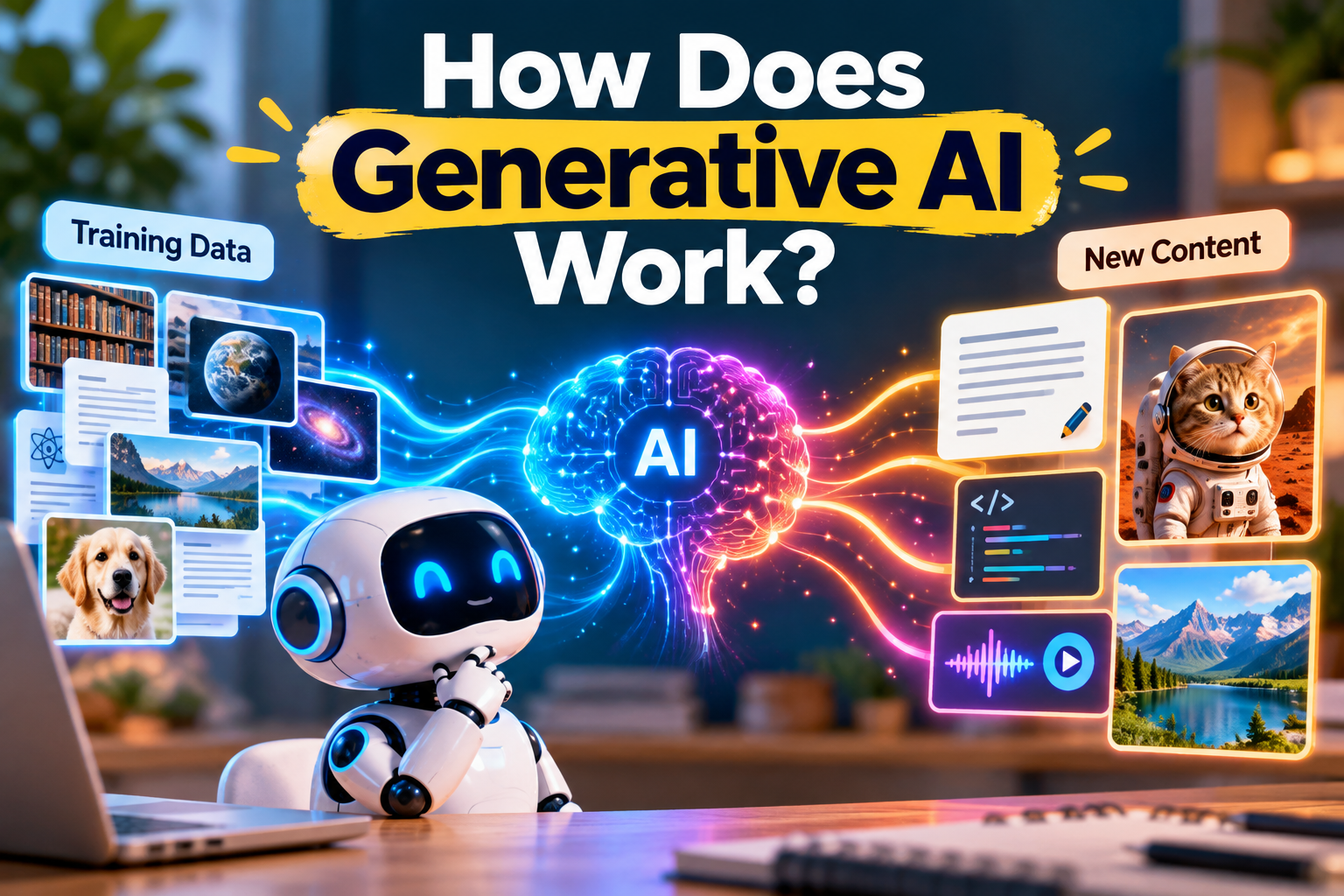
How does generative AI work? If you have ever asked an AI chatbot to write a story, create an image, summarize something, or explain a difficult topic, you have already seen generative AI in action.
But how can a computer create something that did not exist before?
The answer involves machine learning, deep learning, huge amounts of training data, and mathematical models that learn patterns.
Generative AI does not simply copy and paste something from its training data. Instead, it learns patterns in the data and uses those patterns to generate new content.
To understand how this works, it helps to connect it to what we have already learned about artificial intelligence, machine learning, and deep learning.
If you are new to the topic, start with our guide to what is artificial intelligence.
And if you want to understand the technology underneath generative AI, read our guide to how machine learning works and how deep learning works.
What Is Generative AI?
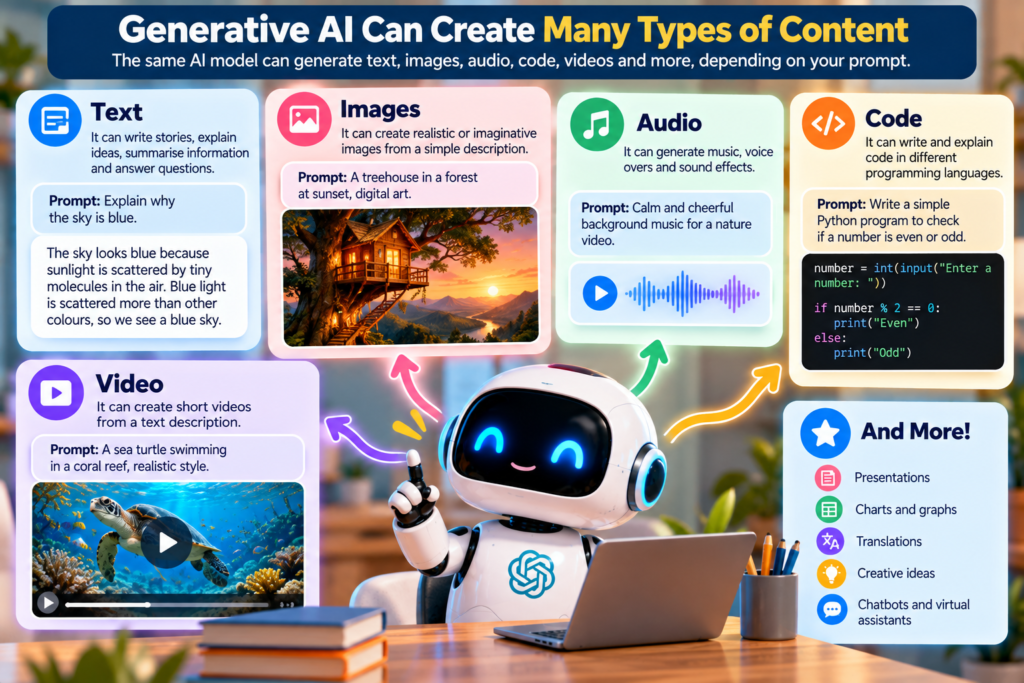
Generative AI is a type of artificial intelligence that can create new content from a prompt or other input.
That content can include:
- Text
- Images
- Audio
- Music
- Video
- Computer code
- Presentations and other documents
For example, you might type:
“Write a short story about a robot exploring Mars.”
A generative AI system can produce a new story based on that instruction.
Or you might type:
“Create an illustration of a robot standing on Mars.”
An image-generation model can create an image based on the description.
This is different from an AI system whose only job is to classify something.
For example, an image-recognition system might look at a photograph and decide:
“This is a cat.”
A generative AI system can use what it has learned about images to create a new picture of a cat.
That difference gives generative AI its name: it generates content.
Is Generative AI the Same as Artificial Intelligence?
No.
Think of AI as a very large umbrella.
Under that umbrella are technologies such as:
Artificial Intelligence → Machine Learning → Deep Learning → Generative AI
Generative AI is therefore not a completely separate technology from machine learning and deep learning.
Modern generative AI systems are generally built using advanced deep-learning models.
That means the ideas we explored in our previous articles are building blocks for understanding generative AI.
How Does Generative AI Work?
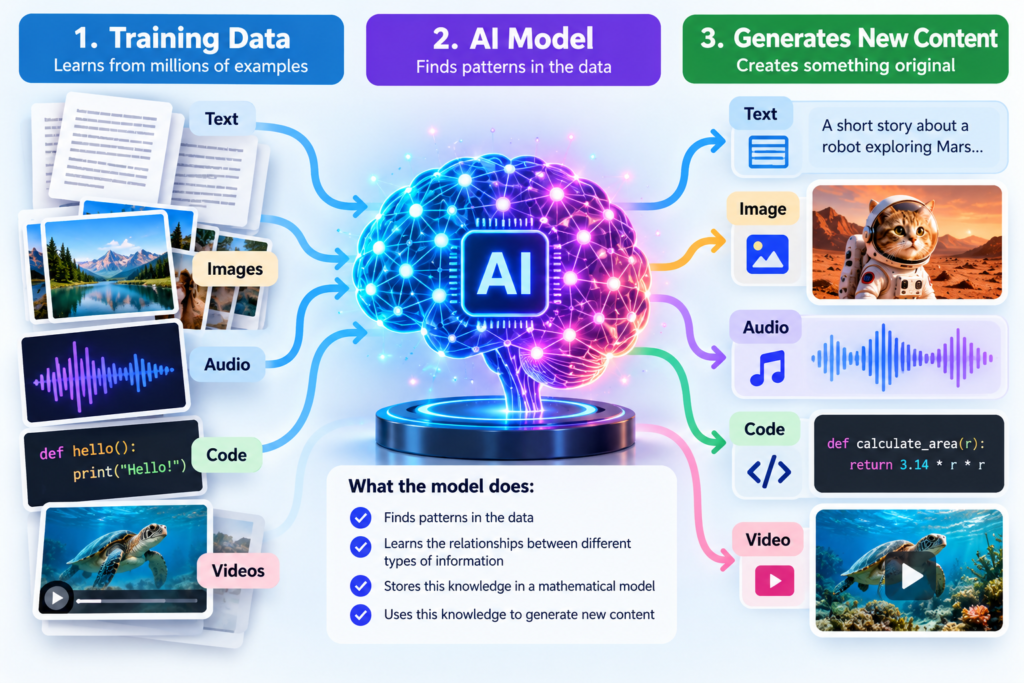
Before a generative AI system can create useful content, it has to be trained.
During training, the model is exposed to enormous amounts of data.
For a text-generation model, this might include very large collections of text.
For an image-generation model, the training data can include huge numbers of images and information describing their visual patterns.
The model doesn’t store a simple list of rules such as:
“A cat has four legs.”
Instead, the neural network gradually adjusts its internal parameters while learning patterns and relationships in the training data.
These parameters are numerical values inside the model that influence how it processes information and produces an output.
This is where deep learning becomes important.
Deep-learning models can contain many layers and enormous numbers of parameters. During training, those parameters are adjusted so that the model becomes better at its task.
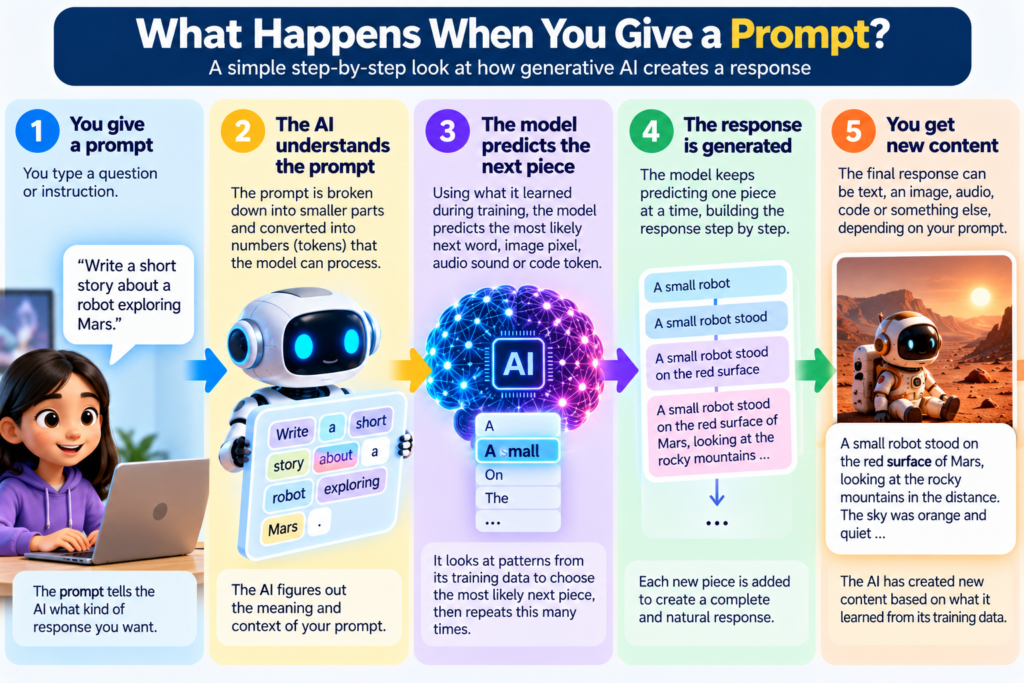
What Happens When You Give Generative AI a Prompt?
Once a model has been trained, you can give it an instruction called a prompt.
For example:
“Write a funny story about a penguin who wants to become an astronaut.”
The prompt becomes the input.
The model processes the words and their relationships, then begins producing an output.
For text generation, the model generally predicts what should come next based on the context it has received.
It does this repeatedly.
You can think of it like this:
Prompt → Understand patterns and context → Predict next piece → Add it to the response → Predict the next piece → Repeat
The result is a complete response.
This happens extremely quickly.
How Does AI Generate Text?
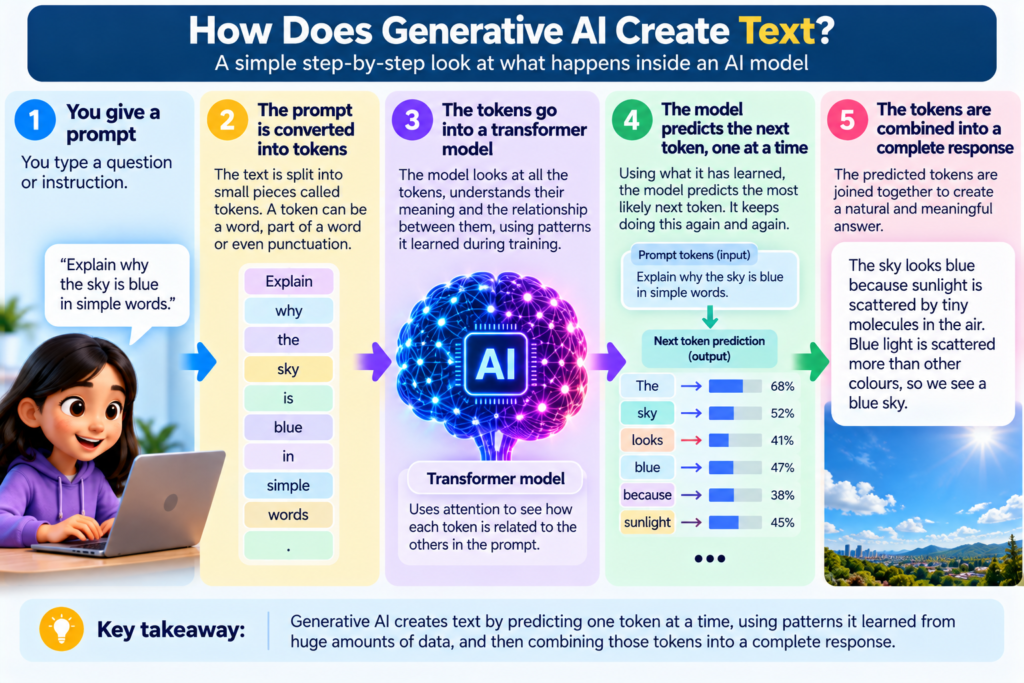
Text-generating AI systems commonly use a type of deep-learning architecture called a Transformer.
Transformers became especially important for modern language models because they can process relationships between words and other pieces of information in a sequence.
One important idea in Transformers is attention.
Imagine reading this sentence:
“The boy put the ball in the box because it was too heavy.”
To understand what “it” refers to, a language model needs to pay attention to the relationships between different parts of the sentence.
Attention mechanisms help a Transformer determine which parts of the input are important when processing another part.
This allows the model to build a representation of the context rather than treating every word as completely independent.
💡 Did You Know?
The term GPT can mean two related but different things.
In AI, GPT stands for Generative Pre-trained Transformer. It describes a type of language model that can generate text by processing patterns in language.
But inside ChatGPT, you may also see the word GPTs. These are customized versions of ChatGPT designed for specific purposes. They can be given special instructions, additional knowledge and selected tools.
So when someone says “GPT”, it is worth checking the context: are they talking about the AI model or a customized version of ChatGPT?
But Does AI Write One Word at a Time?
In a simplified sense, yes.
A language model generates text by repeatedly predicting the next token.
A token isn’t always exactly one word. It can be a whole word, part of a word, or sometimes punctuation or another small piece of text.
Suppose you type:
“The Sun rises in the…”
The model might assign high probabilities to tokens such as:
east
It selects a token, adds it to the sequence, and then considers the expanded context when generating what comes next.
It keeps repeating this process until it has produced the requested response.
So when you see an AI write an entire paragraph almost instantly, it isn’t necessarily creating the whole paragraph in one single step.
It is generating a sequence of pieces while continually using the context that has already been produced.
Does Generative AI Just Copy What It Has Seen?
Not in the simple way you might imagine.
During training, the model learns statistical patterns and relationships in its training data.
It can then use those learned patterns to generate new combinations.
For example, imagine a model has seen many pictures of:
- dogs
- bicycles
- beaches
- mountains
It can learn visual patterns associated with these concepts.
When you ask it for:
“A dog riding a bicycle on a beach with mountains in the background”
the model can combine patterns associated with those concepts into a new image.
That doesn’t mean the model understands the scene exactly as a human does.
It means its learned representations allow it to generate an output that matches the requested patterns.
How Does Generative AI Create Images?
Text and images require somewhat different generation techniques.
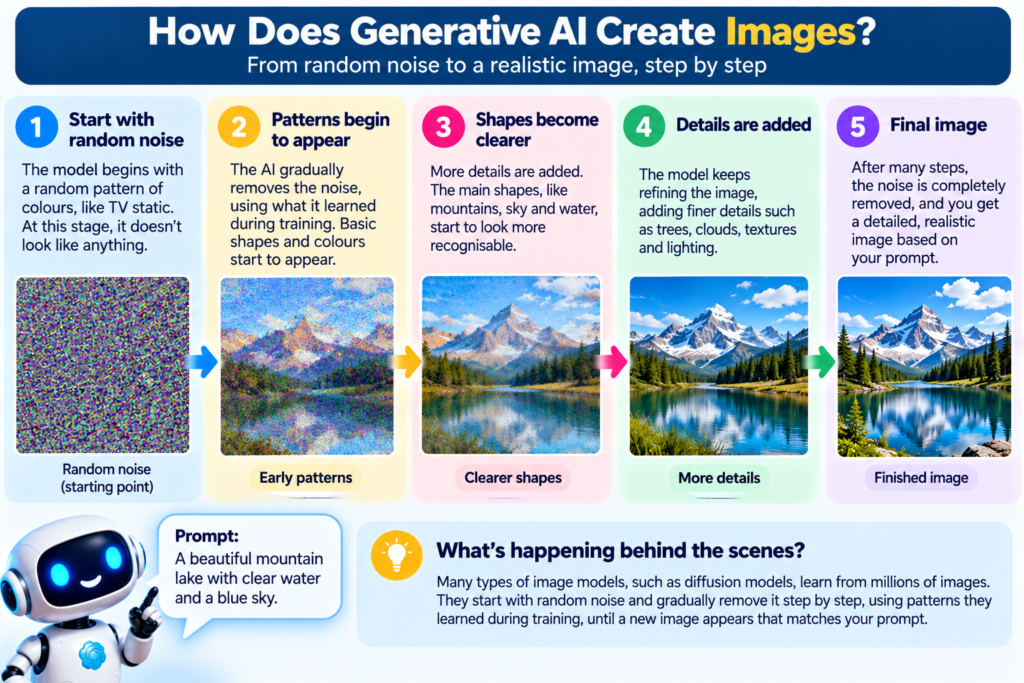
One important technology used for modern image generation is the diffusion model.
The basic idea is surprisingly interesting.
Imagine taking a photograph and gradually adding more and more random noise to it.
At first, you can still recognize the picture.
Add more noise and the details become harder to see.
Eventually, the original image becomes almost completely random-looking.
During training, a diffusion model learns how this process works.
It learns patterns that help it move in the opposite direction—from noisy information toward a meaningful image.
How Does an Image Generator Start With Noise?
When you ask an image-generation system for something like:
“A small robot exploring an ancient library”
the model can begin with random noise.
It then repeatedly transforms that noisy information.
Step by step, the random pattern becomes more structured.
Eventually, recognizable shapes and details appear.
You can think of the simplified process like this:
Random noise → rough shapes → objects and structures → details → final image
The text prompt guides the generation process so that the resulting image matches the requested description.
Diffusion models are one of the important approaches used for image generation today.
How Does the AI Know What "Robot" or "Library" Means?
This is where the training process becomes important.
During training, the model encounters huge numbers of examples containing visual patterns and associated information.
Over time, it learns relationships between concepts.
It doesn’t necessarily store a dictionary entry saying:
Robot = machine with arms and legs
Instead, the model develops numerical representations that capture relationships between different features and concepts.
When you provide a prompt containing the word “robot,” that information influences the generation process.
The same happens with words such as:
library
ancient
wooden
dark
futuristic
The model combines the relationships it has learned to produce an image matching the prompt.
Why Can AI Create Completely New Images?
This is one of the most fascinating parts of generative AI.
The model isn’t limited to reproducing one particular training image.
Instead, it has learned patterns that can be combined in many different ways.
For example, it might have learned visual patterns associated with:
- cats
- astronauts
- spacesuits
- planets
- forests
- paintings
A prompt can ask for:
“A cat astronaut exploring an alien forest in a watercolor style.”
The model can combine these learned concepts into an image that did not previously exist.
The exact way this works depends on the architecture and training process of the particular model, but the central idea is the same:
learn patterns → represent those patterns → generate new combinations.
Why Is Generative AI So Powerful?
One major reason is the enormous scale of modern deep-learning models.
Earlier machine-learning systems were often designed for relatively specific tasks.
Modern foundation models can be trained on huge datasets and then adapted for many different tasks.
For example, a language model can potentially be used to:
- answer questions
- summarize text
- translate languages
- write stories
- generate code
- explain concepts
- transform text into different styles
The same underlying model can therefore perform many different tasks depending on the prompt.
This is one reason generative AI feels so different from traditional software.
Instead of selecting a separate button for every possible task, you can often describe what you want using ordinary language.
What Are Foundation Models?
A foundation model is a large model trained on broad datasets that can serve as the basis for many different applications.
Think of it like a general-purpose foundation on which different buildings can be constructed.
A foundation model can be adapted or used for different tasks.
Some foundation models work primarily with text.
Others can work with images, audio, video or multiple types of information.
Models that can work with several kinds of input and output are often called multimodal models.
For example, a multimodal AI system might accept:
text + image
and produce:
text
Or it might accept:
text
and produce:
image
What Is the Difference Between Generative AI and Traditional AI?
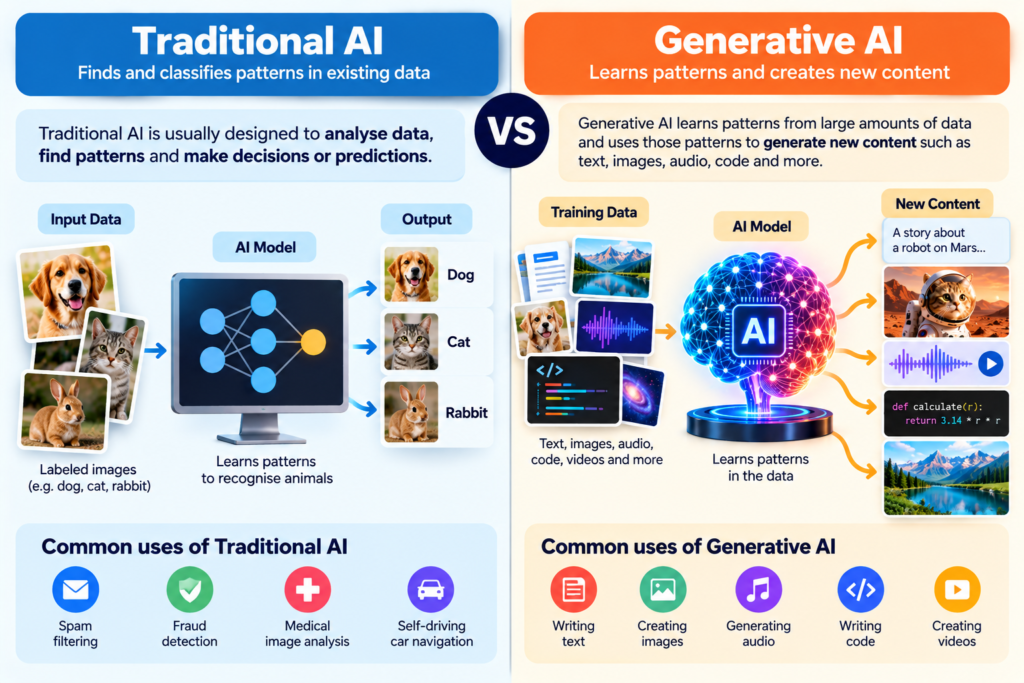
A traditional AI system might be designed to recognize or predict something.
For example:
Photo → Is this a cat or a dog?
The output is a classification.
Generative AI can instead produce new content:
Prompt → New image of a cat
Or:
Question → New text response
So a simple way to remember the difference is:
Traditional AI often analyzes or predicts.
Generative AI can create.
Of course, real-world AI systems can be more complicated, and some systems can both analyze information and generate content.
Can Generative AI Make Mistakes?
Absolutely.
Generative AI can produce information that sounds convincing but is incorrect.
A language model can generate a statement that looks perfectly reasonable even when the underlying information is wrong.
An image model can also create strange or inaccurate details.
For example, an image might contain:
- incorrect text
- unusual hands or objects
- physically impossible details
- inconsistent shadows
- objects that change shape
This happens because generative AI is not simply looking up an answer from a perfect database.
It is generating an output based on patterns learned during training and the instructions it receives.
That is why AI-generated information still needs to be checked, especially when accuracy matters.
Does Generative AI Understand Like a Human?
This is a much bigger question.
Generative AI can process language, recognize patterns and produce remarkably convincing responses.
But that doesn’t automatically mean it experiences the world or understands it in exactly the same way a human does.
A useful way to think about it is:
Generative AI is extremely good at learning patterns in data and using those patterns to produce outputs.
That is different from saying that the machine has human experiences, emotions or consciousness.
Where Do We Use Generative AI?
Generative AI is already being used in many areas.
Writing
AI can draft emails, stories, explanations, summaries and other forms of text.
Images
Image-generation models can create illustrations, artwork, designs and realistic-looking scenes.
Coding
Generative AI can help programmers write, explain and modify computer code.
Audio
AI models can generate or transform speech, music and other sounds.
Video
Generative systems can create or modify video content.
Education
AI can explain difficult concepts, create practice questions and adapt explanations to different learning levels.
Creative work
Artists, designers, writers and other creators can use generative AI as part of their creative workflows.
So, How Does Generative AI Create New Content?
Let’s put everything together.
A simplified version looks like this:
1. Collect huge amounts of training data
The model is exposed to large quantities of text, images, audio, code or other information.
2. Train a deep-learning model
The model learns patterns and relationships within that data.
3. Adjust the model’s parameters
During training, the model’s internal parameters are repeatedly adjusted to improve its performance.
4. Give the model a prompt
You provide an instruction such as:
“Write a story about a robot.”
or
“Create an image of a robot on Mars.”
5. Generate the output
The model uses what it learned during training to produce new content.
For text, this involves generating tokens based on context.
For images, approaches such as diffusion can transform noise into increasingly structured visual content.
6. Evaluate and improve
AI systems can be tested and refined to improve the quality, safety and usefulness of their outputs.
AI, Machine Learning, Deep Learning and Generative AI
If all these terms seem confusing, remember this simple relationship:
Artificial Intelligence
↓
Machine Learning
↓
Deep Learning
↓
Generative AI
This isn’t a perfect description of every AI system, but it is a useful way to understand how the technologies are related.
AI is the broad field.
Machine learning is one way of building AI systems that learn from data.
Deep learning is a type of machine learning based on neural networks with multiple layers.
Generative AI uses advanced machine-learning models to create new content.
And that brings us to an important technology inside many modern generative AI systems:
Large Language Models, or LLMs.
What Comes Next?
You now know the basic idea behind how generative AI can create text and images.
But there is still a fascinating question:
How can an AI model process human language well enough to write an answer, summarize an article or carry on a conversation?
That leads us to Large Language Models.
In the next article, we’ll look at:
How Do Large Language Models Work?
We’ll explore tokens, neural networks, Transformers, attention, parameters and how a language model turns your words into a response.
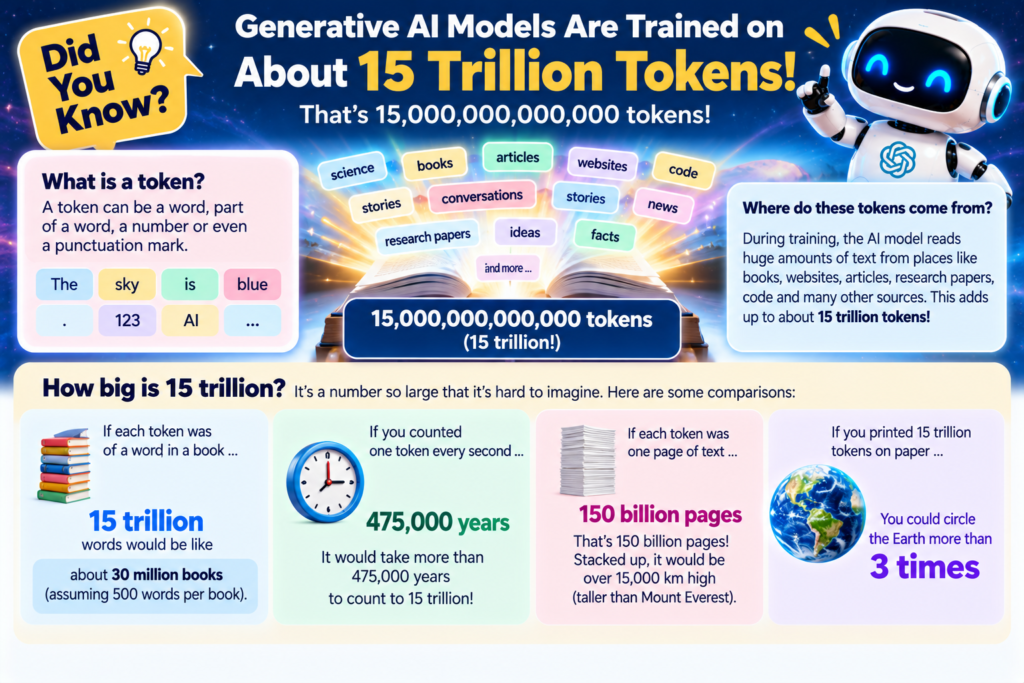
💡 Did You Know?
Some modern AI models are trained using trillions of tokens.
For example, Meta says its Llama 3 models were pretrained on more than 15 trillion tokens.
A token is not necessarily a whole word. It can be a complete word, part of a word, punctuation, or another small piece of text.
So 15 trillion tokens does not mean 15 trillion words.
But just how big is 15 trillion?
15 trillion = 15,000,000,000,000.
If you counted one number every second without stopping, reaching 15 trillion would take more than 475,000 years!
The amount of training data varies greatly between AI models, and companies do not always disclose exactly what data or how much data was used to train their models.