
Have you ever noticed that YouTube seems to know what videos you might like? Or that your email can recognize spam before you even open it? Maybe your phone can recognize your face, or your keyboard can predict the next word you are going to type.
How does it do all that?
One important technology behind many of these features is machine learning.
Machine learning is one of the most important parts of artificial intelligence (AI). Instead of giving a computer a detailed set of instructions for every possible situation, we give it data and examples, and it learns patterns from them.
But what does “learning” actually mean for a machine?
Let’s find out.
New to AI? Before diving into machine learning, you may want to read our guide: What Is Artificial Intelligence? A Simple Guide to How AI Works
What Is Machine Learning?
Machine learning is a way of building computer systems that can learn patterns from data and use those patterns to make predictions or decisions.
Think about how a child learns to recognize a dog.
You don’t usually give the child a mathematical description of a dog. Instead, the child sees lots of dogs.
A small dog.
A big dog.
A black dog.
A golden dog.
A dog with floppy ears.
After seeing enough examples, the child begins to recognize the patterns that make something look like a dog.
Machine learning works in a somewhat similar way.
Instead of showing examples to a child, we give examples to a computer model.
The computer looks for patterns in the data and uses what it learns when it encounters something new.
In a very simple form:
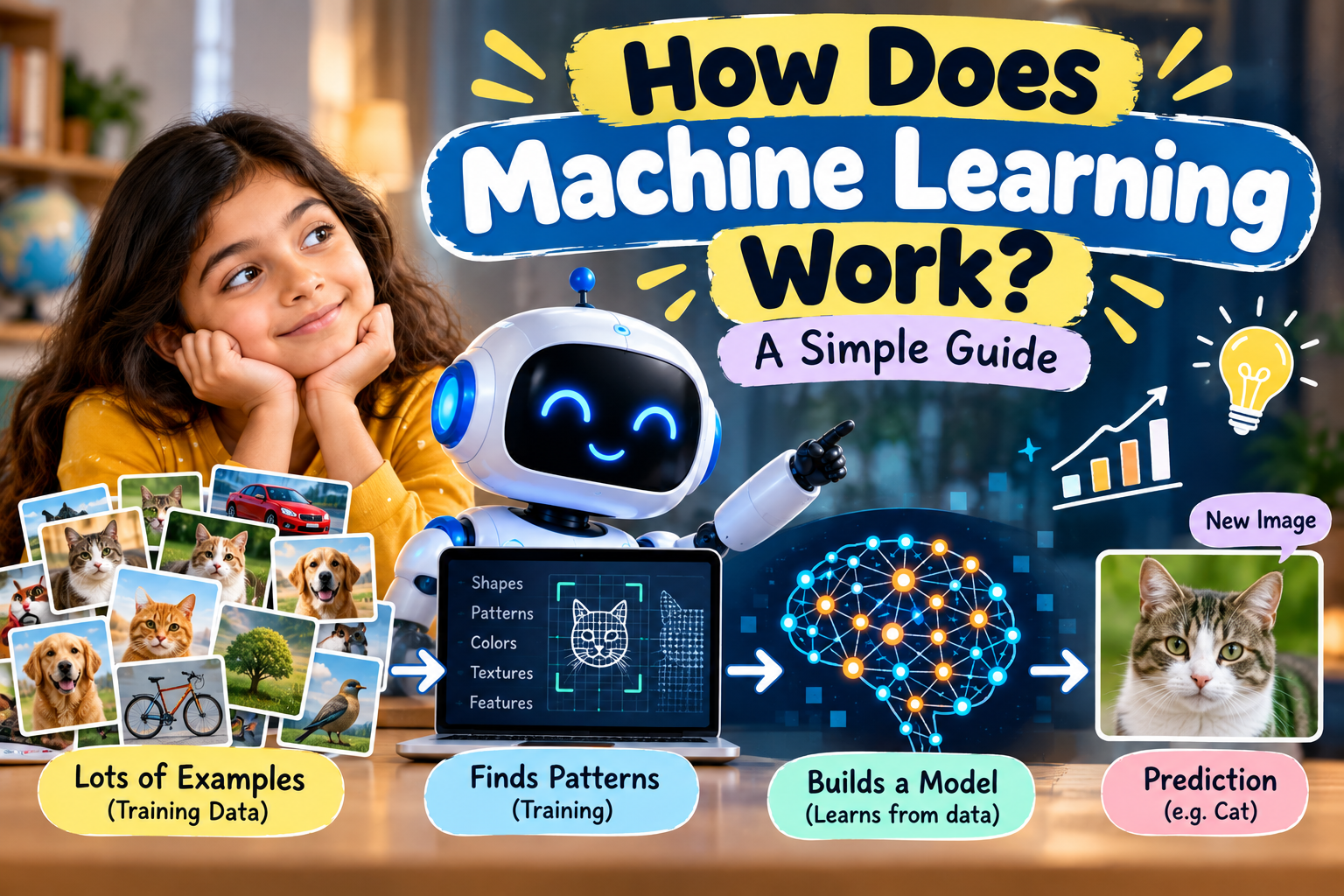
Data → Patterns → Model → Prediction
That’s the basic idea behind machine learning.
How Is Machine Learning Different From Traditional Programming?
To understand machine learning, it helps to first understand how ordinary computer programs work.
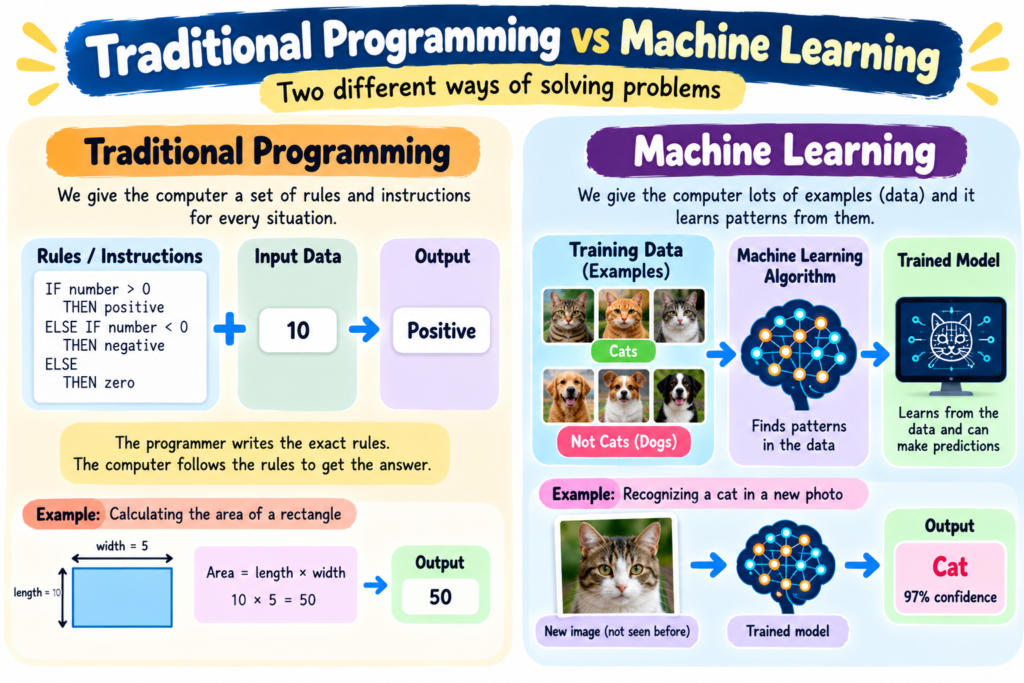
Imagine you want to create a program that calculates the area of a rectangle.
You can give the computer a clear rule:
Area = length × width
If the length is 10 and the width is 5, the program calculates:
10 × 5 = 50
The programmer has explicitly told the computer what rule to follow.
But what if you want a computer to recognize whether a photograph contains a cat?
That’s much harder.
You could try writing thousands of rules:
- Cats have two eyes.
- Cats have four legs.
- Cats usually have fur.
- Cats have whiskers.
- Cats have pointed ears.
But these rules would quickly become complicated.
What about a cat sitting sideways?
What about a kitten?
What about a cat partially hidden behind a sofa?
What about a photograph taken in the dark?
Instead of writing every possible rule, machine learning takes a different approach.
We can give the computer many examples of cats and non-cats and allow the machine-learning system to find useful patterns itself.
That’s one of the big ideas behind machine learning.
So, How Does a Machine Actually Learn?
Let’s imagine we’re teaching a computer to recognize cats.
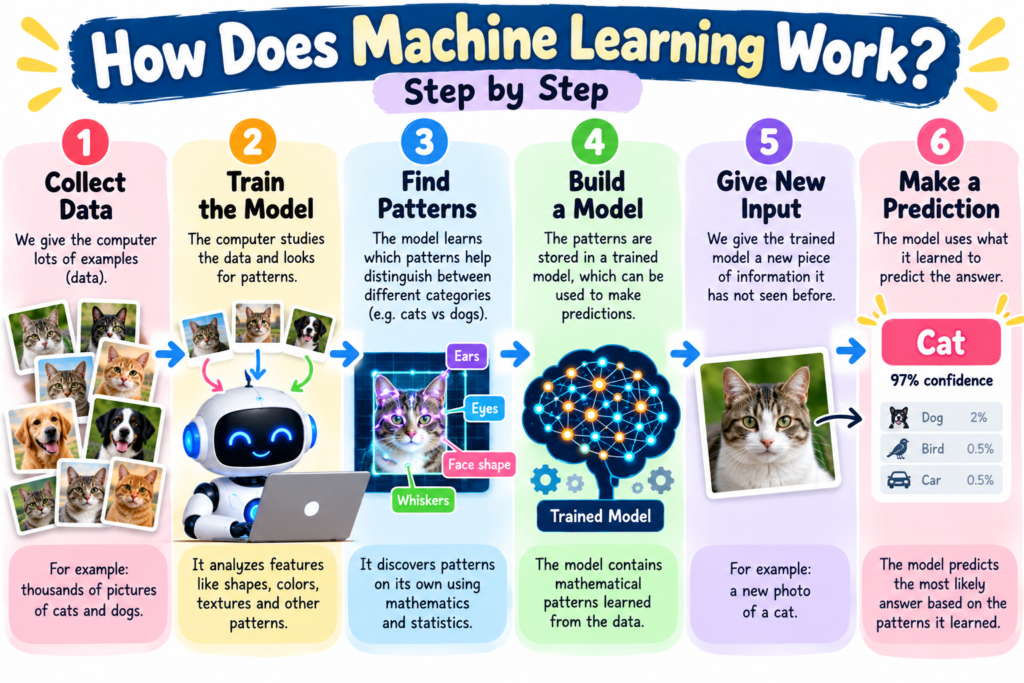
Step 1: Give It Lots of Data
First, we need examples.
We might have thousands or millions of pictures.
Some are labeled:
CAT
Others are labeled:
NOT CAT
The computer doesn’t automatically understand what a cat is.
It simply receives the data.
The quality and variety of this data matter because the machine-learning system can only learn from the examples it receives.
Step 2: The Computer Looks for Patterns
Now the machine-learning system examines the examples.
It searches for patterns that help separate cats from other objects.
Perhaps certain shapes, textures, colors, edges, or combinations of features appear frequently in the cat examples.
The system adjusts its internal mathematical values while training so that its predictions gradually become more accurate.
This process can happen thousands or millions of times.
It isn’t learning in exactly the same way a human learns.
It is using mathematics and statistics to find useful patterns in data.
Step 3: It Builds a Model
After training, we have something called a machine-learning model.
You can think of the model as the result of the learning process.
It contains mathematical patterns and relationships that the system learned from the training data.
Now we can give the model something it hasn’t seen before.
For example:
🐱 A new photograph of a cat
The model analyzes the new image and produces a prediction such as:
“Cat — 97% confidence.”
The exact numbers and methods depend on the type of model being used.
The important point is that the model is using patterns learned from previous examples to analyze new information.
What Is Training in Machine Learning?
The process of teaching a machine-learning model using data is called training.
During training, the model makes predictions and compares them with the expected answers.
When its prediction is wrong, the system adjusts its internal parameters.
It then tries again.
This happens repeatedly.
You can imagine it like practicing a skill.
Imagine a student learning mathematics:
Try → Make a mistake → Check the answer → Understand the mistake → Try again
Machine-learning training has a somewhat similar cycle:
Predict → Compare → Adjust → Predict again
Of course, the mathematics happening inside the model can be extremely complicated.
But the basic idea is surprisingly simple.
What Happens When the Model Gets a New Question?
Once training is complete, the model can be used.
This stage is sometimes called inference.
Suppose we trained a model using thousands of examples of cats and dogs.
Now we show it a completely new photograph.
The model doesn’t need to be trained from scratch every time.
Instead, it uses the patterns it already learned.
It processes the new input and produces an output.
For example:
New image → Trained model → Prediction
The prediction could be:
“Dog”
or
“Cat”
or perhaps a probability for several possible answers.
This is how a trained machine-learning model can be used in the real world.
Does Machine Learning Always Give the Right Answer?
No!
And this is extremely important.
Machine learning systems can make mistakes.
If the training data is poor, incomplete, biased, or doesn’t represent the situations the model encounters later, the model may perform poorly.
Imagine training a cat-recognition system using only photographs of cats sitting indoors.
What happens when it sees a cat outside in the snow?
It may still recognize the cat — but its performance could be different depending on what it learned from its training data.
This is why good data and careful testing are extremely important.
Machine-learning systems don’t magically know everything.
They learn from the information available to them.
What Are the Main Types of Machine Learning?
Machine learning can be divided into several major approaches.
Three commonly discussed types are supervised learning, unsupervised learning, and reinforcement learning.
1. Supervised Learning
In supervised learning, the training data includes examples with known answers.
For example:
Photo → CAT
Photo → DOG
The model learns to connect the input with the correct output.
Supervised learning can be used for tasks such as:
- recognizing objects in images
- detecting spam emails
- predicting house prices
- classifying documents
- identifying certain patterns in data
It’s called “supervised” because the training examples provide guidance about the expected answer.
2. Unsupervised Learning
What if we don’t have labels telling the computer what each example means?
That’s where unsupervised learning can be useful.
The system looks for patterns or groups in the data on its own.
Imagine giving a computer information about thousands of customers without telling it which customers belong together.
It might discover groups based on similarities in their behavior.
For example, one group might frequently buy sports equipment, another might regularly buy books, and another might have completely different shopping patterns.
The computer isn’t necessarily told what these groups mean.
It discovers patterns in the data.
3. Reinforcement Learning
Reinforcement learning works differently again.
Here, a system learns by interacting with an environment and receiving rewards or penalties based on its actions.
Imagine teaching a computer to play a game.
It makes a move.
If the move helps it win, it receives a positive reward.
If the move leads to failure, it receives a negative result.
Over many attempts, the system can learn which actions tend to produce better outcomes.
Reinforcement learning has been used in areas such as games, robotics, and decision-making research.
Where Do We Use Machine Learning?
Machine learning isn’t just something found in research laboratories.
It is already part of many technologies we use every day.
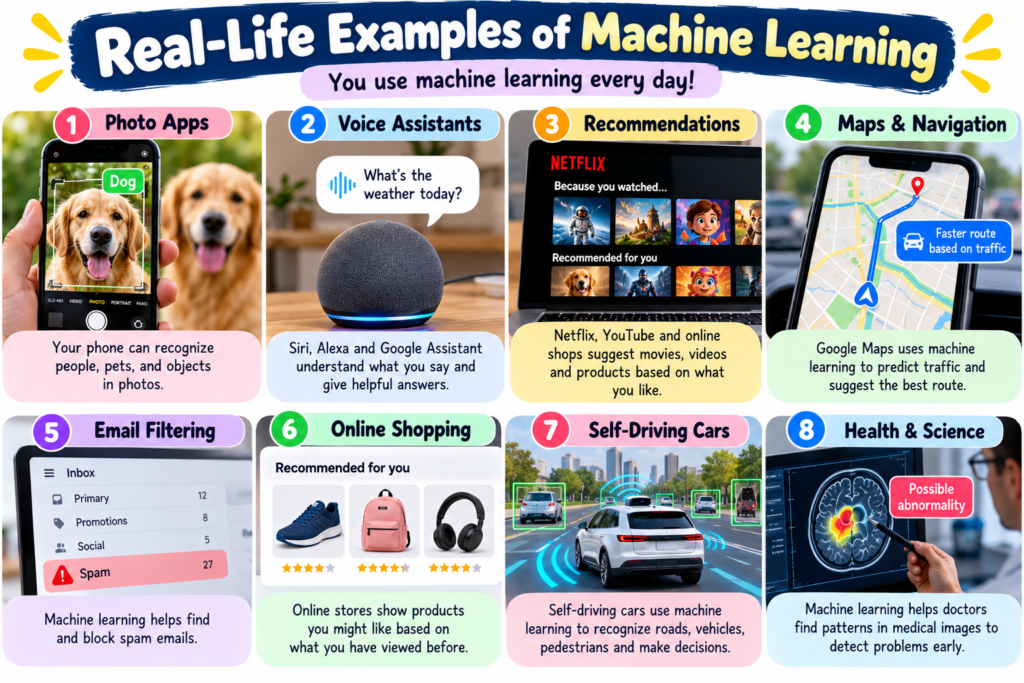
📧 Spam Filters
Your email service can analyze messages and identify patterns associated with spam.
🎬 Recommendations
Streaming services can analyze viewing behavior and recommend movies or shows you might enjoy.
🗺️ Maps and Navigation
Machine-learning techniques can help systems analyze traffic patterns, estimate travel times, and improve route recommendations.
📱 Face and Photo Recognition
Your phone can use machine-learning models to recognize faces, objects, scenes, and other features in photographs.
⌨️ Predictive Text
Your keyboard can analyze the words you’ve typed and predict what you might type next.
🛒 Shopping Recommendations
Online stores can use patterns in browsing and purchasing behavior to recommend products.
In many cases, machine learning is working quietly in the background.
You may not even realize it is there.
What Is Deep Learning?
You may have heard another term while reading about AI:
Deep learning.
Deep learning is a branch of machine learning that uses artificial neural networks with many layers.
These networks are loosely inspired by the way biological neurons are connected, although artificial neural networks are mathematical systems and are not simply copies of the human brain.
Deep-learning systems can work particularly well with complex information such as:
- images
- speech
- video
- text
- other large and complicated datasets
Many modern AI systems use deep-learning techniques.
And this brings us to an important relationship:
Artificial Intelligence
↓
Machine Learning
↓
Deep Learning
Machine learning is part of AI, while deep learning is a type of machine learning.
Our AI pillar article explains this bigger picture in more detail.
Is Machine Learning the Same as Artificial Intelligence?
Not exactly.
Artificial intelligence is the broader field.
Machine learning is one of the major approaches used to create AI systems.
Think of it like this:
AI is the big umbrella. Machine learning is one of the important technologies underneath it.
And deep learning sits further inside machine learning.
Not every AI system necessarily learns using machine learning.
Some AI systems can use rules, logic, search methods, or other techniques.
But machine learning has become extremely important in modern AI because it allows computers to learn useful patterns from large amounts of data.
What About Generative AI?
Here’s where things get especially interesting.
Some machine-learning systems don’t just classify information or make predictions.
They can generate new content.
This is called generative AI.
Generative AI can produce things such as:
- text
- images
- music
- computer code
- audio
- video
Tools such as AI chatbots and image-generation systems use sophisticated machine-learning techniques to generate outputs based on what they have learned.
But how can a machine actually generate something new?
That’s the next fascinating part of our AI journey.
So, How Does Machine Learning Work?
Let’s put everything together.
A simplified machine-learning process looks like this:
1. Collect data
The system receives examples or other information.
↓
2. Train the model
The machine-learning system searches for useful patterns in the data.
↓
3. Adjust and improve
The model’s internal parameters are adjusted during training to improve its performance.
↓
4. Test the model
The model is tested using data it wasn’t trained on to see how well it works.
↓
5. Use the trained model
New information is given to the model.
↓
6. Make a prediction or produce an output
The model uses the patterns it learned to produce a result.
That’s the basic idea behind machine learning.
Of course, real-world machine-learning systems can be enormously more complicated than this simple example.
But the core idea remains:
Machines can learn useful patterns from data and use those patterns to make predictions, classifications, or other outputs.
The Interesting Part: Machines Don't Learn Like We Do
When we say that a machine “learns,” it’s easy to imagine a computer sitting there and thinking like a person.
That’s not what is happening.
A machine-learning model doesn’t experience the world like you do.
It doesn’t have childhood memories, emotions, curiosity, or personal experiences in the human sense.
Instead, it processes data using mathematical operations and adjusts its internal parameters during training.
So when we say “the machine learned,” what we really mean is that its mathematical model changed in a way that allows it to perform a task better.
That’s a very different kind of learning.
And understanding this difference is important when we talk about modern AI.
What's Next in Our AI Series?
Machine learning is one of the building blocks behind today’s AI systems.
But there is another concept that has changed what AI can do:
How can a computer learn from images, sounds, language, and enormous amounts of information using layers of artificial neural networks?
That’s where deep learning comes in.
And after that, we’ll explore how these technologies helped create generative AI — the technology behind AI systems that can create text, images, music, code, and more.
So our journey continues:
AI → Machine Learning → Deep Learning → Generative AI
One “How?” at a time.
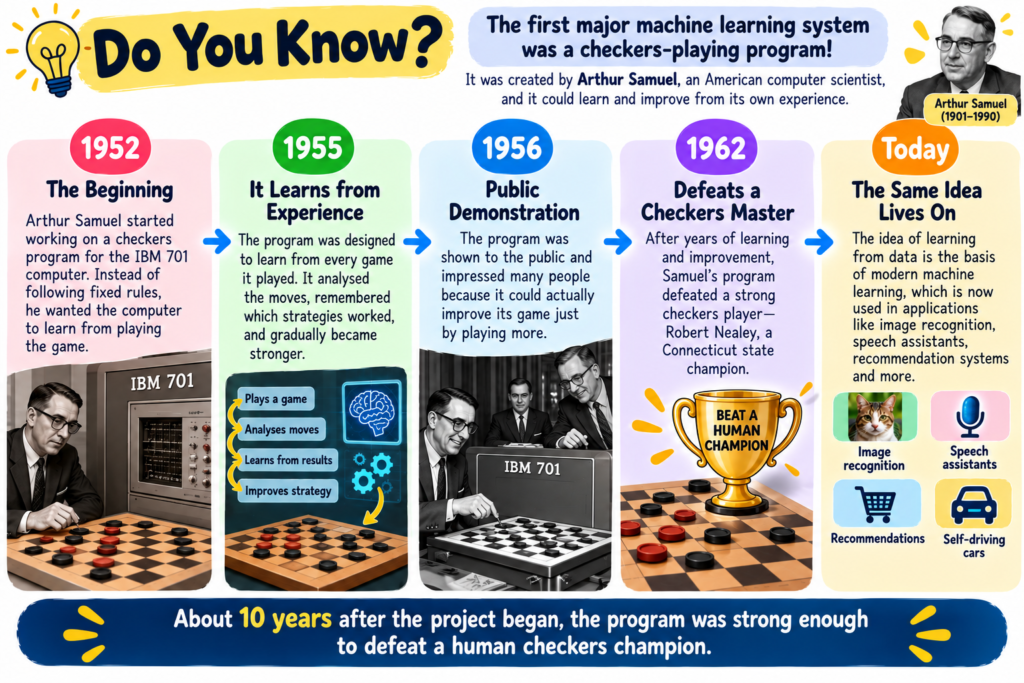
🤔 Do You Know?
One of the First Machines That Learned From Experience Played Checkers!
Machine learning may sound like a very modern idea, but computers were already being taught to learn from experience more than 70 years ago.
In the early 1950s, computer scientist Arthur Samuel at IBM was working on something unusual: he wanted a computer to play the game of checkers.
His first checkers program ran on the IBM 701 computer in 1952.
But Samuel wasn’t satisfied with simply programming the computer with a fixed set of rules. He wanted the computer to improve its playing ability through experience.
By 1955, he had developed a version that could learn. The program could study games, adjust how it evaluated moves, and improve its play. It was demonstrated publicly in 1956.
And here’s the really fascinating part:
The computer didn’t learn in a few minutes or even a few hours.
Samuel’s work continued for years. The program played games, including games against itself, and used the results to improve its decisions. By 1962, it had played thousands of games against itself and was able to defeat a checkers master.
Samuel later became famous for helping establish the term “machine learning.” His work became one of the early milestones in the field that eventually led to the machine-learning systems we use today.
From Checkers to Chatbots
Think about how far we’ve come.
1950s:
A computer learns to improve at checkers by playing games.
↓
Today:
Machine-learning systems can recognize faces, recommend videos, understand speech, analyze images, translate languages and power generative AI.
The basic idea is still surprisingly similar:
Give a machine information or experience, let it find patterns, and use what it learns to improve its performance.
The computers are vastly more powerful today, and the techniques are much more sophisticated — but the basic idea that Samuel explored is still at the heart of modern machine learning.
2 thoughts on “How Does Machine Learning Work? A Simple Guide”