
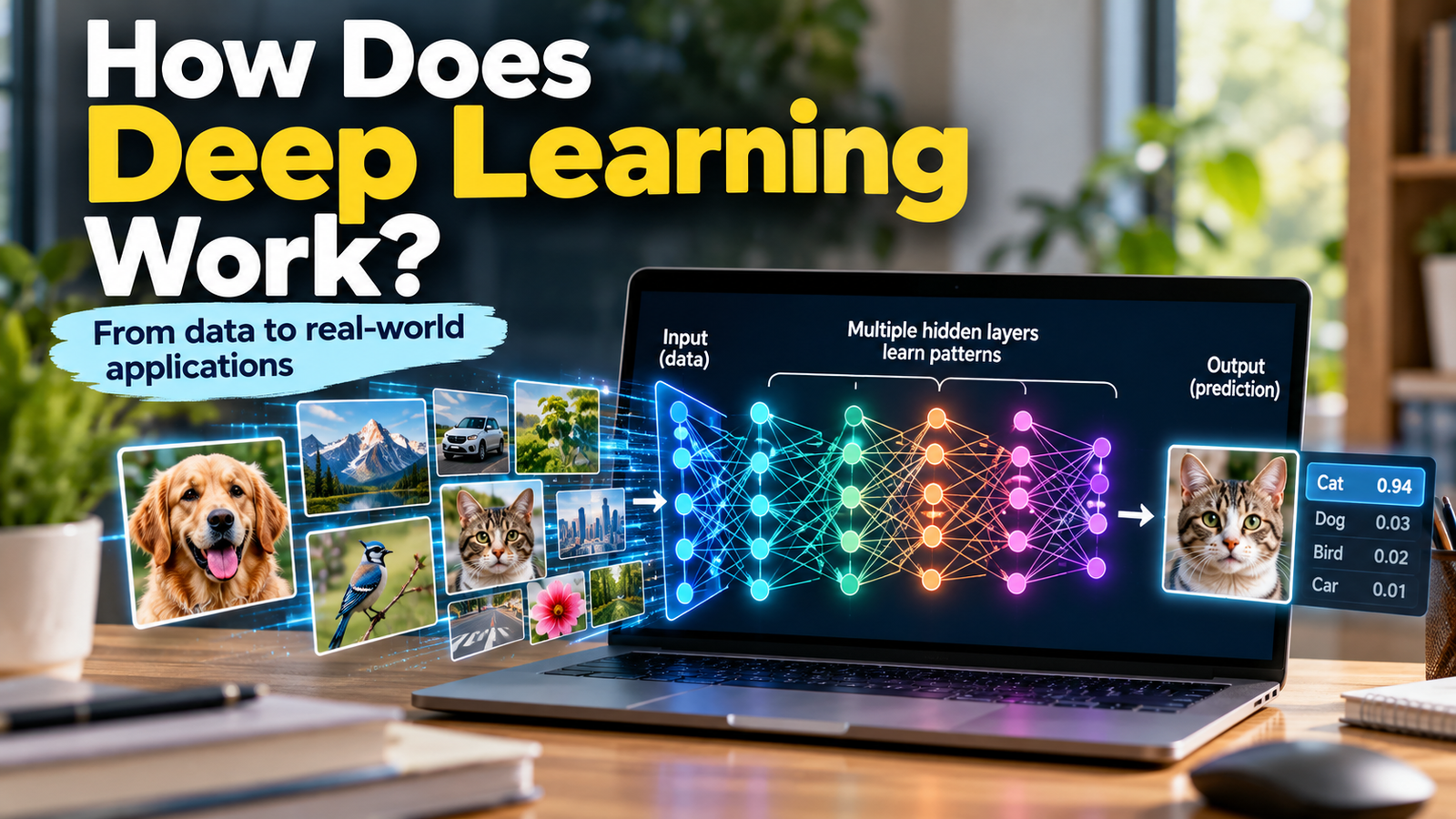
How does deep learning work? Deep learning is one of the technologies behind many AI systems we use today, from facial recognition and voice assistants to image recognition and language tools.
You may already know that artificial intelligence (AI) allows computers to perform tasks that seem intelligent. You may also have heard of machine learning, where computers learn patterns from data instead of being programmed with every rule. If you’re new to the topic, start with our guide to what is artificial intelligence.
Before we dive into deep learning, it helps to understand how machine learning works, because deep learning is actually a type of machine learning.
Deep learning.
Deep learning helps computers recognize faces, understand speech, analyze images, process language, detect objects, and perform many other complicated tasks.
But what exactly is deep learning?
And how can a computer learn something as complicated as recognizing a face or understanding spoken words?
Let’s find out.
What Is Deep Learning?
Deep learning is a type of machine learning that uses artificial neural networks with multiple layers to learn patterns from data.
The easiest way to understand this is to imagine teaching a computer to recognize a cat.
You could show it thousands of pictures of cats and other animals.
Instead of giving the computer a long list of rules such as:
“A cat has two ears, four legs, whiskers and a tail.”
a deep learning system can learn useful patterns from the examples themselves.
It gradually becomes better at recognizing the patterns that distinguish one thing from another.
Deep learning is particularly useful when the information is complicated, such as images, sounds, video and human language.
What Is a Neural Network?
Deep learning works using something called an artificial neural network.
Don’t let the name make it sound too complicated.
A neural network is simply a mathematical system made up of many connected nodes, arranged in layers.
The idea is loosely inspired by the way networks of neurons work in the human brain, but an artificial neural network is not a digital copy of a human brain.
A simple neural network has:
Input → Hidden layers → Output
For example, imagine showing a neural network a photograph.
The image enters the network as the input.
The information passes through several layers.
The network processes what it finds and eventually produces an output.
For example:
Photo → Neural network → “Cat”
The interesting part is what happens between the input and the answer.
Why Are There Layers?
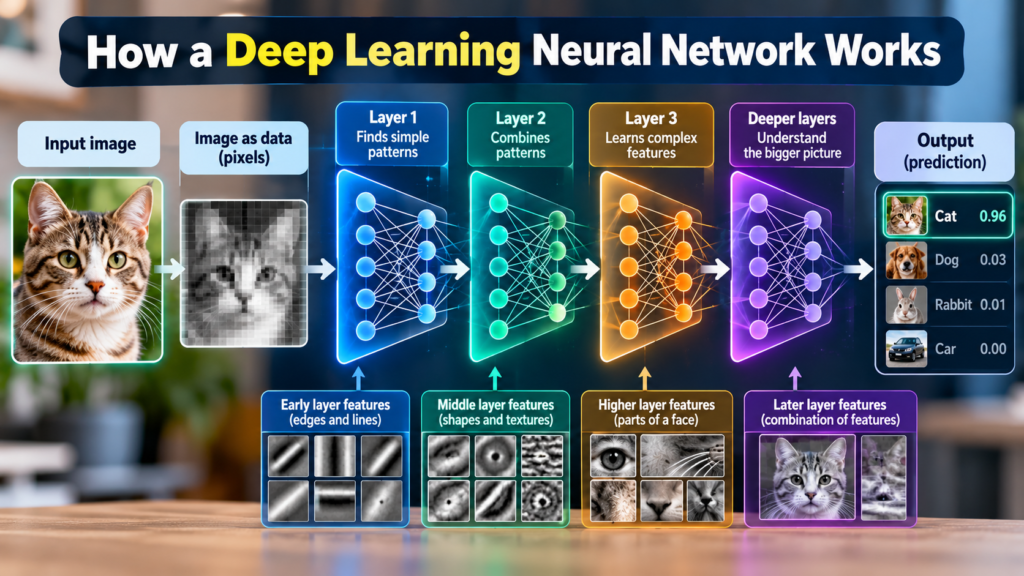
The layers allow the network to build increasingly useful representations of the information.
Imagine a system looking at a photograph.
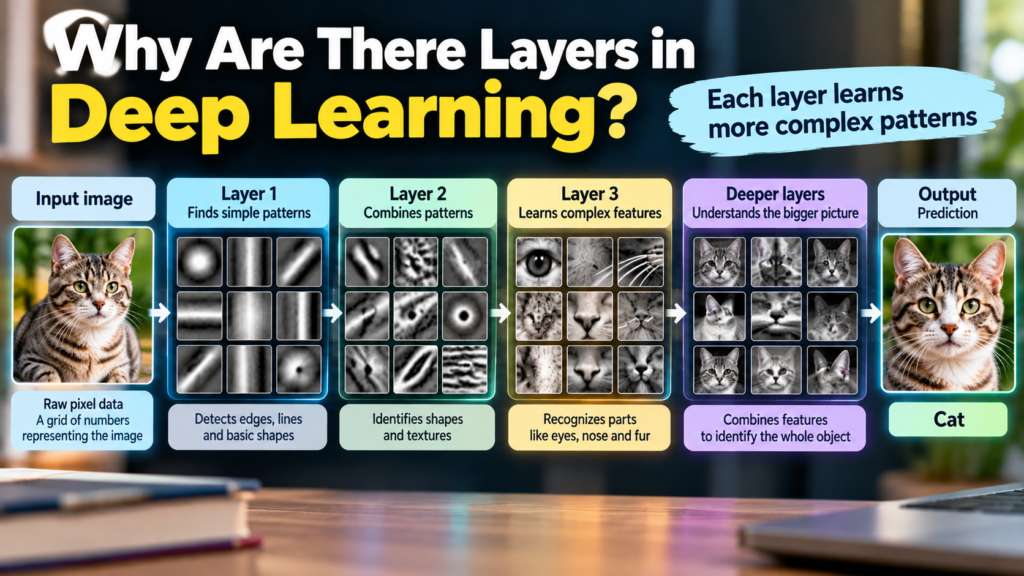
The earliest layers may respond to relatively simple patterns such as edges, lines or changes in brightness.
Later layers can combine those patterns into more complicated shapes.
Still later layers can use those combinations to recognize larger structures or objects.
So you can think of it roughly like this:
Simple patterns → Shapes → Parts → Objects → Final result
This is a simplified way of imagining what happens inside a deep neural network. Real networks are much more complicated.
The important idea is that different layers can transform the information step by step, allowing the network to recognize patterns that would be difficult to describe with simple rules.
Why Is It Called "Deep" Learning?
The word deep refers to the depth of the neural network — in other words, the presence of multiple layers between the input and output.
A neural network with several layers can be described as a deep neural network.
Modern neural networks can contain many layers, depending on the task and architecture.
So:
Machine learning + deep neural networks = Deep learning
And remember the bigger picture:
Artificial Intelligence
↓
Machine Learning
↓
Deep Learning
Deep learning is therefore a subset of machine learning, which itself is a subset of the broader field of artificial intelligence.
How Does Deep Learning Learn?
This is where things become really interesting.
Suppose we want to train a deep learning system to recognize cats.
We start with many training examples.
Some pictures are labeled:
Cat
Others might be labeled:
Dog
Rabbit
Car
and so on.
The network looks at the examples and produces predictions.
At first, its predictions may be terrible.
It might look at a picture of a cat and say:
“Dog.”
The system can compare its prediction with the correct answer and calculate how far off it was.
It then adjusts the numbers inside the network so that it can hopefully make a better prediction next time.
These adjustable numbers are called parameters, and the connections between nodes have associated weights.
During training, these values are adjusted repeatedly to reduce errors. Techniques such as backpropagation help the network determine how its internal values should be changed.
The basic process looks like this:
Training data
↓
Make a prediction
↓
Check the error
↓
Adjust the network
↓
Try again
↓
Repeat many times
Eventually, the network can become very good at the task it was trained for.
What Are Parameters?
You may hear the word parameters when people talk about modern AI models.
A parameter is essentially a number inside a machine learning model that can be adjusted during training.
Imagine thousands, millions or even billions of tiny numerical settings.
During training, the model changes these settings to become better at its task.
You don’t need to remember the mathematics behind every parameter to understand deep learning.
The simple idea is:
Parameters are adjustable values that help the model learn patterns from data.
The more complicated the model, the more parameters it may have.
How Does Deep Learning Recognize an Image?
Let’s go back to our cat example.
Suppose you give a deep learning model a photograph.
The image contains thousands or millions of tiny pieces of information called pixels.
The network processes that information through its layers.
A simplified example might look like:
Image
↓
Early patterns
Edges and lines
↓
More complex patterns
Shapes and textures
↓
Higher-level patterns
Parts of an animal
↓
Final analysis
Cat / Dog / Other
The network isn’t following a human-written rule saying:
“If you see whiskers, then it’s a cat.”
Instead, during training, it learns useful patterns from many examples.
This ability to learn representations from data is one of the important differences between deep learning and many traditional machine learning approaches.
How Is Deep Learning Different From Traditional Machine Learning?
This is one of the most important questions to understand.
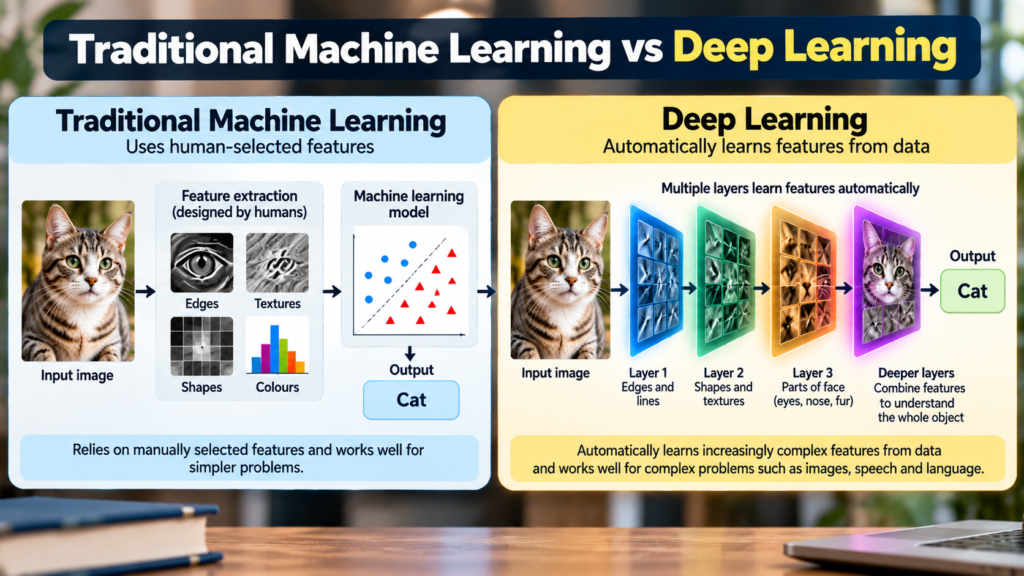
Deep learning is a type of machine learning, but it uses multi-layer neural networks to learn complex representations from data.
Traditional machine learning can use many different techniques, including decision trees, regression methods and other algorithms.
In many traditional machine learning projects, humans need to decide which characteristics, or features, are useful for the model.
Imagine building a system to identify different types of fruit.
A traditional machine learning approach might use features such as:
- Color
- Size
- Weight
- Shape
- Texture
A human may need to decide which measurements are useful and prepare the data accordingly.
Deep learning can reduce much of this manual feature engineering because the neural network can learn useful representations from the raw data itself.
For example, when analyzing images, different layers can gradually learn patterns that become increasingly useful for the final task.
A simple way to remember the difference is:
Traditional machine learning
Human chooses useful features → Machine learning model → Prediction
Deep learning
Raw data → Neural network learns useful representations → Prediction
This doesn’t mean traditional machine learning is outdated or that deep learning is always better.
Different problems require different approaches.
Deep learning is especially powerful when dealing with large amounts of complicated data such as images, speech and language.
How Does Deep Learning Help With Facial Recognition?
Facial recognition is a great real-world example of deep learning.
Think about how difficult it would be to write a complete set of rules for recognizing a person’s face.
You would have to account for:
- Different lighting
- Different camera angles
- Glasses
- Facial expressions
- Hairstyles
- Distance from the camera
- Partial obstruction of the face
- Changes over time
A simple rule-based system would struggle with all these variations.
Deep learning approaches the problem differently.
A model can be trained using many examples of faces.
During training, its neural network learns patterns that help distinguish different faces.
A simplified process might look like:
Face image
↓
Neural network
↓
Learns visual patterns
↓
Builds a representation of the face
↓
Compares it with known information
↓
Produces a result
The network may learn increasingly complex visual representations as information passes through its layers.
This is one reason neural networks are widely used for facial recognition and other image-analysis tasks.
However, real facial recognition systems are much more complicated than this simplified diagram suggests.
And an important point is that deep learning does not automatically make a system perfectly accurate. The quality and variety of the training data, the model design and the conditions in which the system is used can all affect its performance.
How Does Deep Learning Recognize Speech?
Deep learning isn’t limited to pictures.
It can also work with sound.
When you speak to a voice assistant, your voice is converted into information that a computer can process.
A deep learning system can learn patterns in speech, including sounds and relationships between sounds.
A simplified process might look like:
Your voice
↓
Audio information
↓
Deep learning model
↓
Recognized speech
↓
Words
For example, when you say:
“What’s the weather today?”
the system needs to turn the sound waves from your voice into meaningful words.
Modern AI systems can then use additional models to understand what those words mean and decide what response or action is appropriate.
.
How Does Deep Learning Work With Language?
Human language is extremely complicated.
The meaning of a sentence can depend on the words around it and the context of the conversation.
Deep learning has become extremely important in natural language processing, the area of AI concerned with working with human language.
Deep learning models can learn patterns from huge collections of text.
These patterns can help systems perform tasks such as:
- Translating languages
- Summarizing text
- Answering questions
- Recognizing speech
- Predicting words
- Generating text
This is also where technologies such as large language models become important.
We will explore those in more detail later in this AI series.
Why Did Deep Learning Become So Powerful?
Deep learning isn’t a completely new idea.
Researchers have been studying neural networks for decades.
So why did deep learning become so important in recent years?
Three major factors helped:
1. Huge amounts of data
Modern computers and smartphones generate enormous amounts of information.
Images, videos, text, audio and other digital data provide training material for machine learning systems.
2. More computing power
Training large neural networks requires a lot of computation.
Modern hardware, including powerful GPUs and specialized AI processors, makes it possible to perform huge numbers of calculations much more efficiently.
3. Better algorithms and techniques
Researchers have developed better ways to design and train neural networks.
Together, improvements in data, computing power and algorithms helped make modern deep learning systems much more capable.
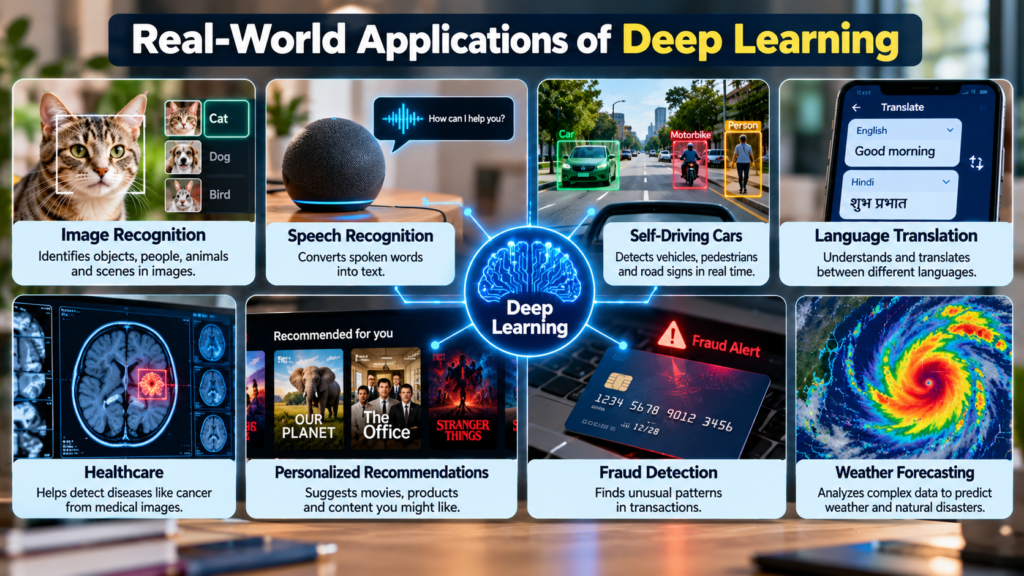
Where Do We Use Deep Learning?
You probably interact with deep learning systems more often than you realize.
They are used in areas such as:
📱 Face recognition
Your phone may use machine learning and neural networks to recognize your face.
🎤 Voice assistants
Deep learning can help computers recognize spoken language.
📷 Photo applications
AI can identify objects, people, scenes and other visual information in photographs.
🗺️ Maps and navigation
Machine learning systems can analyze large amounts of information to help estimate traffic and travel conditions.
🎬 Recommendations
Streaming and social media platforms can use machine learning to predict what content might interest you.
🚗 Driver-assistance systems
Deep learning can help systems detect objects such as vehicles, pedestrians and road features.
🏥 Medical image analysis
Deep learning can also be used to analyze medical images and identify patterns that may be useful to healthcare professionals.
These are just some examples. Deep learning is now used across many areas of technology.
Does Deep Learning Always Get It Right?
No.
This is important to remember.
A deep learning model learns from the data it receives.
If its training data is incomplete, unbalanced, noisy or poorly labeled, the model may learn patterns that are not useful or may make incorrect predictions.
Even a highly advanced model can make mistakes when it encounters information that is very different from what it learned during training.
So deep learning isn’t magic.
It is a powerful mathematical system that learns patterns from data.
Is Deep Learning the Same as AI?
No.
These three terms are related, but they don’t mean exactly the same thing.
Think of them as nested ideas:
Artificial Intelligence
The broadest concept.
AI is the larger field of creating systems that can perform tasks associated with intelligence, such as recognizing information, reasoning, learning or making decisions.
Machine Learning
A part of AI.
Machine learning allows systems to learn patterns from data rather than requiring every rule to be explicitly programmed.
Deep Learning
A type of machine learning.
Deep learning uses multi-layer neural networks to learn complex patterns from data.
So:
AI
→ includes Machine Learning
→ which includes Deep Learning
What About Generative AI?
You may now be wondering:
If deep learning can understand images, speech and language, is it also behind ChatGPT and image generators?
Yes.
Modern generative AI systems are built using advanced machine learning and deep learning techniques.
Generative AI can produce new content such as:
- Text
- Images
- Audio
- Video
- Computer code
Large language models are an important example of deep-learning-based systems that work with language.
So the ideas we’ve discussed here form part of the foundation for the generative AI tools that are becoming common today.
We’ll explore exactly how generative AI creates content in the next part of this series.
A Simple Way to Remember AI, ML and Deep Learning
If all these terms are beginning to sound confusing, remember this:
Artificial Intelligence
The big idea:
Make computers perform tasks that seem intelligent.
↓
Machine Learning
One way to achieve AI:
Let computers learn patterns from data.
↓
Deep Learning
A powerful type of machine learning:
Use multi-layer neural networks to learn complex patterns.
↓
Generative AI
AI systems that can create new content, such as text, images, audio or code.
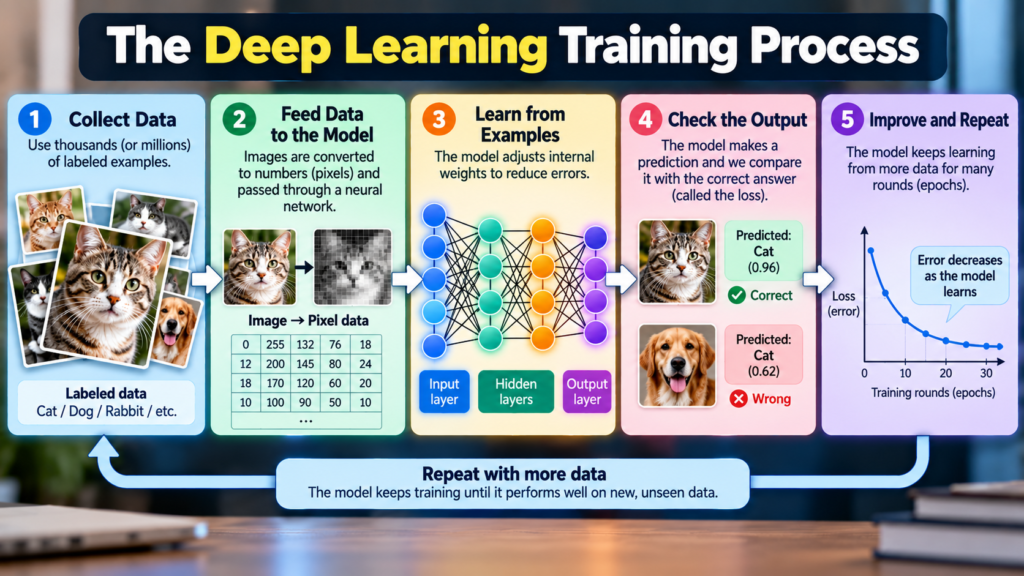
So, How Does Deep Learning Work?
At its simplest, deep learning works like this:
Collect training data
The system receives many examples.
↓
Feed the data into a neural network
The information passes through multiple layers.
↓
Find patterns
The network learns useful representations from the examples.
↓
Make a prediction
The network produces an answer or classification.
↓
Measure the error
The system checks how far its prediction was from the desired result.
↓
Adjust its parameters
The network changes internal values to improve.
↓
Repeat
After many training cycles, the model can become much better at its task.
Once trained, the model can receive new information it hasn’t seen before and use the patterns it learned to produce a prediction or other output.
That’s the basic idea behind deep learning.
The Bigger Picture
Artificial intelligence can sometimes seem mysterious because we see only the final result.
Your phone recognizes your face.
A voice assistant understands what you say.
A photo app identifies objects.
An AI system can generate text or images.
But underneath these impressive abilities are mathematical models trained on data.
Deep learning is one of the important technologies that makes many of these capabilities possible.
And now that you understand AI → Machine Learning → Deep Learning, we’re ready to take the next step.
Next in the AI Series
How Does Generative AI Create Text and Images?
We’ll look at how AI systems can go beyond recognizing patterns and actually create something new.
1 thought on “How Does Deep Learning Work? A Simple Guide”