

How is SpaceX Starship different from other rockets? To answer that question, we need to look at what makes Starship unusual. Unlike many traditional rockets, Starship is being designed as a large, reusable space transportation system that can eventually carry cargo and people beyond Earth.
Rockets have been carrying satellites, spacecraft and astronauts into space for decades. But most rockets have followed a fairly simple idea: launch, deliver the payload, and discard most of the rocket.
SpaceX’s Starship is being designed around a very different idea.
It is enormous, uses methane-powered engines, has two reusable stages and is being developed to eventually return to Earth and fly again. SpaceX also wants it to be capable of carrying huge amounts of cargo and, eventually, people to destinations such as the Moon and Mars.
And Starship has just reached an important milestone.
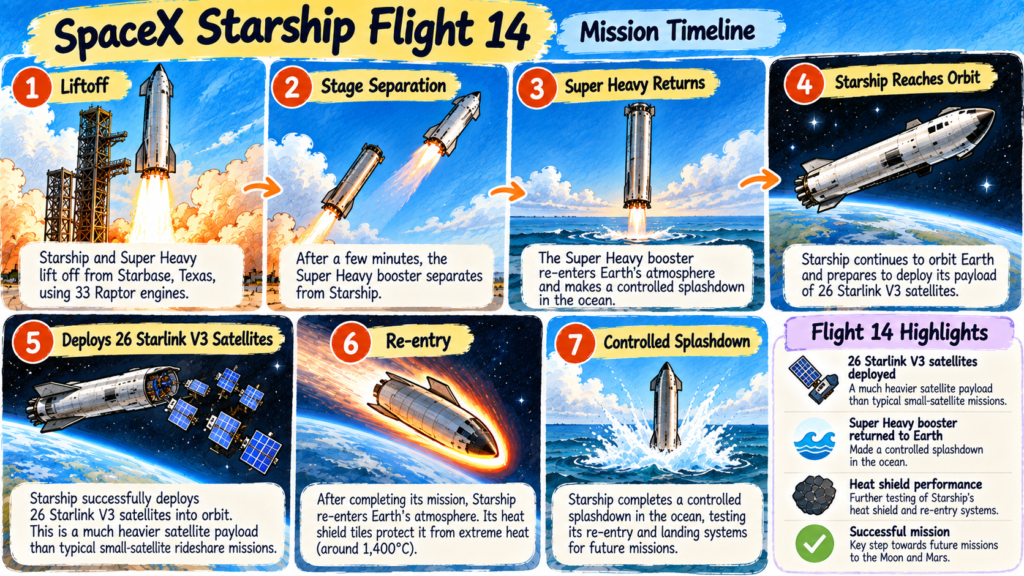
On September 28, 2026, Starship reached Earth’s orbit for the first time and deployed 26 next-generation Starlink V3 satellites. The mission did not go exactly as planned: one of Starship’s engines shut down early, so the planned 10-hour mission was shortened to about three hours. Nevertheless, the spacecraft reached orbit and successfully deployed its payload.
So what makes Starship different from other rockets?
Let’s find out.
🚀 First, What Exactly Is Starship?
There is a small but important detail to understand.
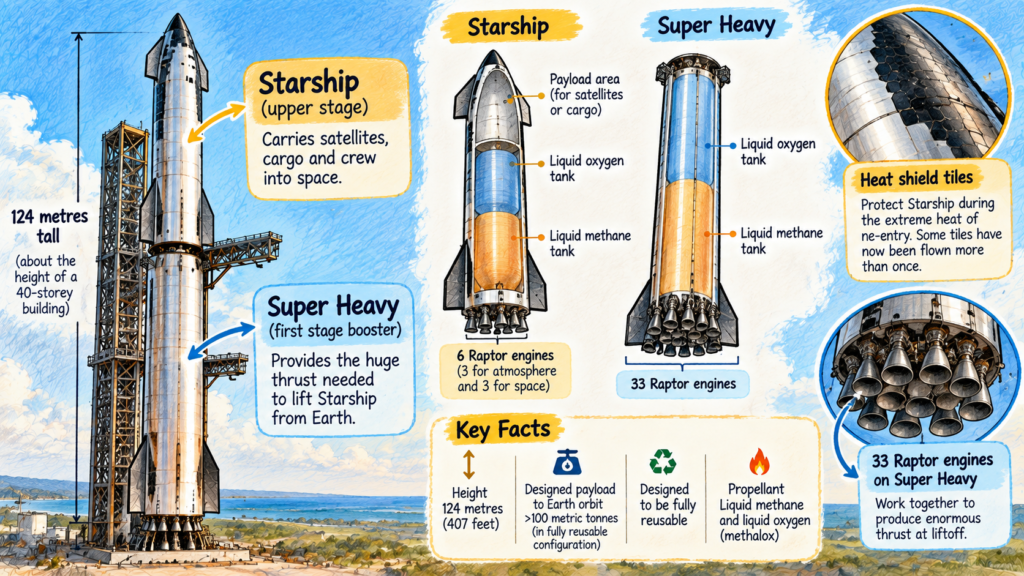
Starship is a two-stage launch system.
It consists of:
1. Super Heavy
The enormous first-stage booster provides most of the thrust needed to lift the vehicle away from Earth.
2. Starship
The spacecraft on top of Super Heavy continues the journey into space. It is also the vehicle designed to carry cargo or people.
When people casually say “Starship,” they sometimes mean the entire launch vehicle. Technically, however, Starship is the name of the upper stage, while the complete system is Starship-Super Heavy.
Together, the complete vehicle stands roughly 124 metres tall—about the height of a 40-storey building.
🤔 Did You Know?
Super Heavy alone is taller than many buildings.
The booster is roughly 72 metres tall, while the Starship spacecraft on top adds another roughly 52 metres.
What Was Special About Flight 14?
There is an important detail to understand before we begin.
The complete launch vehicle is made up of two stages:
Super Heavy
Super Heavy is the enormous first-stage booster at the bottom. Its job is to provide the huge amount of thrust needed to lift the vehicle away from Earth.
Starship
Starship is the spacecraft on top. After separating from Super Heavy, it continues the journey into space.
Together, they form the Starship launch system.
The complete vehicle is about 124 metres tall, making it roughly as tall as a 40-storey building.
So when people say “Starship,” they sometimes mean the spacecraft itself and sometimes use the name to describe the complete system.
What Was Special About Flight 14?
You may have noticed that the recent launch was called Starship Flight 14.
Why 14?
This was the 14th integrated flight test of the Starship-Super Heavy system.
The first 13 integrated flights were intentionally flown on passively safe suborbital trajectories. This allowed SpaceX to test the vehicle and collect data without attempting an orbital mission.
Flight 14 was different.
It was the first Starship flight designed to go into orbit around Earth.
And it succeeded in reaching orbit.
Starship then deployed 26 Starlink V3 satellites before beginning its return to Earth.
Did You Know?
Going to space and going into orbit are not the same thing.
A spacecraft can travel very high above Earth and still fall back down.
To enter orbit, it needs to travel sideways at enormous speed. It then continually falls toward Earth while the curved Earth moves away beneath it.
Why doesn’t the Moon fall to Earth? explains the same basic idea using the Moon’s orbit.
That’s why reaching orbit is such an important milestone.
1. Starship Is Designed to Be Fully Reusable
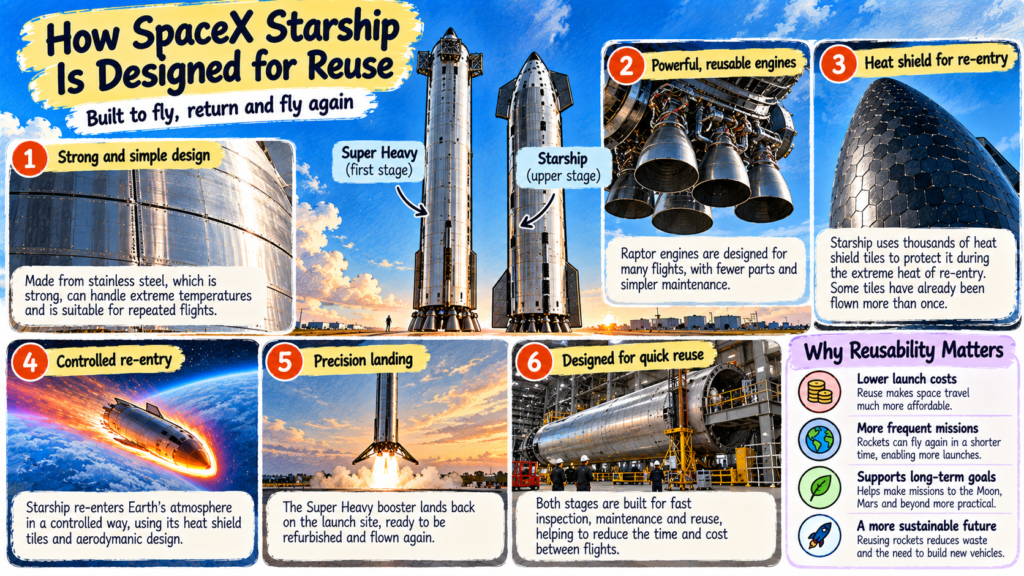
One of the biggest differences between Starship and many traditional rockets is reusability.
A conventional expendable rocket may be used for one mission and then discarded.
SpaceX’s Falcon 9 already demonstrated that a rocket’s first stage can be recovered and flown again.
Starship is designed to take this idea much further.
Both major parts of the system are intended to be reusable:
Super Heavy → return → recover → fly again
Starship → return → recover → fly again
SpaceX’s long-term goal is full and rapid reusability, meaning the vehicles should eventually be capable of flying again with much less refurbishment between missions.
But there is an important distinction.
Starship is designed to be fully reusable. That does not mean the complete system has already demonstrated routine, rapid reuse.
That is one of the major engineering challenges SpaceX is still working on.
2. Starship Is Designed to Return From Space
Getting into space is only half the problem.
Coming back is difficult too.
A spacecraft returning from orbit is travelling extremely fast. As it enters Earth’s atmosphere, it encounters enormous aerodynamic forces and intense heating.
Starship is designed to control its descent using its aerodynamic surfaces and a large heat shield.
Instead of simply dropping vertically, the spacecraft is designed to enter the atmosphere in a more horizontal belly-first orientation.
Near the end of the descent, it can then use its engines to perform a dramatic flip into a vertical position before its final landing manoeuvre.
That means the spacecraft has to perform several complicated tasks:
Re-enter → control its position → flip → ignite engines → land
The heat shield is particularly important because it has to protect the spacecraft from the extreme temperatures of re-entry.
3. Starship's Heat Shield Is Designed for Reuse
This is one of my favourite Starship details because it shows just how difficult reusability really is.
Starship uses thousands of heat-shield tiles to protect the spacecraft during atmospheric re-entry.
On Flight 14, SpaceX tested several heat-shield improvements, including additional tile-retention mechanisms and modified tile designs intended to reduce heating around gaps.
But here’s the really interesting part:
Two heat-shield tiles recovered from an earlier Starship flight were planned to fly again on Flight 14.
That was the first planned reuse of Starship heat-shield tiles.
Why does that matter?
Because if a spacecraft is going to fly repeatedly, engineers need more than reusable engines.
They need to make sure the parts that experience the harshest conditions can survive repeated flights too.
🔥 Think About It
Imagine putting a ceramic tile through an extremely hot journey through Earth’s atmosphere and then asking:
“Can we use this tile again?”
That’s the kind of question Starship engineers are trying to answer.
4. Super Heavy Uses 33 Raptor Engines
Another unusual feature is the enormous number of engines.
The Super Heavy booster is designed around 33 Raptor engines.
Instead of relying on one enormous engine, SpaceX uses a large cluster of engines working together.
These engines burn:
Liquid methane + liquid oxygen
The Starship spacecraft itself uses six Raptor engines, including versions designed for operation in the atmosphere and versions optimized for the vacuum of space.
Using many engines creates another engineering challenge.
They all have to work together while the rocket is experiencing enormous vibration, acceleration and aerodynamic forces.
5. Why Does Starship Use Methane?
Starship uses liquid methane and liquid oxygen as its propellants.
That’s different from SpaceX’s Falcon 9, which uses RP-1—a highly refined kerosene—along with liquid oxygen.
Methane is interesting for another reason.
SpaceX’s long-term plans include missions to Mars, and methane could potentially be manufactured from resources available on Mars.
That doesn’t mean Starship can currently make fuel on Mars.
Producing methane and oxygen on another planet would require substantial equipment, energy and infrastructure.
But the possibility is one reason methane is attractive for a spacecraft intended for future deep-space missions.
6. Super Heavy Is Designed to Be Caught
Here’s one of the strangest parts of the Starship system.
Most reusable rocket boosters land on legs.
Super Heavy is designed differently.
SpaceX’s launch tower is equipped with large mechanical arms designed to catch the returning booster.
These arms are sometimes nicknamed the “Chopsticks.”
Why catch a rocket instead of putting landing legs on it?
One reason is that landing legs add weight and complexity.
A tower-catching system could also allow the booster to return directly to the launch infrastructure.
SpaceX has already demonstrated catching Super Heavy during earlier testing. But the larger goal is to combine recovery with rapid reuse of the vehicle.
Flight 14 itself did not end with a tower catch; the booster splashed down offshore.
7. Starship Is Much Bigger Than Many Rockets
Size is another obvious difference.
The complete Starship-Super Heavy system is approximately 124 metres tall.
But the important thing isn’t simply how tall it is.
Starship is being designed to carry very large amounts of cargo into orbit.
SpaceX describes the system as capable of carrying more than 100 metric tonnes to Earth orbit in a fully reusable configuration.
A vehicle with that kind of capacity could potentially carry:
- Large satellites
- Many smaller satellites
- Space-station equipment
- Cargo
- Scientific instruments
- Future lunar infrastructure
And Flight 14 provided an early demonstration of that potential by carrying 26 Starlink V3 satellites.
8. Starship Can Carry Satellites Into Orbit
Flight 14 wasn’t simply a test of whether Starship could reach orbit.
It also carried a real payload.
The spacecraft deployed 26 Starlink V3 satellites into orbit.
According to SpaceX, each V3 satellite is designed to add about 1 terabit per second of capacity to the Starlink network, meaning the 26 satellites together represent about 26 Tbps of additional theoretical capacity.
This illustrates why a very large rocket can be useful.
Instead of launching a small number of satellites at a time, a much larger launch vehicle can potentially carry a much larger payload.
🛰️ Did You Know?
Flight 14 was the first Starship mission to deploy Starlink V3 satellites into orbit.
9. Starship Could Be Refuelled in Space
Here’s where Starship starts to look less like a conventional rocket and more like a transportation system.
Imagine driving a car on a very long journey.
You don’t necessarily carry all the fuel you’ll ever need from your starting point. You can stop and refuel along the way.
Future Starship missions could use a similar idea.
A Starship tanker could carry propellant into Earth orbit and transfer it to another Starship.
The refuelled spacecraft could then begin a much longer journey.
NASA’s current plans for the SpaceX Starship Human Landing System also include an orbital propellant-storage and refuelling architecture before the lunar mission.
This is particularly important for missions to the Moon and beyond.
10. Starship Is Being Developed for the Moon
Starship isn’t intended only to launch satellites.
NASA is working with SpaceX to develop a version called the Starship Human Landing System (HLS).
This vehicle is intended to carry astronauts from lunar orbit to the Moon’s surface and back as part of NASA’s Artemis missions.
NASA currently lists SpaceX’s Starship HLS for Artemis III and Artemis IV.
The planned architecture is quite different from simply launching a spacecraft directly from Earth to the Moon.
The Starship HLS would be launched without astronauts, reach lunar orbit and be supplied with propellant before the crew arrives.
Astronauts would then transfer from NASA’s Orion spacecraft to Starship HLS in lunar orbit and descend to the Moon.
So Starship isn’t just being designed to carry things into space.
It is being developed as part of a system for moving people and cargo through space.
11. And Eventually, Mars
SpaceX’s ambitions go even further.
The company describes Starship as a system intended for transportation to Earth orbit, the Moon, Mars and beyond.
But getting people to Mars would require solving many difficult problems.
A Mars transportation system would need to deal with:
- Long travel times
- Radiation
- Food and water
- Life support
- Landing large vehicles on Mars
- Producing or transporting fuel
- Taking off from Mars
- Protecting astronauts during the journey
So building Starship is only one part of the much bigger challenge of sending humans to Mars.
How Is SpaceX Starship Different From Other Rockets?
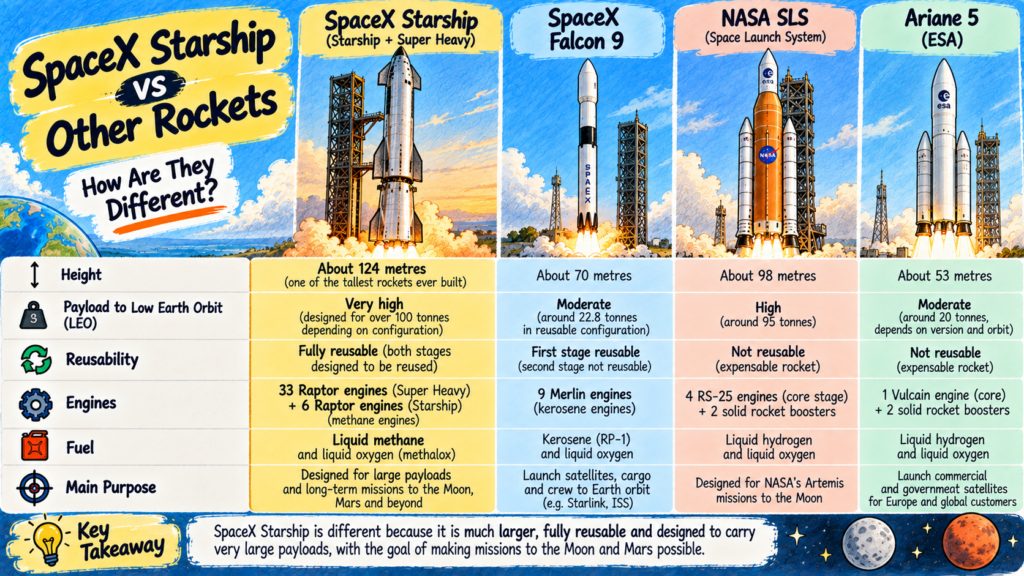
Here’s a simple comparison:
| Feature | Traditional expendable rocket | Falcon 9 | Starship |
|---|---|---|---|
| Reusability | Usually limited or none | First stage reusable | Designed for both stages to be reusable |
| Main fuel | Varies | RP-1 + liquid oxygen | Methane + liquid oxygen |
| Main stages | Usually multiple | Booster + second stage | Super Heavy + Starship |
| Booster recovery | Usually none | Vertical landing | Designed for tower catch |
| Spacecraft recovery | Varies | Second stage is expendable | Starship designed to return |
| Approx. height | Varies | ~70 m | ~124 m |
| Orbital refuelling | Not generally part of the architecture | Not central to its design | Important to planned deep-space missions |
| Moon/Mars role | Depends on vehicle | Primarily launch vehicle | Designed as part of future Moon/Mars transportation architecture |
The important word in the Starship column is “designed.”
Some of these capabilities are still being developed and demonstrated.
That distinction matters.
What Did Flight 14 Actually Prove?
Flight 14 was important, but it is also important not to exaggerate what it demonstrated.
The flight showed that Starship could:
- Launch from Earth
- Separate from Super Heavy
- Perform its orbital insertion burn
- Reach Earth orbit
- Deploy 26 Starlink V3 satellites
- Perform a deorbit burn
- Begin atmospheric re-entry
However, the mission was shortened after one of Starship’s engines shut down unexpectedly. The vehicle still completed its orbital insertion and satellite deployment before returning to Earth.
So Flight 14 was a major test milestone—but it did not demonstrate the complete vision of a rapidly reusable Starship system.
There is still much more to prove.
And that’s exactly why test flights are important.
Engineers use them to discover problems, collect data and improve the vehicle.