
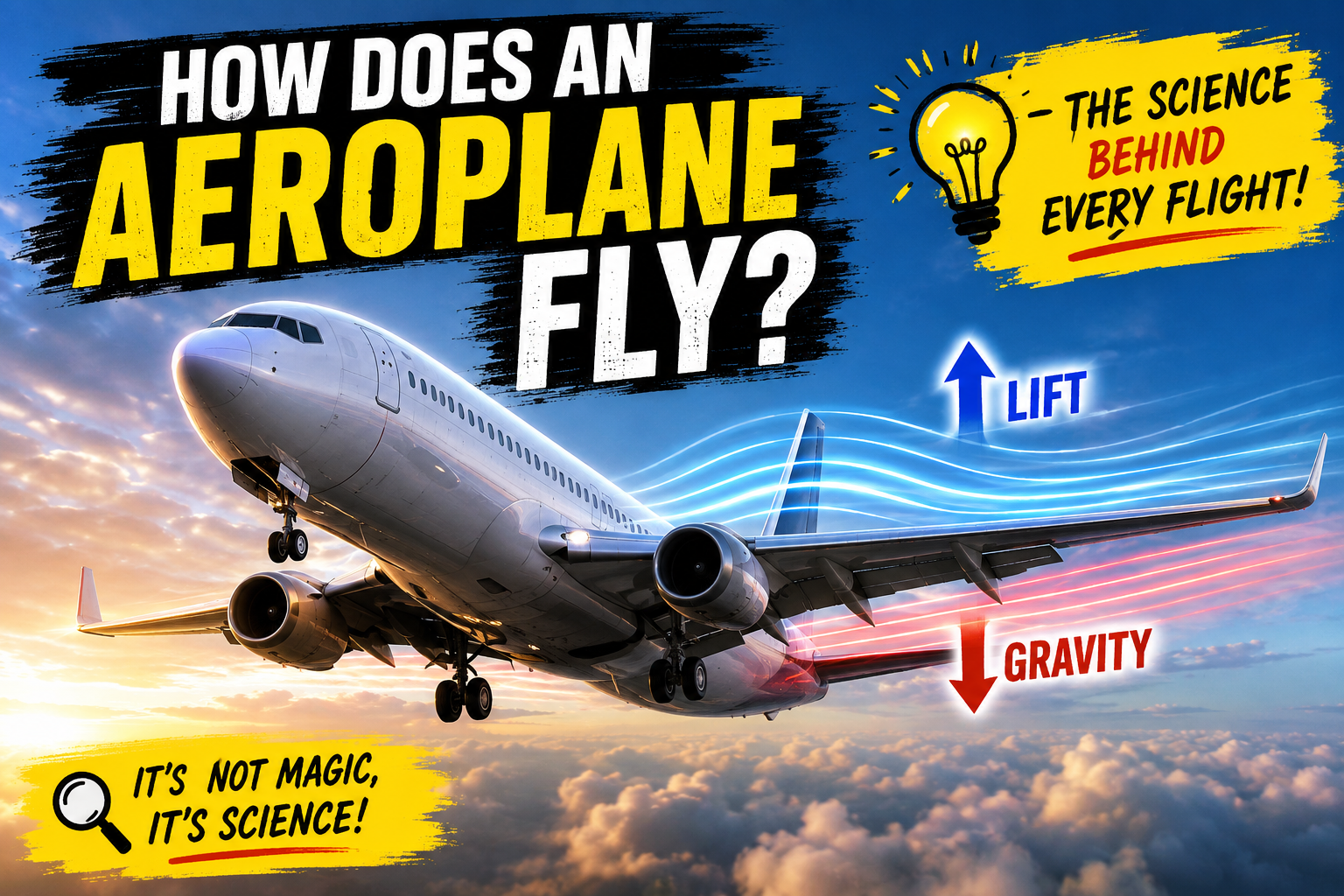
Have you ever looked up at the sky and wondered how an enormous aeroplane can fly?
An aeroplane can weigh thousands of kilograms, carry hundreds of people, luggage and fuel, and yet somehow rise into the sky and travel through the air.
It almost seems impossible!
So, how does an aeroplane fly?
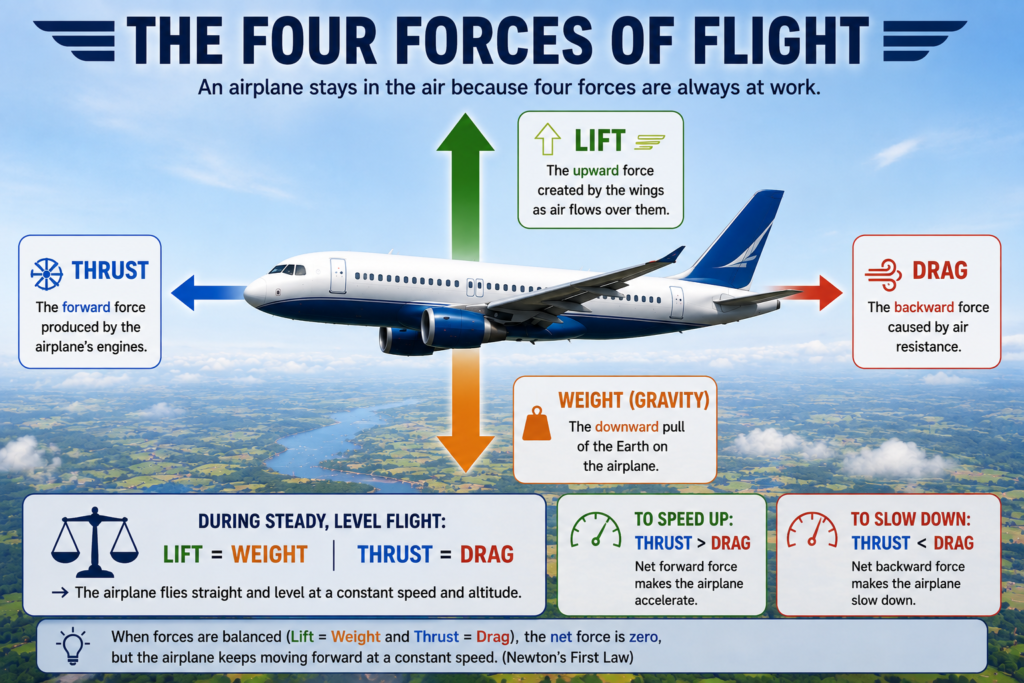
The answer lies in four important forces: lift, gravity, thrust and drag. Together, these forces allow an aeroplane to take off, stay in the air and eventually land safely.
Let’s understand how it works.
The Four Forces That Make Flight Possible
When an aeroplane is flying, four main forces are acting on it.
1. Lift — The Force That Helps the Aeroplane Rise
Lift is the upward force that helps an aeroplane stay in the air.
The wings of an aeroplane are specially designed to interact with the air flowing around them.
As the aeroplane moves forward, air travels around its wings. The shape and angle of the wings cause the air to be pushed downward. In response, the air pushes the wings upward.
This upward force is called lift.
When lift becomes strong enough to overcome the aeroplane’s weight, the aeroplane can rise into the sky.
2. Gravity — The Force Pulling It Down
Gravity is constantly pulling the aeroplane toward Earth.
It doesn’t matter whether the aeroplane is flying at 10,000 metres or sitting on the runway—gravity is always there.
So how does the aeroplane stay up?
It needs enough lift to balance its weight.
Think of it like a tug-of-war:
Lift pulls upward ↑
Gravity pulls downward ↓
When these forces are balanced during steady flight, the aeroplane can continue flying at a constant altitude.
3. Thrust — The Force That Moves It Forward
An aeroplane also needs to move forward through the air.
This is where thrust comes in.
Jet engines produce thrust by taking in air, compressing it, mixing it with fuel and burning the mixture. The hot gases then rush out of the back of the engine at very high speed.
The gases moving backward create a force that pushes the aeroplane forward.
This is based on a simple idea from physics:
For every action, there is an equal and opposite reaction (Newton’s laws of motion)
Thrust helps the aeroplane gain the speed it needs for its wings to produce enough lift.
4. Drag — The Force That Resists Motion
Whenever something moves through air, the air pushes back against it.
This resistance is called drag.
You can feel drag yourself if you put your hand outside a moving car window. The faster the car moves, the harder the air pushes against your hand.
An aeroplane experiences the same thing.
Its engines must produce enough thrust to overcome drag and keep the aircraft moving forward.
So, What Actually Makes an Aeroplane Fly?
Now we can put the four forces together.
Thrust → moves the aeroplane forward
Drag → resists its movement
Lift → pushes it upward
Gravity → pulls it downward
During normal level flight, lift balances the aeroplane’s weight, while thrust balances drag.
That’s the basic science of flight.
But there is still an important question:
How do the wings create lift?
How Do Aeroplane Wings Create Lift?
An aeroplane’s wings are not simply flat pieces of metal.
They have a carefully designed shape called an airfoil.
As the aeroplane moves forward, air flows around the wing. The wing is also tilted at a particular angle to the incoming air.
The wing changes the direction of the airflow and pushes air downward.
According to Newton’s laws of motion, pushing air downward results in an upward force on the wing.
At the same time, the pressure of the air around the wing also contributes to lift.
So, lift is not caused by just one simple trick. It is the result of the wing’s shape, its angle, its speed through the air and the way it changes the airflow.
And here’s something important:
A wing does not need to flap to create lift.
Unlike birds, aeroplanes use their engines to move forward while their wings use the moving air to generate lift.

How Does an Aeroplane Take Off?
Takeoff is one of the most exciting parts of a flight.
When an aeroplane is sitting on the runway, it isn’t producing enough lift to fly.
The engines begin producing more thrust, and the aeroplane starts moving faster and faster along the runway.
As its speed increases, more air flows over the wings.
More airflow means the wings can produce more lift.
Eventually, the pilot raises the aircraft’s nose using the controls.
The wings reach the required flying conditions, and the lift becomes strong enough to overcome the aircraft’s weight.
The wheels leave the runway.
The aeroplane is airborne!
Why Does the Aeroplane Keep Its Nose Slightly Up?
After takeoff, you may notice that an aeroplane’s nose points upward.
This helps the wings maintain the appropriate angle relative to the airflow and allows the aircraft to climb.
Once the aeroplane reaches its cruising altitude, the pilot adjusts the aircraft’s controls so it can fly efficiently and maintain a relatively steady altitude.
How Does an Aeroplane Turn?
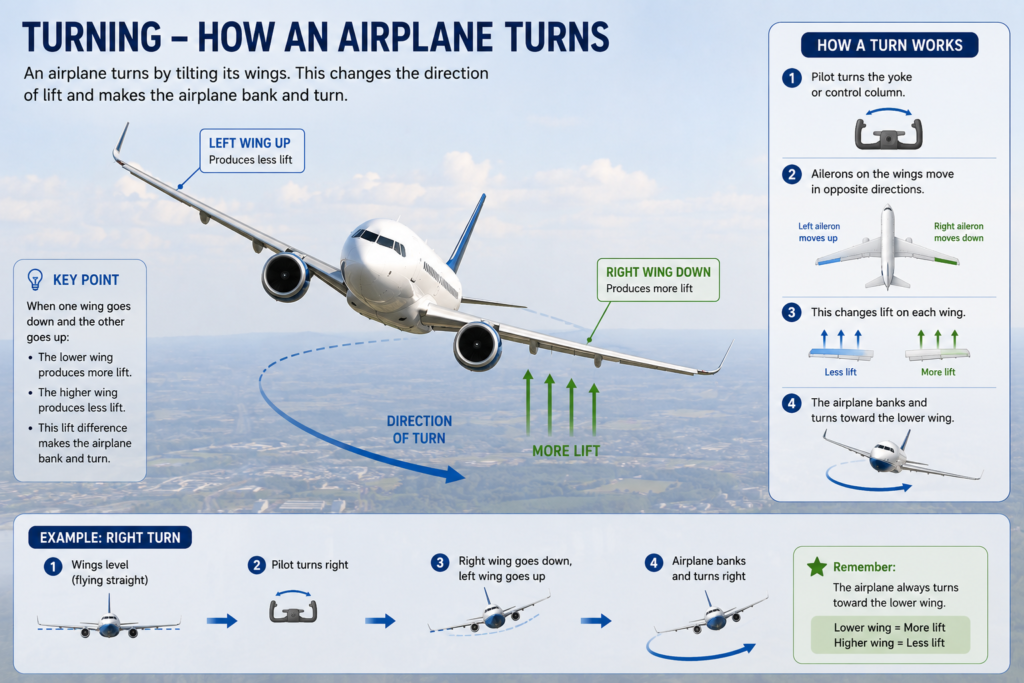
Aeroplanes don’t turn exactly like cars.
When an aeroplane needs to turn, it can roll its wings to one side.
Special movable surfaces on the wings called ailerons help control this rolling motion.
For example, when the aeroplane rolls to the right, the aircraft begins turning to the right.
The tail also contains important control surfaces that help control the aircraft’s pitch and yaw.
So the pilot isn’t simply controlling one big machine.
They are constantly controlling several aerodynamic surfaces that work together to guide the aircraft.
What Happens When an Aeroplane Lands?
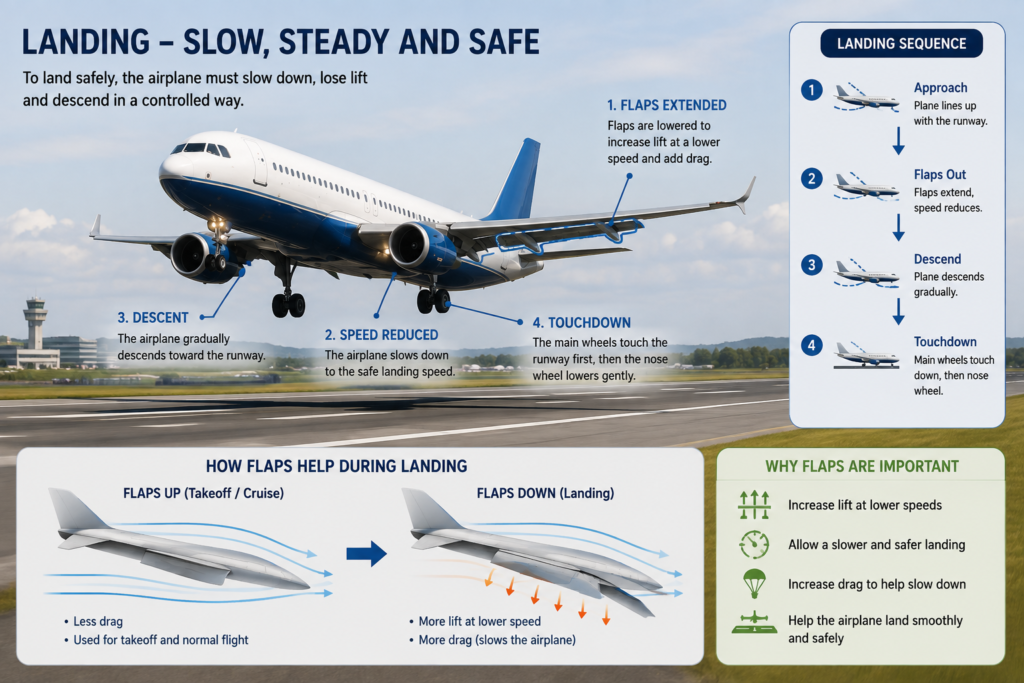
Landing is basically the reverse of takeoff—but carefully controlled.
The aeroplane gradually reduces its speed and begins descending toward the runway.
Special movable surfaces called flaps are extended from the wings.
Flaps change the shape and aerodynamic characteristics of the wings. They allow the aircraft to produce enough lift at lower speeds, which is very useful during takeoff and landing.
As the aircraft gets closer to the runway, its speed is reduced further.
The wheels touch the runway.
Then the aircraft uses its brakes, spoilers and sometimes reverse thrust to slow down.
And finally, it reaches the airport gate.
Why Doesn't an Aeroplane Just Fall Out of the Sky?
This is probably the question that comes to mind when you see a huge aircraft flying overhead.
The aeroplane doesn’t stay in the air because it is “floating.”
It stays in the air because its wings are continuously interacting with the moving air.
As long as the aircraft has the appropriate speed, wing configuration and angle of attack, its wings can generate enough lift to support its weight.
The engines provide the thrust needed to keep the aircraft moving through the air.
So flight is actually a carefully balanced interaction between air, wings, engines and gravity.
What If the Engines Stop?
This sounds scary, but an interesting fact about aeroplanes is that engines are not what directly keep an aeroplane in the air.
The wings create lift.
The engines mainly provide thrust.
If an aircraft loses engine power, it does not suddenly drop like a stone. As long as it has sufficient airspeed, the wings can continue producing lift.
The aircraft can glide through the air.
Pilots are trained to handle such situations and can use the aircraft’s altitude and forward motion to reach a suitable landing area.
This is one reason why understanding aerodynamics is so important in aviation.
Why Are Aeroplanes Shaped So Smoothly?
Look closely at an aeroplane.
Its body is long and streamlined. Its wings are carefully shaped, and many parts have smooth surfaces.
That’s not just for appearance.
The shape helps reduce unnecessary drag.
Less drag means the engines don’t have to work as hard to maintain the aircraft’s speed.
This improves efficiency and helps the aeroplane use fuel more effectively.
Did You Know?
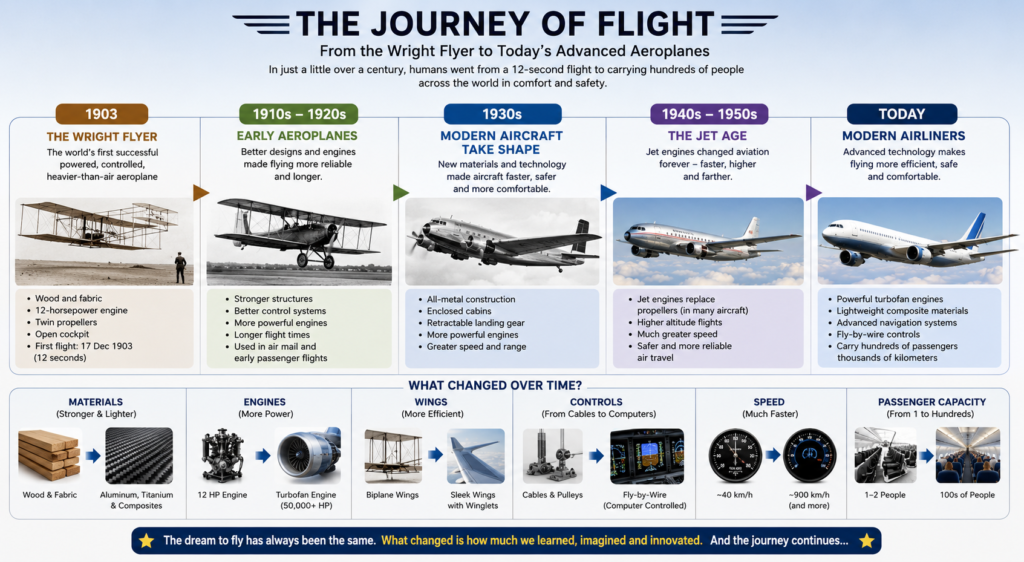
The Wright brothers are widely credited with achieving the first successful powered, controlled and sustained heavier-than-air flight in 1903.
Their aircraft was very different from today’s passenger jets.
Modern aeroplanes use incredibly advanced engines, computers, materials and aerodynamic designs—but the basic idea remains the same:
Move through the air → create lift → control the aircraft.
Modern aircrafts use sophisticated navigation systems to determine where they are and where they need to go. GPS is one of the technologies that helps us understand location. You can learn more about this in How Does GPS Know Our Location?
A Simple Way to Remember How an Aeroplane Flies
You can remember the four forces with this simple picture in your mind:
↑ LIFT
↓ GRAVITY
→ THRUST
← DRAG
Lift and gravity act mostly in opposite vertical directions.
Thrust and drag act mostly in opposite horizontal directions.
When these forces are carefully controlled, an aeroplane can climb, cruise, turn and land.
The Big Idea
So, how does an aeroplane fly?
It flies because its wings generate lift as air flows around them, while its engines provide thrust to move the aircraft forward.
At the same time, the aircraft must deal with gravity, which pulls it downward, and drag, which resists its forward motion.
It isn’t magic.
It isn’t simply the engine “pushing the plane into the sky.”
It is a beautiful combination of physics, engineering and the properties of air.
And perhaps the most amazing part is this:
The same air that seems invisible and weightless is strong enough to help lift a giant aeroplane carrying hundreds of people into the sky.
Next time you see an aeroplane flying overhead, don’t just watch it.
Ask yourself:
“How is the air helping those wings stay up?”
That’s where the real science of flight begins.
Quick Recap
- Lift helps the aeroplane move upward.
- Gravity pulls the aeroplane toward Earth.
- Thrust moves the aeroplane forward.
- Drag resists its forward movement.
- The wings create lift by interacting with the air.
- The engines provide thrust.
- Flaps and other control surfaces help pilots control the aircraft.
- During a flight, pilots carefully manage all these forces.
And that is how an aeroplane flies!
1 thought on “How Does an Aeroplane Fly? Discover the Amazing Science of Flight”