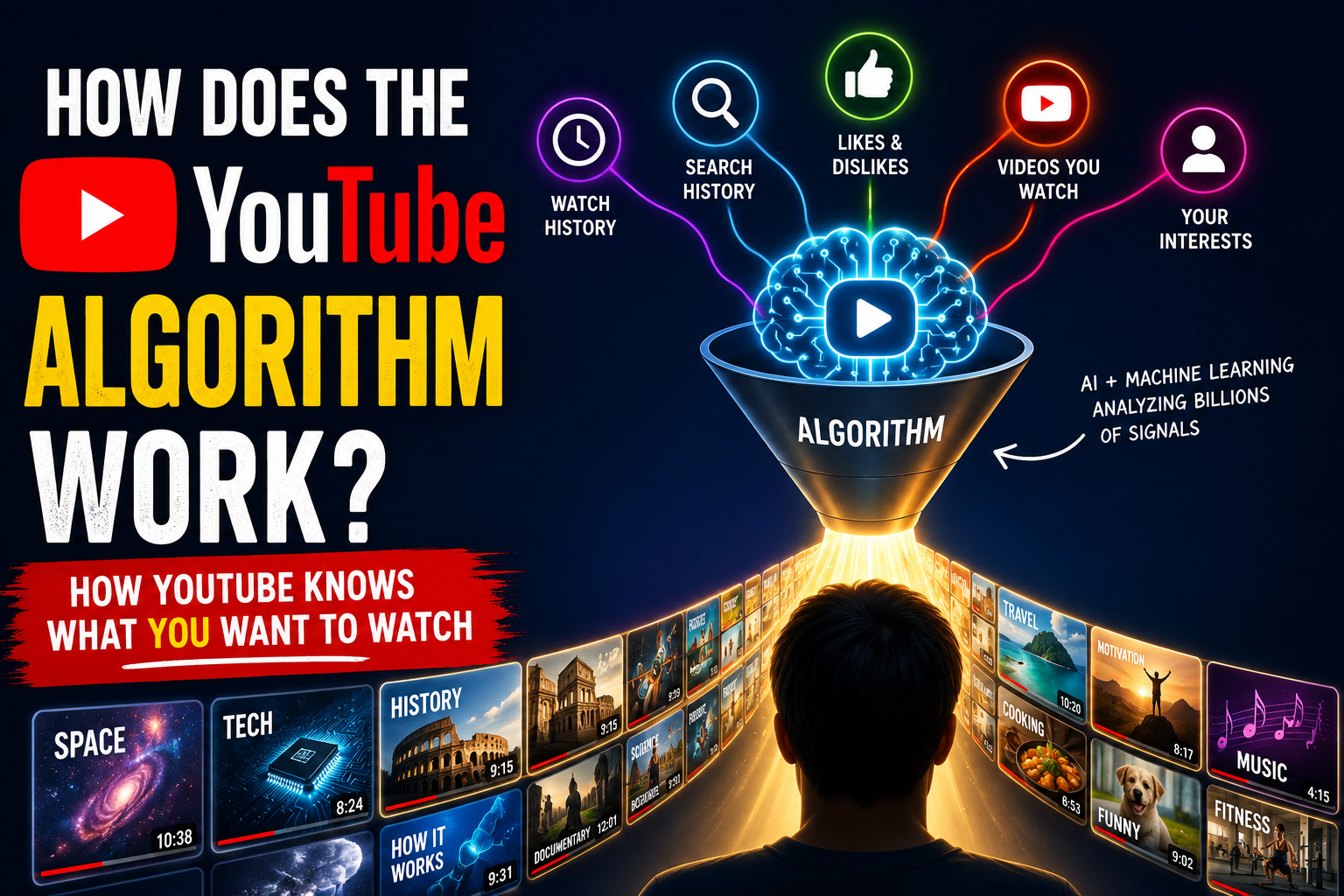
How does the YouTube algorithm work, and how does YouTube know what you want to watch?
Have you ever watched one video about space, and suddenly YouTube starts showing you videos about black holes, planets, astronauts and the universe?
Or maybe you watch a few cricket highlights, and before you know it, your YouTube homepage is filled with cricket.
It can almost feel like YouTube knows what you’re thinking.
But does it?
Not really. YouTube isn’t reading your mind.
Instead, it uses a complex recommendation system—often simply called the YouTube algorithm—that learns from your behaviour and tries to predict which videos you are most likely to enjoy.
So, how does the YouTube algorithm actually work?
Let’s find out.
What Is the YouTube Algorithm?
First, there’s an important point to understand.
There isn’t one single algorithm that decides everything you see on YouTube.
Different parts of YouTube—such as the Home page, Search, Shorts and Up Next—use recommendation and ranking systems in somewhat different ways.
But they all have a similar basic goal:
Help each viewer find videos they are likely to watch and enjoy.
Think of YouTube as having a very clever digital assistant.
Imagine you walk into a library every day and always pick up books about:
- Space
- Science
- Technology
- History
After watching you for a while, the librarian might say:
“I think you’d like this new book about black holes.”
The YouTube algorithm does something similar—but on a gigantic scale.
It looks at patterns in what viewers do and uses those patterns to make predictions.
How Does YouTube Know What You Like?
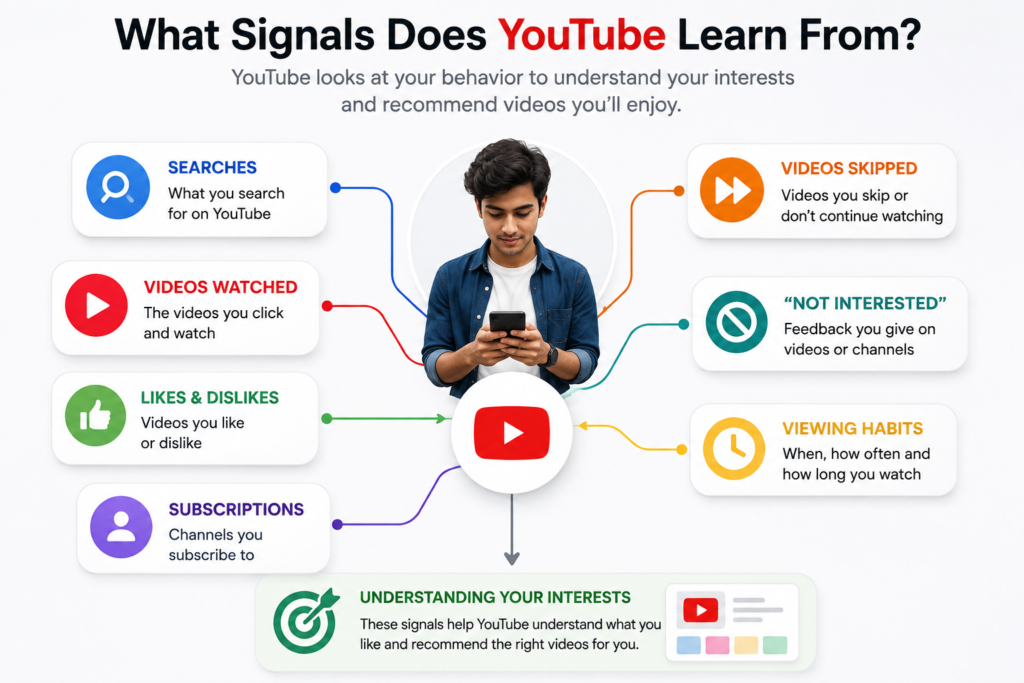
Every time you use YouTube, you leave behind clues.
For example, you might:
- Search for a topic
- Click on a video
- Watch a video for a while
- Watch most of a video
- Skip a video
- Like or dislike a video
- Subscribe to a channel
- Select “Not interested”
- Watch several videos about the same topic
- Return to the same type of content later
YouTube can use these signals to understand your interests. Its current documentation specifically lists watch history, search history, subscriptions, likes, dislikes, feedback such as “Not interested,” and satisfaction surveys among the signals it uses.
So if you regularly watch videos about how things work, YouTube may gradually learn:
“This person seems to enjoy explanatory and educational videos.”
That’s when your recommendations start becoming more personalised.
Your Watch History Is a Big Clue
Suppose you watch:
“How Does a Rocket Work?”
Then you watch:
“How Do Astronauts Live in Space?”
Then:
“What Happens Inside a Black Hole?”
YouTube now has several clues pointing in the same direction.
You seem interested in space and science.
So the next time you open YouTube, you might see:
“How Does the James Webb Space Telescope Work?”
You didn’t search for that video.
YouTube simply predicted that you might like it based on your previous behaviour.
For the Home page, YouTube says watch history is one of its primary signals for personalising recommendations.
Your Searches Give You Another Clue
Your searches can also influence what YouTube recommends.
Imagine you search:
You watch a video explaining smartphone batteries.
Later you search:
“How does fast charging work?”
Then you watch a video about phone processors.
YouTube can start connecting these activities.
It may conclude that you’re interested in:
Smartphones → Batteries → Charging → Technology
So you may start seeing more videos related to those subjects.
In other words, your searches help YouTube understand what you’re curious about right now.
What Happens When You Skip a Video?
Here’s something interesting.
The algorithm doesn’t only learn from what you watch.
It can also learn from what you don’t watch.
Suppose YouTube recommends 10 football videos to you.
You ignore all of them.
But when it recommends a science video, you click immediately and watch most of it.
That’s useful information.
YouTube can gradually learn:
Football → probably not very interesting
Science → much more interesting
You can also explicitly tell YouTube what you don’t want by selecting “Not interested” or “Don’t recommend channel.” These are recommendation signals too.
Does YouTube Care How Long You Watch?
Yes—but there’s an important detail.
You might think YouTube simply wants you to watch a video for as long as possible.
It’s more complicated than that.
YouTube says its systems consider whether people choose to watch, whether they keep watching, and whether they are satisfied with what they watched. It uses signals such as average view duration and average percentage viewed, along with other indicators of satisfaction.
Imagine two videos.
Video A
You click it, watch for 20 seconds and leave.
Video B
You click it, watch almost the entire video and feel satisfied.
The second video provides a stronger indication that the content was a good match for you.
So YouTube isn’t simply asking:
“How long can we keep this person watching?”
It’s trying to predict:
“Is this something this person will actually enjoy?”
YouTube Also Learns From Other People
This is one of the most fascinating parts.
YouTube doesn’t only learn from your behaviour.
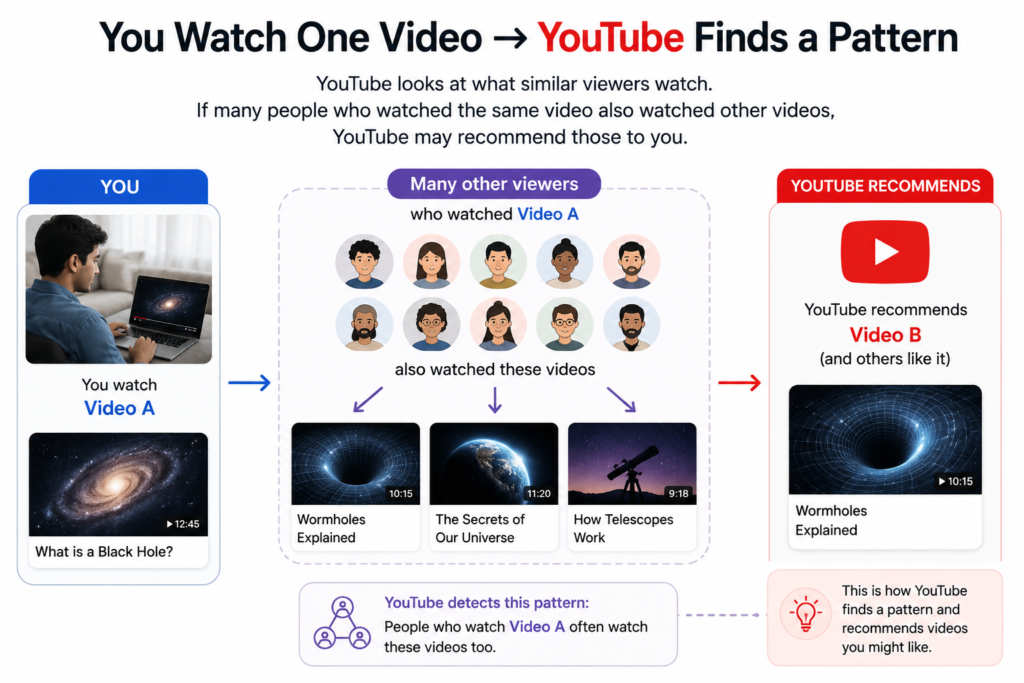
It can also look for patterns among other viewers.
Imagine thousands of people watch:
Video A: “How Do Rockets Work?”
A large number of those people then watch:
Video B: “How Do Astronauts Train?”
YouTube can notice that connection.
Now imagine you watch Video A.
You haven’t watched Video B yet.
YouTube may recommend it because:
People who enjoyed something similar to what you watched also tended to enjoy this.
YouTube describes this as learning from what similar viewers watch and enjoy.
It’s almost like millions of viewers are unknowingly helping YouTube recommend videos to one another.
This Is Why YouTube Can Seem to Read Your Mind
Let’s say you suddenly become interested in ancient Egypt.
You watch:
- Egyptian pyramids
- How mummies were made
- Tutankhamun
- Ancient Egyptian technology
Soon, your homepage starts filling with more ancient-Egypt videos.
It can feel like YouTube knows exactly what you’re thinking.
But the system doesn’t need to know your thoughts.
Your behaviour has already given it clues.
It’s essentially saying:
“People who watch these kinds of videos often enjoy these other videos too.”
Then it makes a prediction.
Sometimes the prediction is remarkably accurate.
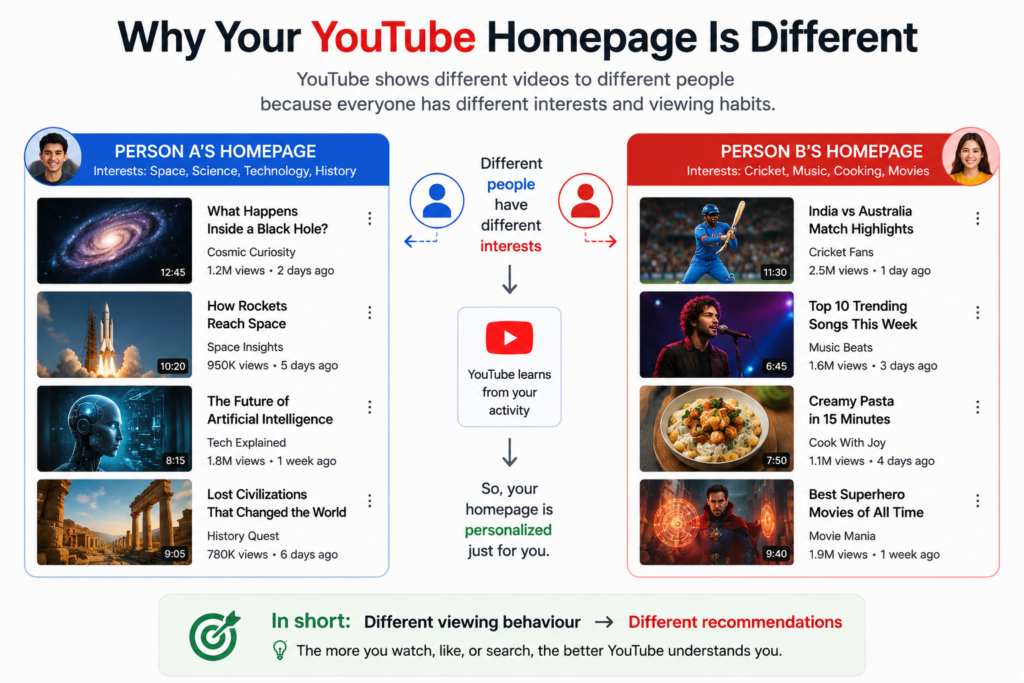
Why Do Two People Get Different YouTube Homepages?
Here’s a simple experiment.
Open YouTube on your account and ask someone else to open it on theirs.
Look at the Home page.
They probably won’t look anything like each other.
You might see:
Science → Technology → Space → History
while they might see:
Music → Cricket → Movies → Cooking
Why?
Because YouTube is trying to personalise the experience for each viewer.
Your watch history is different.
Your searches are different.
Your likes and dislikes are different.
Your interests are different.
And even the kinds of content you regularly watch can be different.
So there isn’t really one YouTube homepage.
There are millions of personalised versions.
Does the Time of Day Matter?
Interestingly, YouTube’s current explanation says its recommendation system can also consider contextual information such as device, time of day and past habits.
Imagine you usually watch:
News on your phone in the morning
and
Entertainment on your television at night.
Over time, these patterns can help the system understand that your viewing behaviour changes depending on the situation.
So recommendations aren’t necessarily based only on who you are.
They can also depend on what you’re doing and when you’re watching.
What About the "Up Next" Videos?
Have you noticed the videos that appear after—or beside—the video you’re currently watching?
That’s the Up Next recommendation system.
Here, the video you’re currently watching becomes an especially important clue.
For example, if you’re watching:
YouTube might recommend:
- How jet engines work
- How pilots control airplanes
- Why airplanes stay in the air
- How turbulence works
These recommendations are connected to what you’re watching right now, along with other personalised signals.
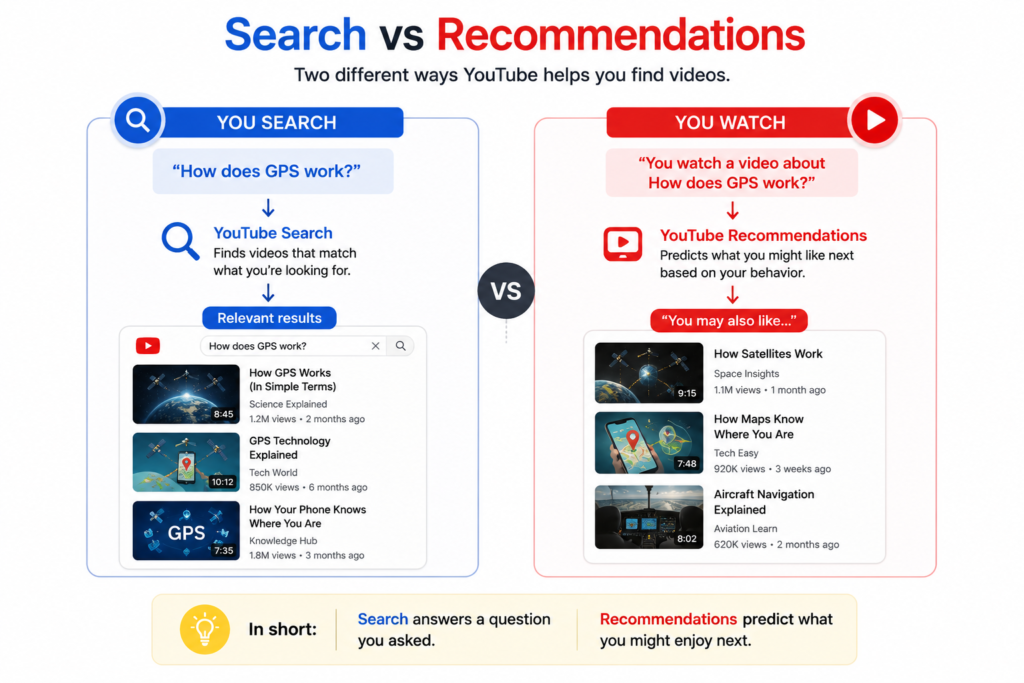
Is YouTube Search the Same as the YouTube Algorithm?
Not exactly.
This is an important distinction.
If you search YouTube for:
YouTube has to decide which results are most relevant to your search.
YouTube says its search system considers three major areas:
Relevance + Engagement + Quality
It looks at how well the title, description and video content match your search, along with engagement and signals related to quality. Your search and watch history can also make results more personally relevant.
Recommendations are different.
Instead of you asking:
“Show me videos about GPS.”
the recommendation system is essentially asking:
“What might this person want to watch next?”
Where Does Artificial Intelligence Come In?
This is where things get really interesting.
YouTube deals with an enormous amount of information.
There are billions of viewing interactions happening across the platform.
A human team could never manually look at everyone’s viewing habits and decide what to recommend.
That’s where machine learning and artificial intelligence become useful.
Machine-learning systems can identify patterns in huge amounts of data and use those patterns to make predictions.
For example:
People who watch A often watch B.
People who skip A usually don’t enjoy B.
People interested in topic X often become interested in topic Y.
The system can continually learn from new signals and improve its predictions.
YouTube says its recommendation system is constantly evolving and learns from billions of signals.
Why Does YouTube Sometimes Get It Completely Wrong?
If the algorithm is so clever, why does it sometimes recommend something you have absolutely no interest in?
Because it’s making predictions—not reading your mind.
Suppose your friend sends you a cricket video.
You watch it once.
You aren’t actually interested in cricket.
But YouTube doesn’t necessarily know why you watched it.
It sees:
You watched a cricket video.
So it may test the waters by recommending another cricket video.
If you keep ignoring them, that gives the system another clue:
“Maybe cricket isn’t actually their thing.”
Eventually, your recommendations can change.
This is why the algorithm is constantly adjusting.
Can You Change What YouTube Recommends?
Absolutely.
Your behaviour influences your recommendations, so you can also teach YouTube what you want—and don’t want—to see.
For example, you can:
- Stop watching topics you’re no longer interested in
- Use “Not interested” when appropriate
- Select “Don’t recommend channel”
- Manage your watch history
- Delete videos from your watch history
- Change your subscriptions and interactions
YouTube says that deleting or turning off watch history can affect future recommendations based on that history.
So if your homepage suddenly becomes filled with videos you don’t care about, you aren’t completely stuck with it.
Your future behaviour can help change it.
Is YouTube Listening to Your Conversations?
This is probably one of the first things people wonder when YouTube suddenly recommends something they were talking about.
You might say:
“We were just talking about Goa!”
And then you see a Goa-related video.
It can certainly feel creepy.
But a recommendation appearing after a conversation doesn’t by itself mean YouTube listened to that conversation.
There are many other possible explanations.
Maybe you searched for something related earlier.
Maybe you watched a similar video.
Maybe someone else using the account searched for it.
Or perhaps the recommendation was based on patterns among viewers with similar interests.
Sometimes the algorithm simply makes a prediction that feels surprisingly personal.
So, Does YouTube Really Know What You Want?
No—not exactly.
YouTube doesn’t know what you’re thinking.
It doesn’t know for certain which video you’ll enjoy.
Instead, it constantly makes educated guesses.
It looks at signals such as:
What you watched
↓
What you searched for
↓
What you clicked or skipped
↓
What you liked or disliked
↓
What you told YouTube you weren’t interested in
↓
What similar viewers enjoyed
↓
How viewers responded to videos
↓
What you’re most likely to enjoy next
And then it makes a recommendation.
The Simple Answer
So, how does the YouTube algorithm work?
The YouTube algorithm is a collection of recommendation and ranking systems that use signals about viewers, videos and viewing behaviour to predict what content is most relevant and satisfying for each person.
It learns from your watch and search history, the videos you choose or ignore, your interactions and feedback, and patterns among viewers with similar interests. Different parts of YouTube use these signals differently.
So the next time YouTube recommends a video that seems to be exactly what you wanted to watch, remember:
It probably isn’t reading your mind.
It’s reading the patterns in your behaviour.
And with billions of signals being processed, those patterns can sometimes make YouTube look almost psychic.
🤔 Try This Yourself
The next time you watch a completely new topic on YouTube, pay attention to your recommendations over the next few days.
How quickly does YouTube figure out your new interest?
That’s the fascinating part.
You are not just watching YouTube.
Your choices are helping teach YouTube what to show you next.