
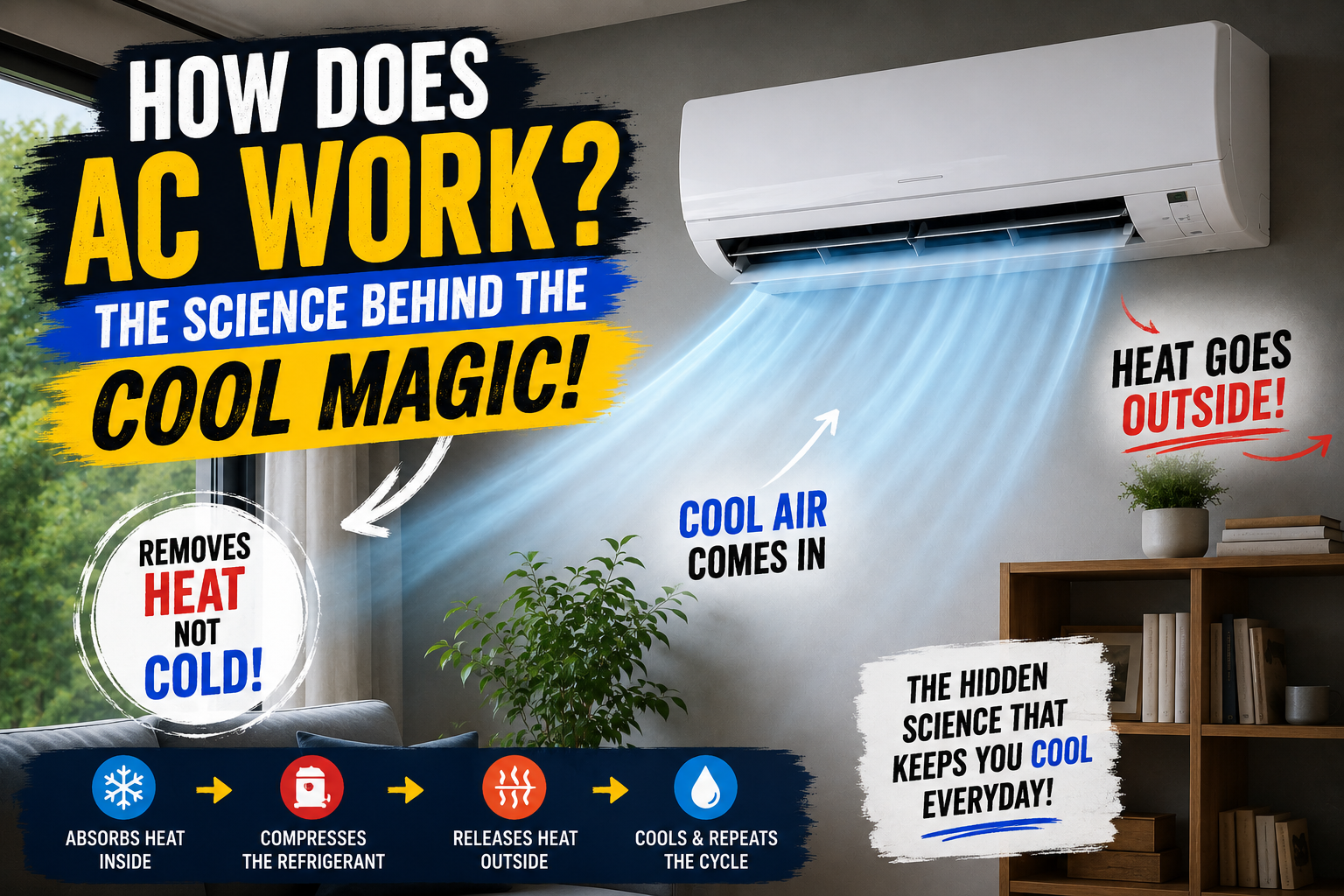
Have you ever wondered how does AC work what actually happens when you switch on an air conditioner?
You hear the AC start, feel cool air coming from the indoor unit, and within a few minutes the room becomes comfortable. But where does the heat go? Does the AC actually make cold air? And how can a machine sitting inside your room make the heat disappear? So How does an AC work?
The surprising answer is: an air conditioner doesn’t really create cold air. It removes heat from your room and sends that heat outside.
But how does it do that?
Let’s find out.
First, What Does an AC Actually Do?
Think of your room as a box filled with air.
When sunlight enters through the windows, electronic devices are running, or people are inside, heat builds up in the room. The air conditioner has one main job:
Take that heat out of the room.
An AC uses a special fluid called a refrigerant to carry heat from inside your room to the outdoors.
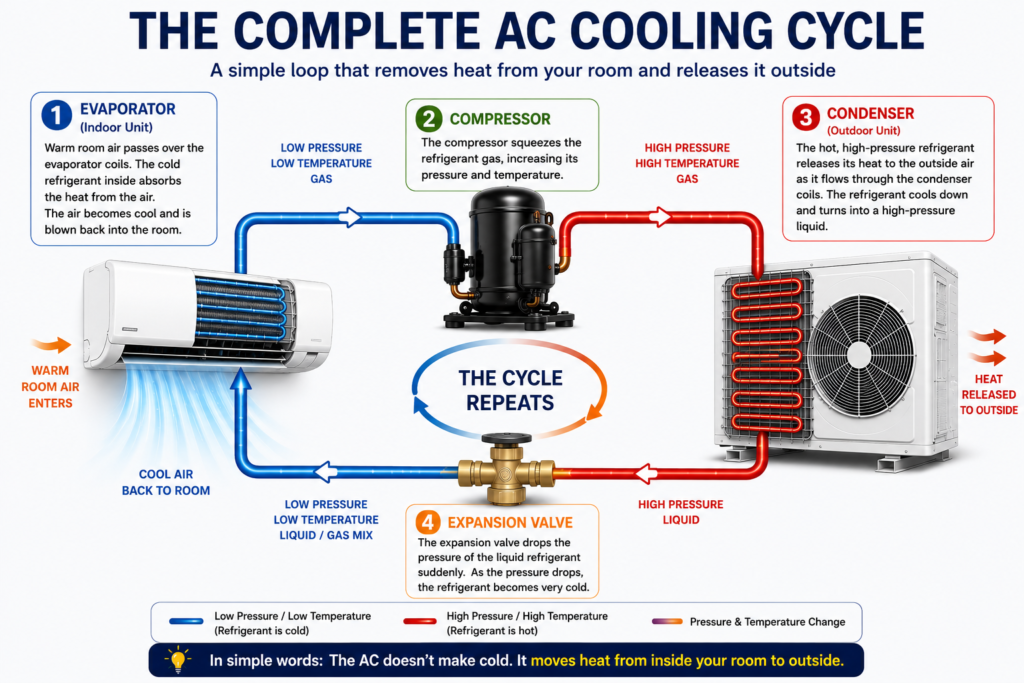
This happens through a continuous cycle involving four important components:
- Evaporator
- Compressor
- Condenser
- Expansion device
Together, they create the refrigeration cycle that makes air conditioning possible.
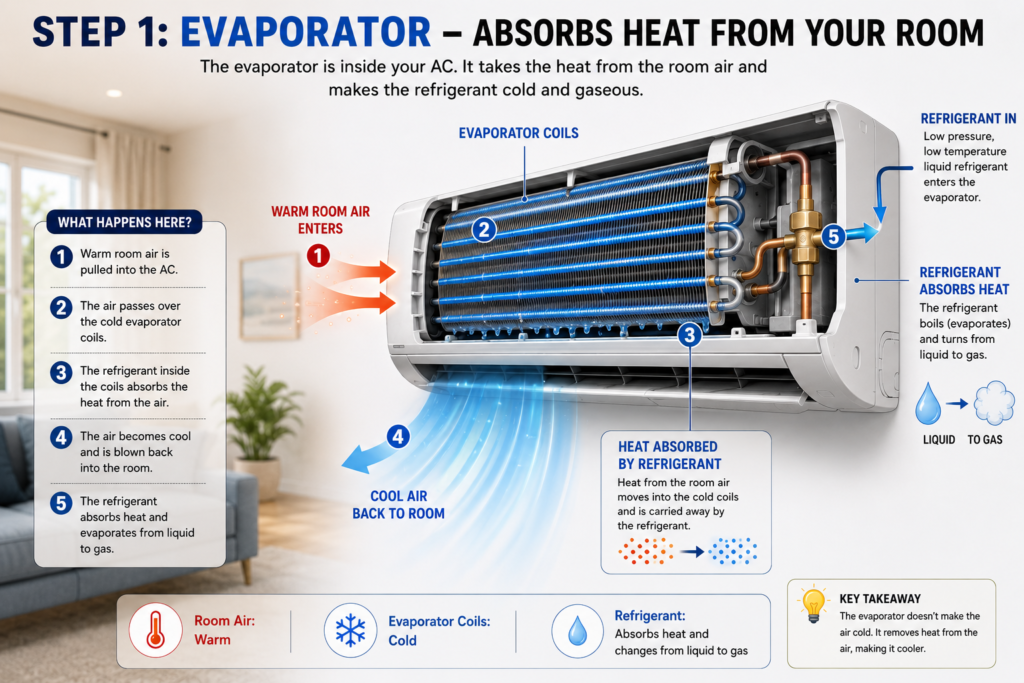
Step 1: The AC Absorbs Heat From Your Room
Inside the indoor AC unit is a component called the evaporator coil.
A fan pulls warm room air into the AC and blows it across this cold coil.
Inside the coil is a low-pressure refrigerant that is cold enough to absorb heat from the air.
As the warm air passes over the coil:
Warm room air → heat is transferred to the refrigerant → cooler air comes back into the room
That’s why you feel cool air coming from the AC.
But here’s the important part:
The AC hasn’t destroyed the heat. It has simply transferred it somewhere else.
The refrigerant absorbs that heat and changes from a liquid into a gas as it evaporates.
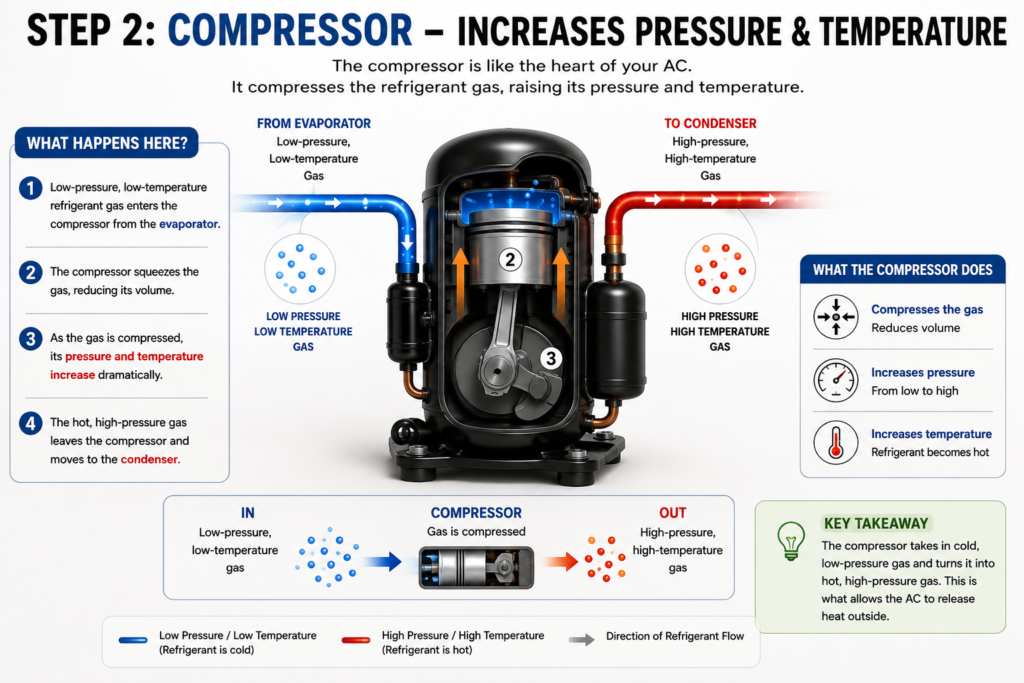
Step 2: The Compressor Gives the Refrigerant a Push
Now the refrigerant is a warm, low-pressure gas.
It travels through the pipes to the compressor, which is usually located in the outdoor unit of a split AC.
The compressor squeezes the refrigerant gas.
When a gas is compressed, its pressure and temperature increase.
So the refrigerant leaves the compressor as a:
Hot, high-pressure gas
This may sound strange.
Why would an AC deliberately make something hotter?
Because the refrigerant now needs to be hot enough to release the heat it collected from inside the room.
That’s where the outdoor unit comes in.
Step 3: The AC Throws the Heat Outside
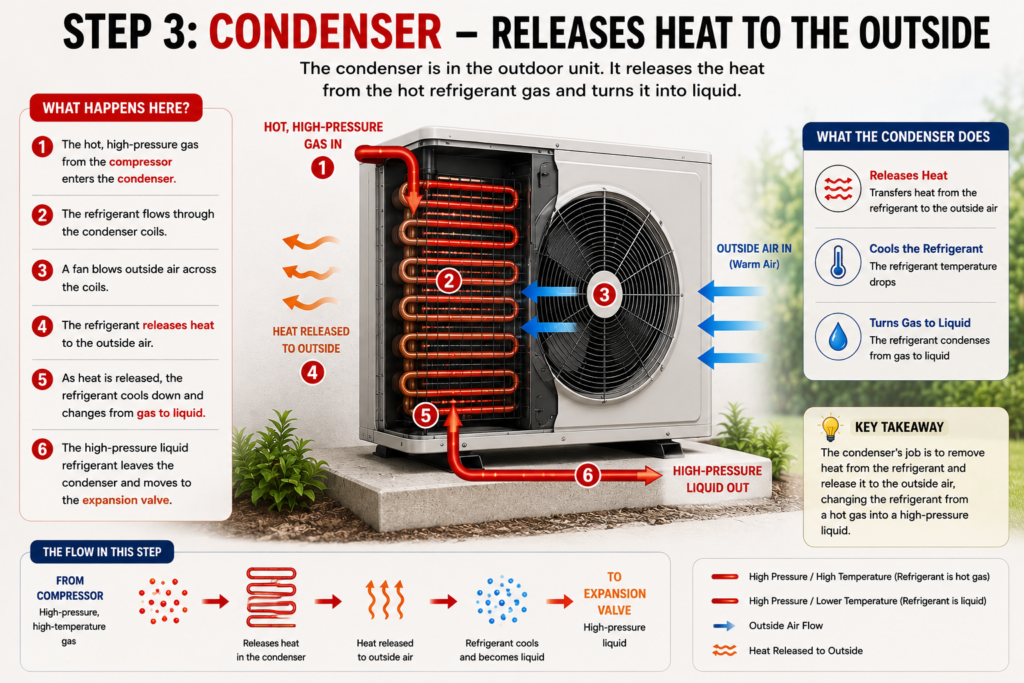
The hot refrigerant gas now enters the condenser coil in the outdoor unit.
A fan blows outdoor air across this coil.
Because the refrigerant is hotter than the surrounding outdoor air, heat moves from the refrigerant into the outside air.
The refrigerant loses its heat and changes from a gas back into a liquid.
So, if you’ve ever stood near the outdoor unit of an AC and felt hot air coming out, that’s exactly what you’re experiencing.
The AC is dumping the heat from your room outside.
The outdoor unit isn’t producing heat from nowhere. Much of that heat originally came from your room, along with some additional heat generated by the compressor while doing its job.
Step 4: The Refrigerant Gets Cold Again
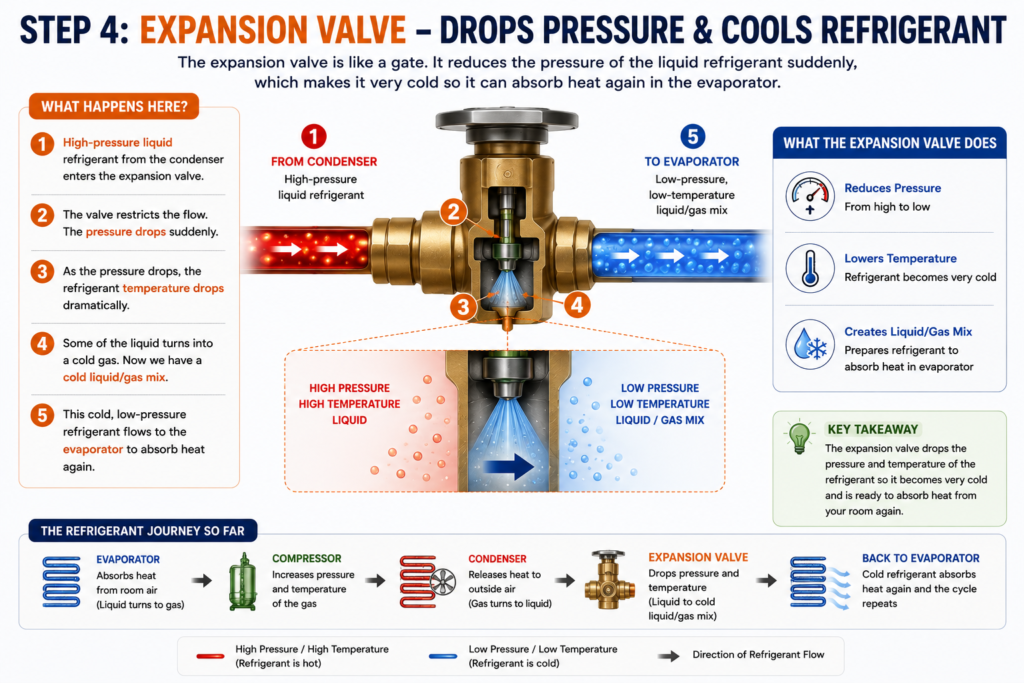
The refrigerant is now a high-pressure liquid.
Before it can return to the indoor evaporator coil, it passes through an expansion device such as an expansion valve.
This causes the refrigerant’s pressure to drop suddenly.
When its pressure drops, its temperature also falls.
The refrigerant becomes cold enough to absorb heat from your room again.
And then it returns to the evaporator.
The whole process repeats.
Absorb heat → compress → release heat → expand → absorb heat again
And it happens continuously while your AC is cooling.
So Where Does the Heat From Your Room Go?
This is probably the biggest mystery about air conditioning.
The answer is surprisingly simple:
It goes outside.
Imagine moving a bucket of water from one place to another.
The AC is doing something similar, except instead of moving water, it is moving heat.
The refrigerant acts like a heat-carrying messenger:
Room → Refrigerant → Outdoor unit → Outside air
That’s why an AC can make your room cooler even though the outdoor unit becomes hot.
Does an AC Make Cold Air?
Not exactly.
This is one of the most common misunderstandings about air conditioners.
The AC’s main job is not to manufacture “cold.”
Instead, it removes thermal energy (heat) from the indoor air.
Once heat is removed, the remaining air has a lower temperature, so it feels cold to us.
It’s similar to a refrigerator.
A refrigerator doesn’t create “cold” either. It removes heat from inside the refrigerator and releases that heat into the surrounding room.
An air conditioner does essentially the same thing, but on a much larger scale.
Why Does the AC Also Remove Moisture?
There’s another thing happening when your AC runs.
It doesn’t just cool the air. It can also remove moisture from it.
Warm air can hold more water vapour than cold air.
When humid room air passes over the cold evaporator coil, some of the water vapour condenses into liquid water on the coil.
That water collects and drains away.
That’s why water can drip from an AC’s drain pipe.
So your AC is doing two jobs at once:
Cooling the air + reducing humidity
This is one reason an air-conditioned room can feel much more comfortable than a room that is simply cooled by a fan.
Then Why Can't a Fan Cool a Room Like an AC?
A fan and an AC work very differently.
A fan mainly moves air around.
It doesn’t remove heat from the room.
When air from a fan moves across your skin, it helps sweat evaporate faster, making you feel cooler.
But the room itself hasn’t necessarily become much colder.
An AC, on the other hand, actually removes heat from the room and transfers it outdoors.
That’s why leaving a fan running in a closed room doesn’t produce the same cooling effect as an air conditioner.
What About an Inverter AC?
You may have heard the term inverter AC while shopping for an air conditioner.
The basic cooling process is still the same.
The important difference is how the compressor operates.
A traditional fixed-speed AC generally switches its compressor on and off to maintain the desired temperature.
An inverter AC can vary the compressor’s speed depending on how much cooling the room needs.
For example:
Room is very hot → compressor works harder
Room is close to the desired temperature → compressor slows down
This allows an inverter AC to adjust its cooling output instead of repeatedly operating at full capacity and then stopping. That can provide steadier temperatures and, under suitable conditions, lower energy consumption.
Think of it like driving a car.
A fixed-speed system is somewhat like repeatedly pressing the accelerator hard and then taking your foot completely off it.
An inverter system is more like adjusting the accelerator smoothly to maintain the speed you want.
Why Does an AC Consume So Much Electricity?
Moving heat isn’t free.
The AC needs electricity to operate its compressor, fans, controls and other components.
The compressor is especially important because it does the heavy lifting in the refrigeration cycle.
It compresses the refrigerant and allows the system to keep moving heat from the indoor space to the outdoors.
The more heat the AC needs to remove, the harder the system may need to work.
That’s why factors such as outdoor temperature, room size, insulation, sunlight, number of people in the room and the AC’s efficiency can affect electricity consumption.
The Amazing Part: The Refrigerant Keeps Going Around
Here’s something that makes the whole system even more interesting.
The refrigerant isn’t normally used up every time the AC cools your room.
It continuously travels through a closed loop, changing its state as it moves through different parts of the AC.
It changes like this:
Liquid → Gas → Liquid → Gas → Liquid…
But when exactly does this happen?
When Does the Liquid Turn Into Gas?
After the refrigerant passes through the expansion device, its pressure drops sharply. This makes the refrigerant very cold.
It then enters the evaporator coil inside your room.
As warm room air passes over the cold evaporator coil, the refrigerant absorbs heat from the room.
That absorbed heat causes the refrigerant to evaporate — changing from a liquid into a gas.
So:
Inside the evaporator:
🧊 Cold refrigerant + heat from room → Liquid turns into gas
This is also why the component is called an evaporator.
When Does the Gas Turn Back Into Liquid?
The refrigerant, now a warm gas, travels to the compressor in the outdoor unit.
The compressor squeezes the gas, making it high-pressure and very hot.
It then enters the condenser coil.
Here, the refrigerant releases the heat it picked up from your room into the outdoor air.
As it loses heat, the refrigerant condenses — changing from a gas back into a liquid.
So:
Inside the condenser:
🔥 Hot refrigerant + heat released outside → Gas turns into liquid
That’s why this component is called a condenser.
So the Complete Cycle Looks Like This
The four basic stages are:
- Evaporation – The refrigerant absorbs heat indoors and changes from liquid → gas.
- Compression – The compressor squeezes the gas, increasing its pressure and temperature.
- Condensation – The refrigerant releases heat outdoors and changes from gas → liquid.
- Expansion – The pressure of the liquid drops, making it cold enough to absorb heat again.
Then the cycle starts all over again:
Liquid → Gas → Liquid → Gas → Liquid…
And this happens again and again while your AC is running.
One Important Thing to Remember
The refrigerant doesn’t become a gas simply because it is “used up,” and it doesn’t become a liquid because the AC needs more coolant.
It changes between liquid and gas because heat and pressure change as the refrigerant moves through the system.
That’s the clever trick that allows the AC to continuously move heat from inside your room to the outside world.
Final Thought
The next time you sit comfortably in an air-conditioned room on a scorching summer afternoon, remember what’s really happening.
Your AC isn’t creating a magical supply of cold.
It’s quietly picking up heat from your room and throwing it outside.
That’s the fascinating science behind something we use almost every day.
But long before air conditioners and refrigerators existed, how did people make and preserve ice? Discover the fascinating science behind [how ice was made before refrigeration].