
How was ice made before refrigeration? Today, making ice is almost ridiculously easy.
Fill an ice tray with water, put it in the freezer, and a few hours later you have ice.
But what if you lived 500 years ago? Or 1,000 years ago? What if there was no refrigerator, no freezer, no electricity—and you lived in a place where summers were extremely hot?
How did people get ice?
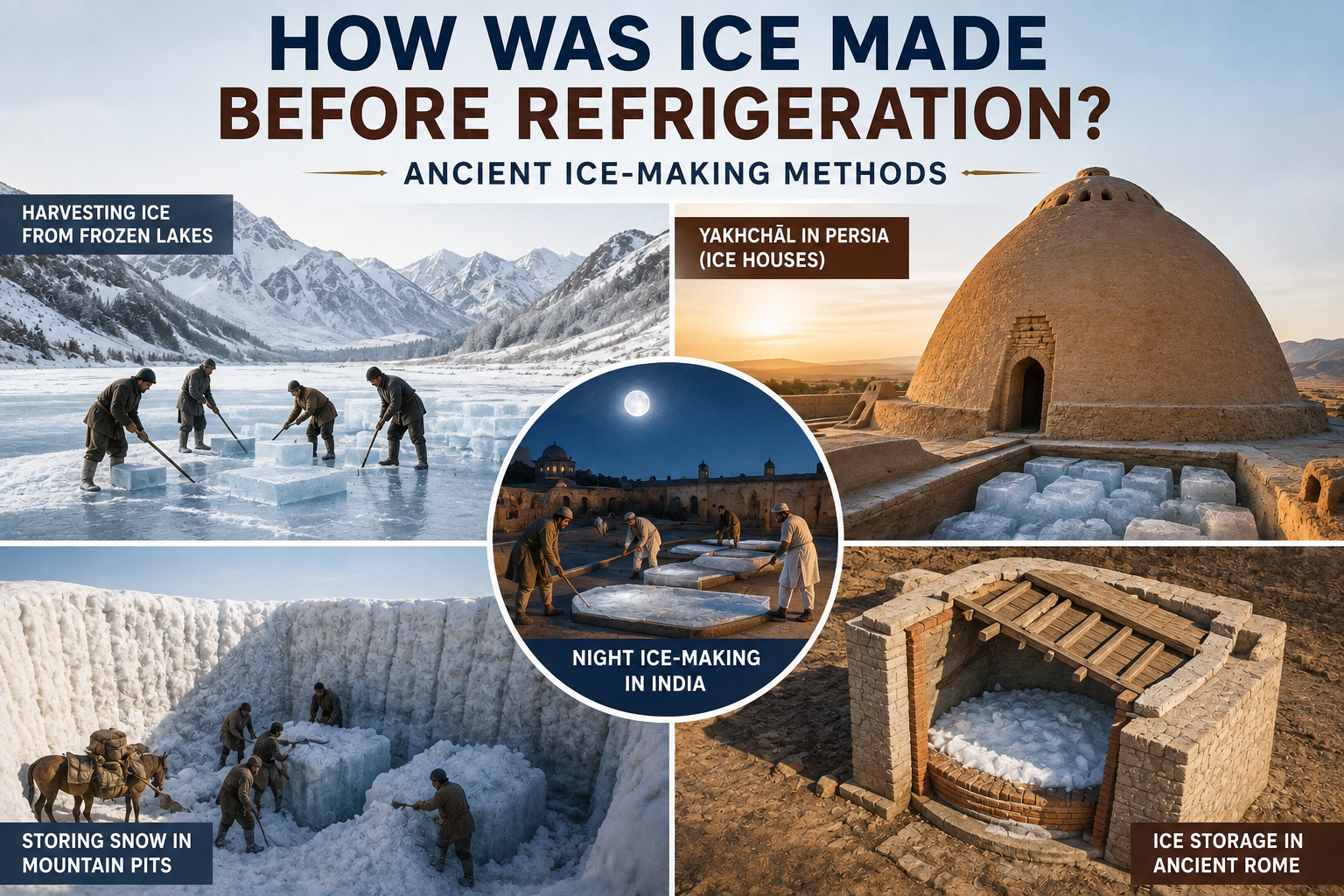
The surprising answer is that people had several clever ways of getting and preserving ice long before refrigerators were invented. Some harvested ice from frozen lakes and rivers. Others brought snow down from mountains. And in places such as Persia and India, people even developed ingenious methods to make ice during cold nights.
So, how did they do it?
First, People Didn't Always "Make" Ice
Before we look at the different civilizations, there is one important distinction.
For most of human history, people harvested ice rather than manufactured it.
During winter, workers would cut blocks of ice from frozen rivers, ponds and lakes. Snow and ice could also be collected from mountains, where temperatures remained low even when the surrounding regions were warmer.
The challenge was not necessarily getting ice.
The real challenge was:
How do you keep ice frozen until summer?
That led to the invention of some remarkably clever ice houses and underground storage systems.
1. Ancient Mesopotamia: Ice for Kings
One of the oldest known examples comes from the ancient kingdom of Mari in Mesopotamia, in present-day Syria.
Records from around the 18th century BCE mention an ice house used by the royal court. Ice was brought from nearby mountains and stored so that it could be used by the king.
And why did a king need ice?
One important use was to chill wine.
At that time, ice was a luxury. Ordinary people certainly weren’t putting ice cubes into their everyday drinks. Having access to ice demonstrated wealth and status.
The ice house was essentially an early version of a refrigerator—but instead of electricity, it depended on winter cold, insulation and underground storage.
2. Ancient China: Winter Ice Saved for Summer
Ancient China developed an impressive system for harvesting and storing ice.
Chinese texts describe officials whose job was specifically connected with cutting, storing and distributing ice.
The Rites of Zhou, an ancient Chinese text, describes an official known as the Ice Officer, who supervised the cutting of ice during winter and its storage in ice houses. The stored ice was later distributed during warmer months for food, drinks, ceremonies and other purposes.
Another ancient Chinese text, the Book of Songs, describes people cutting ice during winter and carrying it to ice houses.
So the basic idea was simple:
Winter → cut ice → store it → use it in summer.
But keeping ice frozen for months required careful storage.
Ice houses were often partially underground or heavily insulated. Ice could be packed together and covered with insulating materials such as straw.
Archaeological evidence also supports the existence of ancient Chinese ice-storage structures.
This was not an ordinary household convenience. In ancient China, maintaining an ice supply was closely associated with the royal court and wealthy households.
3. The Greeks and Romans: Snow Delivered to the Cities
The ancient Greeks and Romans also enjoyed something very similar to a cold drink—but they had to work much harder to get it.
They collected snow from mountains and transported it to cities.
The snow was then stored in pits, often covered with insulating material, so that it would last as long as possible.
In the Greek and Roman worlds, snow and ice were particularly associated with chilling wine and preparing luxurious foods and drinks.
Ancient sources describe snow being brought to summer gatherings so that wine could be served cold. In some places, snow became a commercial product, sold to people who could afford it.
Imagine that for a moment:
You want a cold drink.
Instead of opening your freezer, you need someone to travel to a mountain, collect snow, bring it back and store it carefully.
That gives a whole new meaning to the phrase “cold drink.”
4. Persia Did Something Even More Amazing: Making Ice in the Desert
Now we come to one of the most fascinating examples.
Ancient Persia, in present-day Iran, developed the yakhchāl.
The word yakhchāl literally refers to an ice pit.
These enormous structures were essentially ancient natural refrigerators—and some could actually produce ice, not merely store it.
The basic design was brilliant.
A typical yakhchāl had:
- A large underground storage chamber
- Extremely thick walls
- A tall domed roof
- Shaded ice-making pools
- Water channels
- In some cases, windcatchers and connections to underground water systems
The underground chamber provided natural insulation.
But how did they actually make ice?
How was Ice made before refrigeration in Persia ?
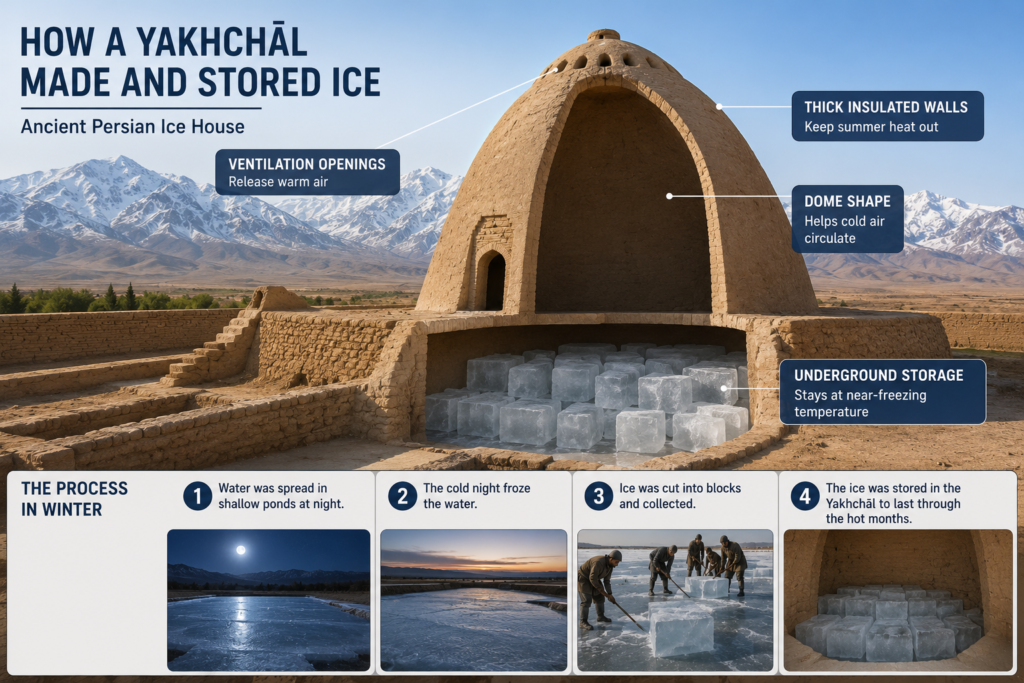
During the coldest part of winter, water was directed into very shallow pools beside the yakhchāl.
A large wall was positioned to keep the pools shaded from the sun.
The water was spread into a thin layer.
Then came the important part:
The cold desert night.
The Iranian plateau can have extremely dry air and clear skies. During a clear night, the surface of the water can lose heat by radiating it toward the sky.
At the same time, evaporation removes additional heat.
Under suitable conditions, the thin layer of water could freeze.
The next day, workers could collect the ice.
Then another thin layer of water was added.
The process could be repeated night after night until a substantial amount of ice had accumulated.
So the Persians had discovered something remarkable:
Under exceptionally favorable conditions, water can freeze even when the surrounding air temperature is slightly above 0°C, because the water surface can lose heat through evaporation and radiation.
Under the right conditions, the water surface can lose enough heat to freeze during a clear, dry night.
Experiments and later scientific studies of traditional Iranian ice makers have confirmed that ice could form under certain conditions even when the measured air temperature was slightly above freezing.
But Making Ice Was Only Half the Problem
Making ice is one thing.
Keeping it frozen through a scorching Persian summer is another.
This is where the yakhchāl became truly clever.
The ice was moved into a large underground chamber.
The chamber was protected by thick walls made from traditional insulating materials. The huge dome above it also helped manage heat and airflow.
Some yakhchāls were connected with qanats, underground water channels, and some used windcatchers to move cooler air through the structure.
The result was a giant natural refrigerator that required no electricity and no mechanical compressor.
The ice could then be used during the hot months for cooling drinks, preserving certain foods and making frozen treats such as faloodeh.
5. India Had an Incredible Ice-Making Method Too
India had another fascinating chapter in the story.
During the Mughal period, ice was largely obtained from colder regions such as Kashmir and transported to royal centres. Later, by the 18th and 19th centuries, people in parts of northern and eastern India developed methods for producing small quantities of artificial ice during winter nights. Porous clay pots containing water were placed in shallow, insulated trenches, where favorable nighttime conditions could cause a thin layer of ice to form.
The Mughals Also Built "Baraf Khanas"
The Mughals developed systems for storing and transporting ice.
Ice storage buildings and underground chambers were known as baraf khanas.
Ice could be brought from colder regions, including Kashmir, and carefully insulated during transportation.
Materials such as straw were used to reduce melting, while saltpetre was also associated with the preservation and cooling of ice during transport.
The ice eventually reached royal centres such as Delhi and Agra.
And what did the royal kitchens do with it?
Among other things, they used ice to prepare chilled drinks and frozen desserts.
This is one of the fascinating connections between old refrigeration technology and the history of kulfi and other frozen treats.
6. Europe: Ice Houses Kept Winter Ice Alive
Europe eventually developed its own widespread system of ice houses.
The basic principle was remarkably simple.
During winter:
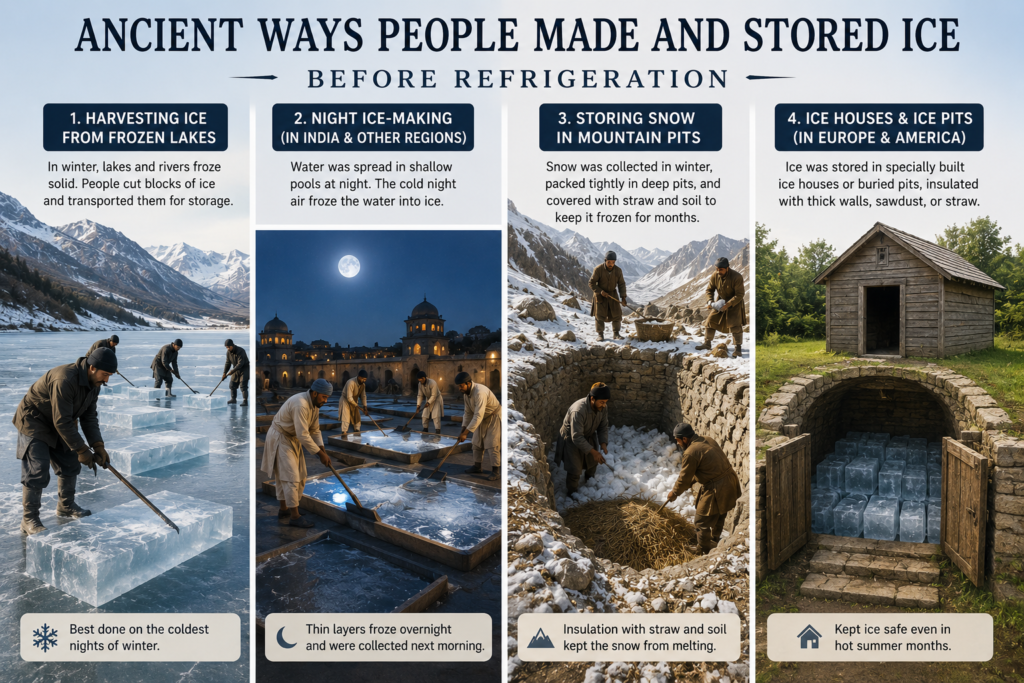
Cut ice from a frozen lake or pond → transport it to an ice house → pack it tightly → cover it with insulating material.
Ice houses were often underground or partially underground.
Straw, sawdust and other materials could be used as insulation.
Because the ice was packed tightly and protected from sunlight and warm air, a significant amount could survive for months.
By the 17th and 18th centuries, ice houses became particularly common on wealthy European estates.
They allowed wealthy families to enjoy chilled food and drinks long before refrigerators existed.
So Which Method Was the Cleverest?
It depends on where you lived.
Different environments required different solutions.
| Place | How they obtained ice | How they kept it |
|---|---|---|
| Mesopotamia | Mountain ice | Ice houses |
| Ancient China | Frozen rivers/lakes | Ice houses |
| Greece & Rome | Mountain snow and ice | Underground pits |
| Persia | Harvested ice + artificial ice-making | Yakhchāls |
| Mughal India | Mountain ice + artificial ice-making | Baraf khanas and insulated storage |
| Europe | Frozen lakes, ponds and rivers | Ice houses |
The basic principle was always the same:
Find cold → capture it → protect it from heat.
But Persia and parts of India took the idea one step further by finding ways to produce ice during cold nights, even without a naturally frozen lake nearby.
Why Didn't the Ice Melt Immediately?
This is where the science becomes interesting.
Ice melts when it absorbs enough heat.
So the people who built ancient ice houses were essentially trying to slow down the movement of heat into the ice.
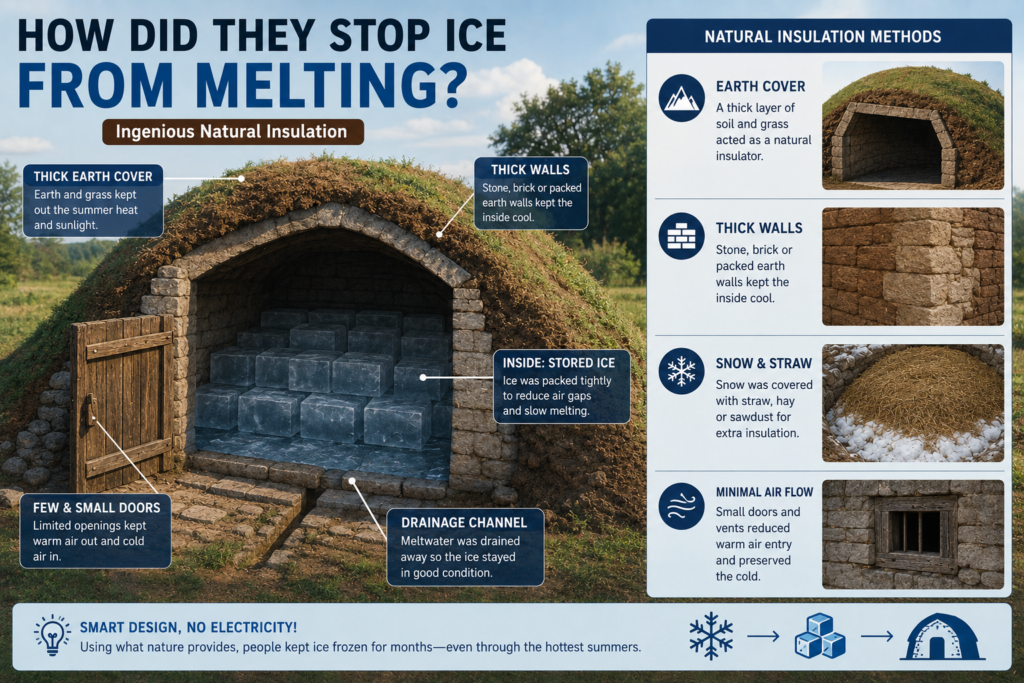
They used several tricks:
Underground storage
The ground temperature several metres below the surface changes much less than the temperature outside.
So an underground chamber could remain much cooler than the summer air.
Thick walls
Thick walls slowed the transfer of heat from the hot outside environment into the cold interior.
Straw and other insulation
Straw, sawdust and similar materials trapped air and reduced heat transfer.
Darkness
Keeping ice away from direct sunlight prevented solar radiation from heating it.
Drainage
When some ice inevitably melted, the water had to be removed quickly. Otherwise, it could transfer heat to the remaining ice and speed up melting.
The entire system was essentially thermal engineering without electricity.
Did Everyone Have Ice?
Definitely not.
For most of history, ice was not an everyday household item.
In many places it was expensive, difficult to transport and labour-intensive to store.
Ice was therefore often associated with:
- Royal courts
- Wealthy families
- Large estates
- Important ceremonies
- Luxury food and drinks
- Medical or therapeutic uses
A person living in an ordinary village might never have had access to ice during summer.
For a king, however, having ice available on a hot summer day could be a symbol of enormous wealth.
The Most Amazing Part: They Understood the Environment
The people who developed these systems didn’t have modern thermometers, refrigeration textbooks or computers.
Yet they observed something incredibly important:
The environment itself could do the cooling.
Cold winter air could freeze water.
Dry air could increase evaporation.
Clear night skies could allow surfaces to lose heat through radiation.
The ground could provide insulation.
Thick walls could slow heat transfer.
And clever architecture could move warm air away.
They combined all these effects into practical systems.
That’s why an ancient yakhchāl wasn’t simply a storage room.
It was a carefully engineered passive cooling system.
Just as people once learned to tell time by observing the Sun, shadows and stars, they learned to make and preserve ice by observing temperature, water and the night sky.
From Ice Houses to Refrigerators
For thousands of years, humans depended on nature to provide cold.
They harvested winter ice.
They collected mountain snow.
They dug underground pits.
They built enormous ice houses.
They experimented with evaporation and night-sky cooling.
Eventually, the Industrial Revolution changed everything.
Mechanical refrigeration meant that people no longer had to wait for winter, climb mountains or maintain enormous underground ice stores.
A machine could simply remove heat from an enclosed space.
And today, we have taken that technology even further.
Your refrigerator doesn’t actually create cold.
It removes heat.
That’s the same fundamental problem that ancient ice houses were trying to solve—but modern refrigerators use electricity, compressors and refrigerants instead of winter weather, underground chambers and straw.
So the next time you open your freezer and grab an ice cube, remember:
The ice cube may be modern, but the human obsession with making things cold is thousands of years old.
And perhaps the most surprising part is that some ancient engineers were already using the laws of heat transfer in ways that still make sense to scientists today.
Did You Know !!!???
Thousands of years ago, people built enormous underground structures to protect ice from the summer heat. Today, we’re still using the same basic idea—using naturally cold environments, insulation and technology to preserve things that are precious.
One amazing example is the Svalbard Global Seed Vault in Norway. Deep inside a mountain in the Arctic, it stores backup copies of seeds from around the world at −18°C. The surrounding permafrost provides an additional layer of natural protection.
The purpose is very different from an ancient ice house, but the idea is surprisingly similar: keep something valuable cold, protected and safe for the future.
2 thoughts on “How was Ice made before refrigeration? Ancient ice-making methods”