
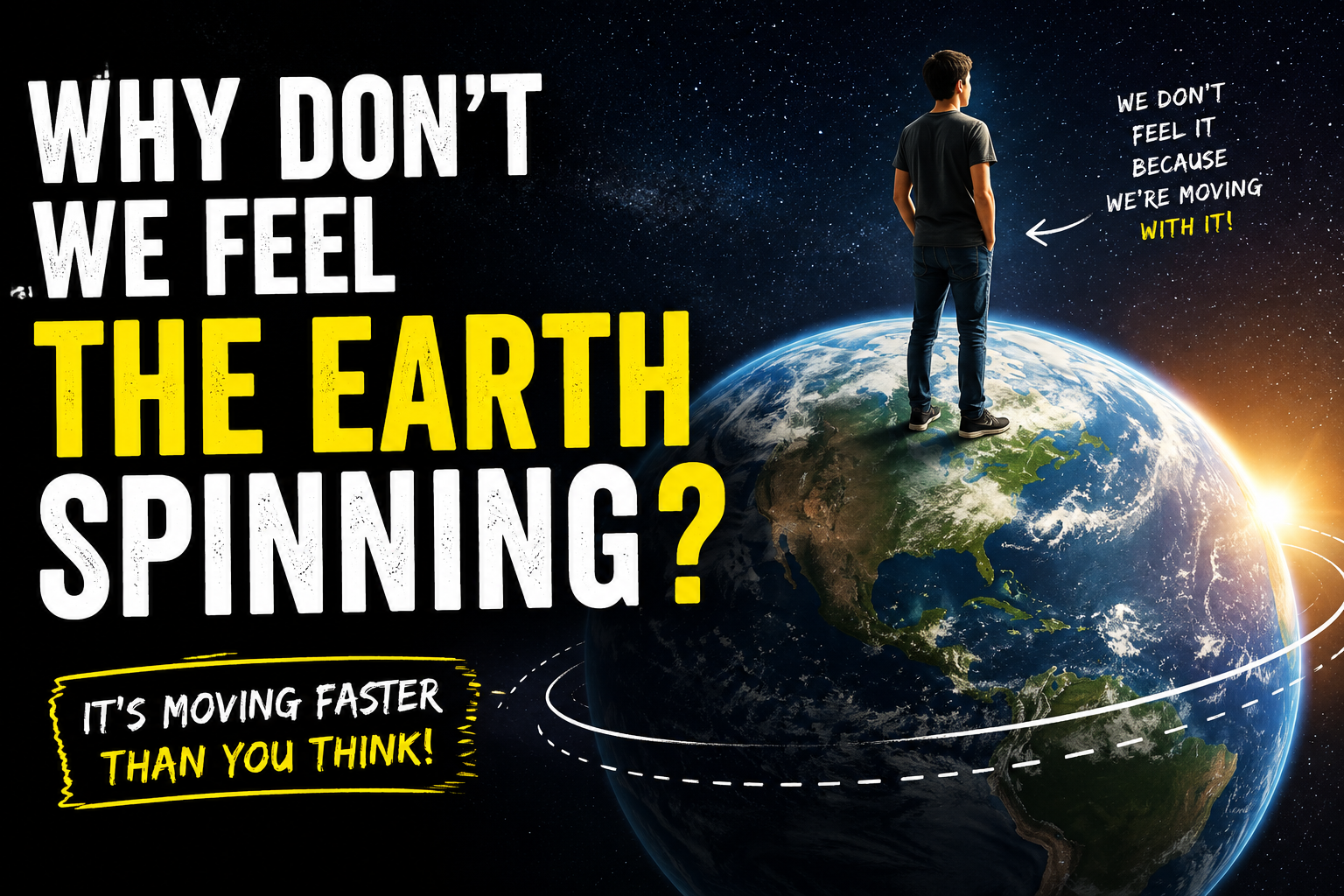
Why don’t we feel the Earth spinning? The Earth is spinning all the time. In fact, the ground beneath your feet is moving incredibly fast as the planet rotates around its axis.
So here is a strange question:
If the Earth is spinning so fast, why don’t we feel it?
You don’t feel the Earth rotating because you, the ground, the air, and almost everything around you are all moving together with the Earth.
But there is a little more to it than that. Let’s understand why we don’t feel the Earth spinning.
Is the Earth Really Spinning?
Yes!
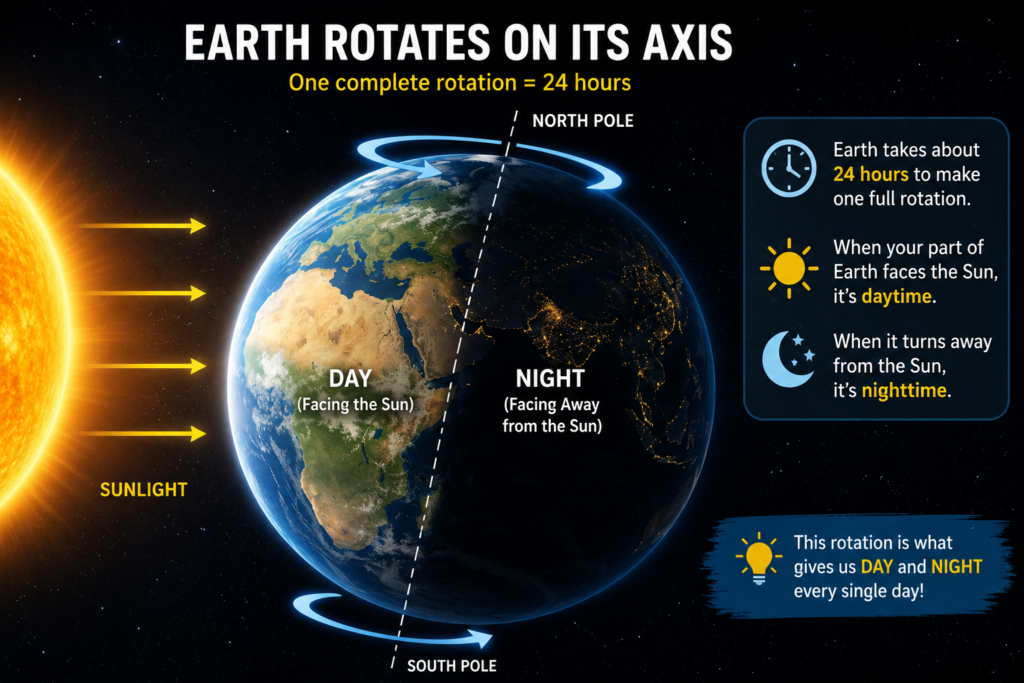
The Earth rotates around an imaginary line called its axis. This axis runs from the North Pole to the South Pole.
One complete rotation takes about 24 hours. This rotation is what gives us day and night.
When your part of Earth faces the Sun, it is daytime. When it turns away from the Sun, it becomes night time.
But if Earth is constantly rotating, shouldn’t we be able to feel the movement?
How Fast Is the Earth Spinning?
This is where things get surprising.
The Earth takes about 24 hours to make one rotation, but the speed at which you move depends on where you are on Earth.
At the equator, Earth’s surface moves at roughly 1,670 kilometres per hour!
That’s much faster than most airplanes.
Yet you don’t feel like you’re moving at 1,670 km/h.
Why?
Because speed by itself isn’t what you feel.
We Feel Changes in Motion, Not Constant Motion
Imagine sitting inside a smooth-moving airplane.
Once the airplane has reached cruising speed and is flying steadily, you can:
- Walk around
- Drink your coffee
- Use your phone
- Read a book
You don’t feel like you’re moving hundreds of kilometres per hour.
But if the airplane suddenly accelerates, brakes, or turns, you notice it immediately.
That’s because your body responds mainly to changes in motion, such as acceleration or a change in direction.
The same basic idea applies to the spinning Earth.
Earth’s rotation is extremely steady. We are already moving along with it.
You Are Already Moving With the Earth
Think about standing inside a moving train.
If the train is moving smoothly, everything inside the train is moving along with it.
You, your seat, your bag, and the air inside the train are all travelling together.
Earth works in a similar way.
You are not standing on a stationary surface while the Earth spins underneath you.
You are part of the spinning Earth.
The ground beneath you is rotating.
The atmosphere is moving with the planet too.
And your body is moving with everything around you.
So there is no sudden motion for your body to notice.
Why Don't We Get Thrown Off the Earth?
This is another interesting question.
If Earth is spinning, why don’t we get thrown into space?
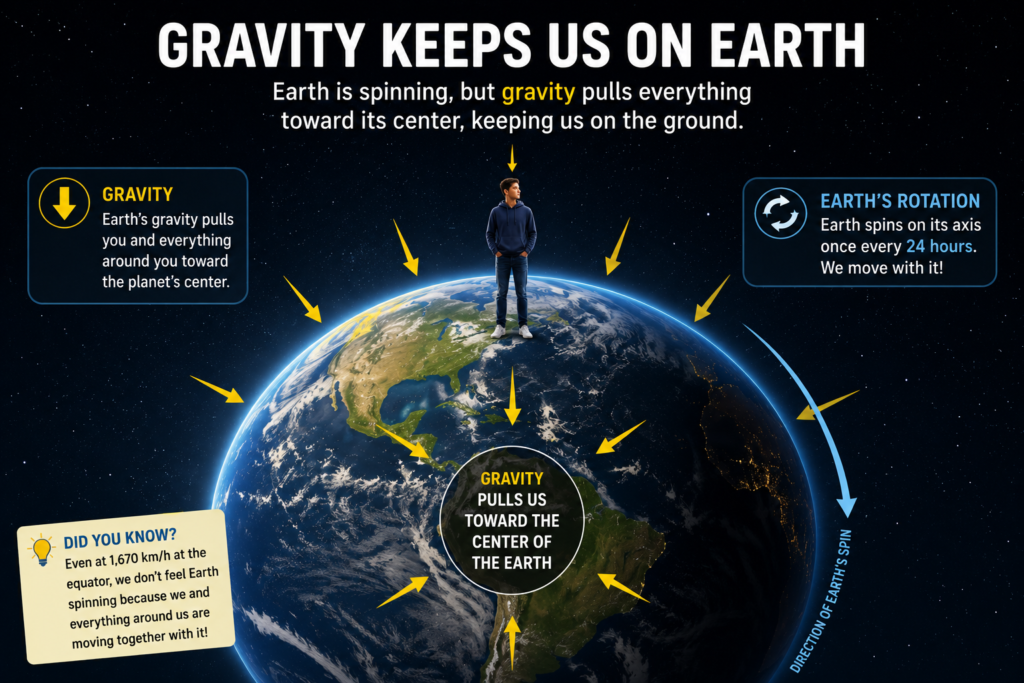
The answer is gravity.
Earth’s gravity pulls everything toward the planet’s centre. But gravity does much more than keep us on the ground—it also helps explain why the Moon stays in orbit instead of falling straight down to Earth.
Why Doesn’t the Moon Fall Down to Earth?
Earth’s rotation does have a small effect that tends to push objects outward, but Earth’s gravity is much stronger.
So gravity keeps you firmly on the surface while Earth rotates.
In fact, you are already being carried around Earth’s axis by the rotating planet.
What About the Air?
You might wonder:
If Earth is spinning, shouldn’t the atmosphere be left behind?
Not normally.
The atmosphere is also moving along with the rotating Earth.
The Earth’s surface, oceans, and atmosphere all participate in Earth’s rotation.
There are winds and other movements in the atmosphere, of course, but the atmosphere isn’t simply sitting still in space while Earth spins underneath it.
That’s why we don’t experience a constant hurricane-like wind just because Earth is rotating.
Why Don't We Feel the Speed?
Here’s the key idea:
Constant speed doesn’t automatically create a sensation of movement.
Your body is very good at detecting acceleration and other changes in motion.
For example, when a car suddenly starts moving, you may feel yourself pushed backward.
When it suddenly stops, you move forward.
When it turns sharply, you feel yourself pulled to one side.
But if the car travels smoothly at a constant speed, you may barely notice the motion.
Earth’s rotation is much smoother and more gradual than anything we experience in a car.
But Earth Is Changing Direction All the Time
There’s an interesting detail here.
Even though Earth’s rotation is steady, the direction of your motion is continuously changing because you’re travelling in a circle around Earth’s axis.
That means there is a type of acceleration called centripetal acceleration.
But it is very small compared with the effects of Earth’s gravity.
So you don’t experience it as a dramatic sensation of spinning.
Would We Feel It If Earth Suddenly Stopped?
Absolutely!
This is where things become very different.
If Earth suddenly stopped rotating, the ground would stop, but objects and the atmosphere would tend to keep moving because of inertia.
That would create enormous effects.
But don’t worry—Earth isn’t expected to suddenly stop spinning.
Its rotation does change very slightly over extremely long periods, but these changes are gradual.
Can We Prove That Earth Is Spinning?
Yes!
We don’t have to rely on simply looking at the Sun moving across the sky.
There are several ways to demonstrate Earth’s rotation.
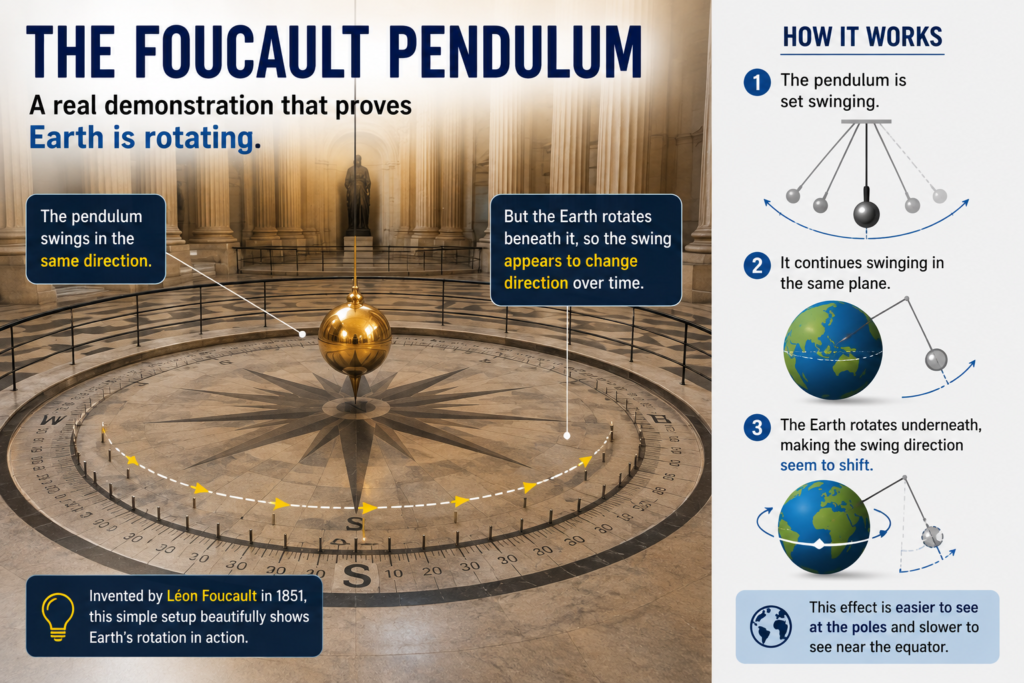
One famous example is the Foucault pendulum.
A long pendulum swings back and forth in a way that appears to change its direction over time. What’s actually happening is that the Earth is rotating beneath the pendulum.
Satellites, astronomy, and modern measurements also provide extremely precise evidence that Earth rotates.
So, Why Don't We Feel the Earth Spinning?
Let’s put everything together.
We don’t feel Earth’s rotation because:
1. We are moving with Earth.
The ground, oceans, atmosphere, and everything around us are rotating together.
2. Earth’s rotation is very smooth.
There isn’t a sudden acceleration that our bodies would strongly notice.
3. We mainly notice changes in motion.
Starting, stopping, and turning are much easier for our bodies to detect than steady motion.
4. Gravity keeps us on Earth.
Earth’s gravity is strong enough to keep us firmly attached to the surface.
5. The rotational effects are relatively small.
Although Earth is moving very quickly at the equator, the effects we experience from that rotation are subtle.
The Amazing Part: You're Moving Right Now!
You may be sitting completely still while reading this article.
But you’re not actually stationary.
You are rotating with Earth.
And Earth is also travelling around the Sun.
The Sun itself is moving through the Milky Way.
So even when you feel perfectly still, you are taking part in several enormous cosmic motions at once.
And you don’t feel any of them.
That’s one of the fascinating things about living on a planet that is constantly moving through space.
What Changes Between the Equator and the Poles?
Earth doesn’t spin at the same surface speed everywhere.
At the equator, you are about 6,378 km from Earth’s rotation axis, so you travel the greatest distance during each rotation. Your surface speed is about 1,670 km/h.
At the North or South Pole, you are essentially sitting on the rotation axis. You still complete one rotation every day, but you don’t travel around a large circle. Your rotational surface speed is therefore almost zero.
Does This Make a Difference to Us?
Yes — although the differences are subtle.
At the equator, Earth’s rotation produces a slightly stronger outward centrifugal effect. This slightly reduces the effective gravity you experience, so you would weigh a little less at the equator than at the poles.
There is another effect too: Earth’s rotation contributes to the Coriolis effect, which influences the paths of moving air and water and is important in weather systems.
But there’s an important detail: not all of the difference in gravity between the equator and poles is caused by Earth’s rotation. Earth is slightly wider around the equator than from pole to pole, which also affects gravity.
Can You Actually See Earth's Rotation at the Equator or Poles?
This is where it gets really interesting.
Try a Foucault Pendulum
A Foucault pendulum is one of the best demonstrations of Earth’s rotation.
At the North or South Pole, the pendulum’s swing plane appears to rotate completely around once in about a day.
At the equator, something surprising happens: the swing plane does not rotate because of Earth’s rotation.
At locations between the equator and the poles, the effect is somewhere in between.
So the Foucault pendulum gives us a beautiful demonstration of how Earth’s rotation behaves differently depending on where you are on the planet.
A Fascinating Equator vs Pole Comparison
| Equator | Poles | |
|---|---|---|
| Surface speed from Earth’s rotation | ~1,670 km/h | ~0 km/h |
| Distance from rotation axis | Greatest | Almost zero |
| Centrifugal effect | Greatest | Essentially zero |
| Foucault pendulum rotation | Zero | Fastest |
| Coriolis effect | Zero at exact equator | Strongest |
| Effective gravity | Slightly lower | Slightly higher |
1 thought on “Why Don’t We Feel the Earth Spinning? The Amazing Truth Explained”