
How Does an Earthquake Happen?
Imagine you are sitting quietly at home.
Suddenly, the glass in the window rattles.
Then the fan begins to sway.
The floor seems to move beneath your feet.
For a moment, you wonder:
“What just happened?”
The answer may be an earthquake.
But here is the strange part: the Earth beneath us is moving all the time. Its enormous rocky plates are slowly pushing, pulling and sliding past one another.
So why don’t we feel this movement every day?
Because most of the time, the movement is incredibly slow.
An earthquake happens when that slow movement suddenly turns into a violent release of energy.
Let’s go underground and see what is really happening.
The Earth Beneath Your Feet Isn't Standing Still
When you look around, the ground appears completely solid and still.
The Earth may look still, but our planet is actually in constant motion. The Earth itself is also spinning all the time.
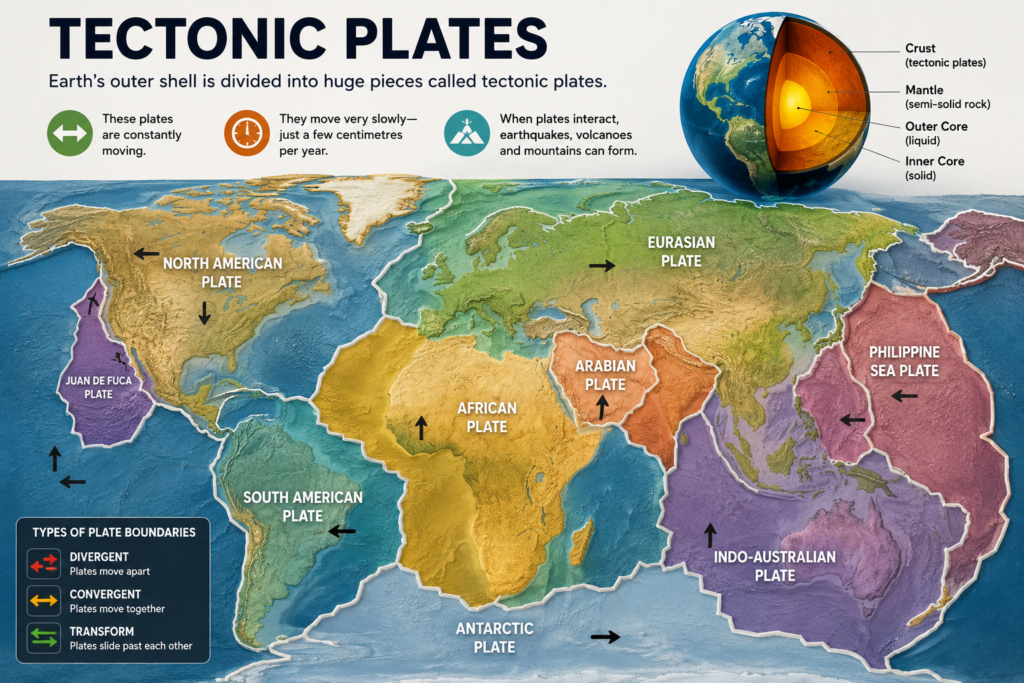
The outer rocky layer of our planet is broken into huge pieces called tectonic plates.
These plates are enormous. Some carry continents, while others form large parts of the ocean floor.
And they are constantly moving.
Not quickly.
Usually, they move only a few centimetres each year.
That doesn’t sound like much.
But imagine pushing something incredibly heavy with enormous force and finding that it barely moves.
That’s roughly what is happening between some tectonic plates.
And this is where things get interesting.
What Happens When the Earth Gets "Stuck"?
Tectonic plates don’t always slide smoothly past one another.
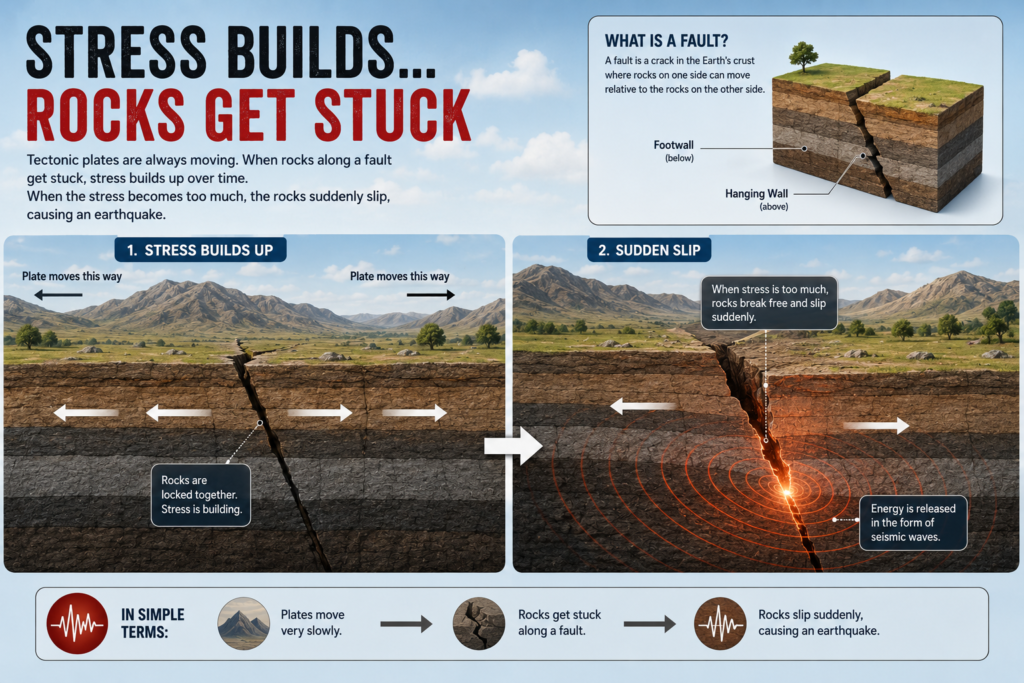
Sometimes, the rocks along their boundaries become locked together.
The plates, however, continue trying to move.
So what happens?
Stress begins to build up in the rocks.
Think about bending a plastic ruler.
At first, nothing dramatic happens. You keep bending it and energy is stored inside it.
Bend it far enough, and suddenly—
SNAP!
The ruler releases that stored energy.
Rocks deep underground can behave in a similar way.
The difference is that the forces involved in the Earth are unimaginably larger.
The Hidden Crack Called a Fault
The places where rocks can break and move against each other are called faults.
Imagine two huge blocks of rock pressing against each other.
They may remain stuck for a long time.
Meanwhile, the forces pushing them continue to build.
Eventually, the stress becomes greater than the rocks can withstand.
The rocks suddenly break, slip or shift along the fault.
And in that instant, energy that had been stored in the rocks is released.
That is the beginning of an earthquake.
How Does an Earthquake Happen Deep Underground?
An earthquake doesn’t begin at the surface.
It usually starts deep underground.
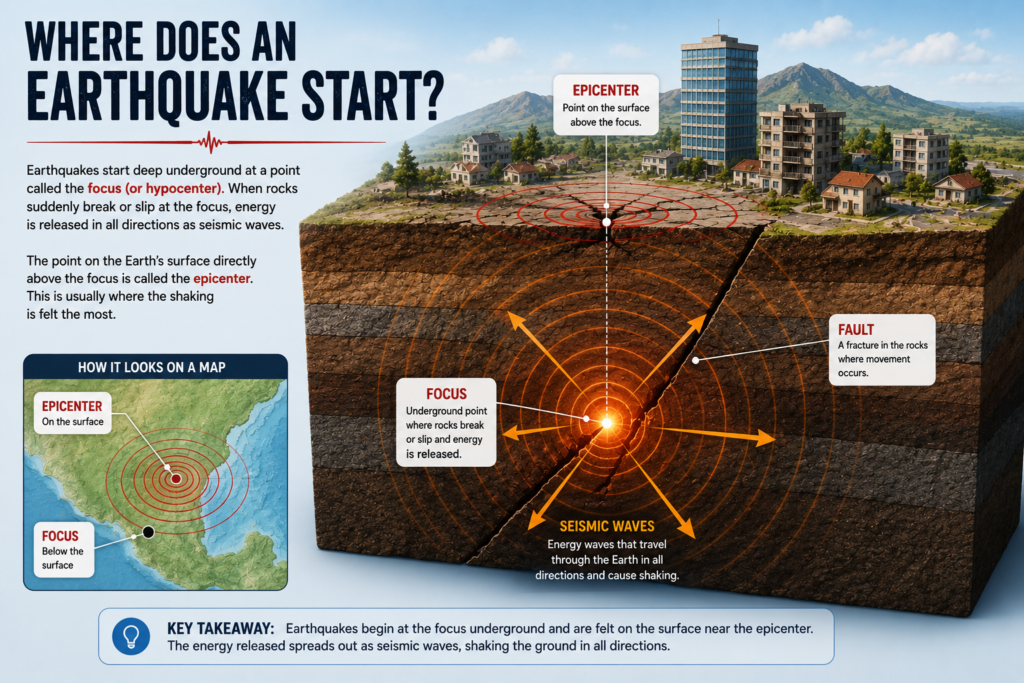
The point inside the Earth where the rupture begins is called the focus, or hypocenter.
Directly above it, on the Earth’s surface, is the epicenter.
Think of dropping a stone into a pond.
The place where the stone hits the water is the starting point, and waves spread outward from there.
An earthquake is somewhat similar.
Except instead of water waves spreading across a pond, seismic waves spread through the Earth.
So What Actually Makes the Ground Shake?
When the rocks suddenly move, they release energy.
That energy travels through the Earth as seismic waves.
Some travel through the Earth’s interior, while others move along its surface.
When these waves reach where you are standing, they make the ground move.
And that’s the shaking you feel.
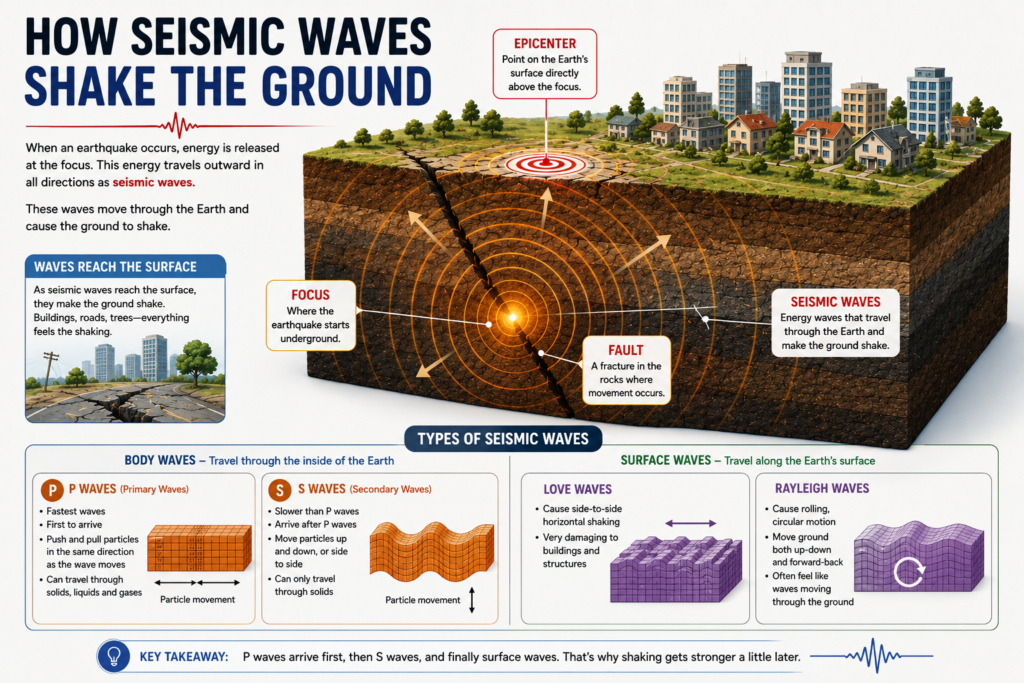
Some waves push and pull the ground.
Others make it move from side to side or up and down.
The combination can make buildings sway, objects fall and roads or bridges move.
Why Can a Tiny Movement Cause So Much Damage?
This is one of the most surprising things about earthquakes.
The rocks along a fault may move only a relatively small distance.
Yet the energy released can be enormous.
That’s because the earthquake isn’t caused simply by the distance the rocks move.
It is the result of huge forces acting over enormous areas of rock.
A fault can extend for hundreds of kilometres.
When a large section of it suddenly slips, an enormous amount of stored energy can be released.
That energy travels outward as seismic waves.
And suddenly, something that happened deep underground can affect everything above it.
Why Do Some Earthquakes Feel Like a Gentle Shake While Others Are Violent?
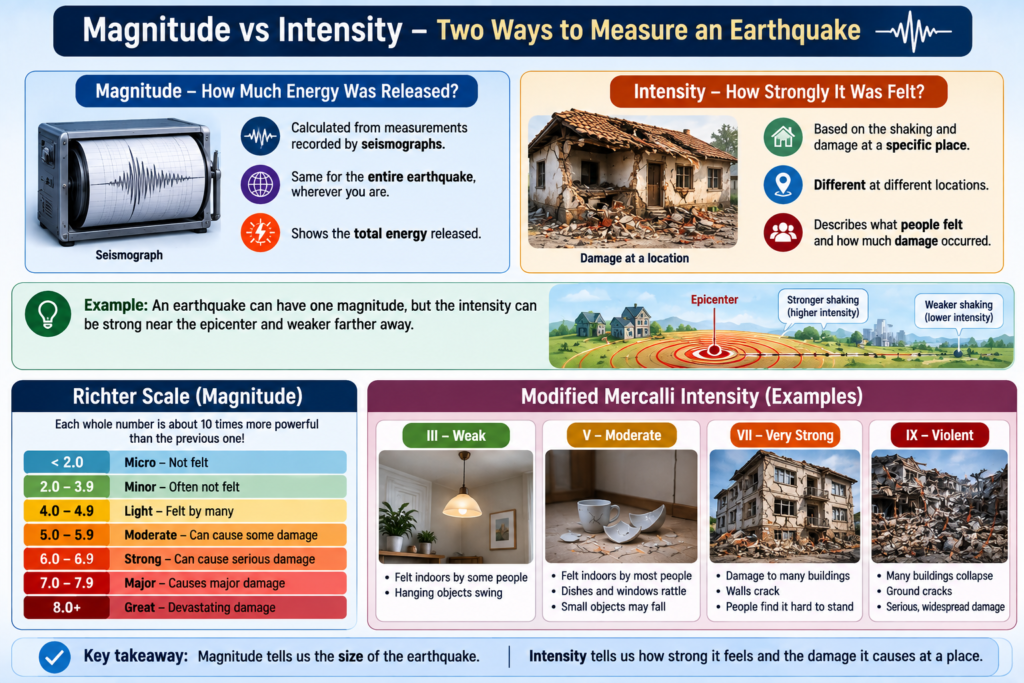
Not all earthquakes release the same amount of energy.
A small rupture may produce barely noticeable shaking.
A large rupture can release an enormous amount of energy.
But there is another important factor:
Where the earthquake happens matters.
An earthquake close to the surface can produce intense shaking nearby.
The type of ground also matters.
Soft sediments can sometimes amplify shaking compared with solid rock.
And buildings respond differently depending on their design, height, materials and construction.
That’s why one building may sway noticeably while another nearby experiences much less movement.
Can an Earthquake Happen Without Tectonic Plates Colliding?
Yes.
When we think of earthquakes, we often imagine two plates crashing into each other.
But earthquakes can occur in several different tectonic settings.
Plates can:
- Push toward each other
- Pull apart
- Slide past one another
All three types of movement can create earthquakes.
And earthquakes can sometimes occur away from major plate boundaries too, when stresses are transmitted through the Earth’s crust.
Can Humans Cause Earthquakes?
Most earthquakes are natural and are caused by movements within the Earth’s crust.
But human activity can sometimes trigger earthquakes.
Activities such as mining, filling large reservoirs, geothermal operations and injecting fluids deep underground have, in certain circumstances, been associated with induced seismicity.
These earthquakes are generally much smaller than the largest naturally occurring earthquakes.
Can Scientists Predict an Earthquake?
This is where things get tricky.
Scientists know where earthquakes are more likely to happen.
They can study faults, past earthquakes and movements of tectonic plates to understand earthquake risk.
But they cannot currently say:
“An earthquake will happen here at 3:17 PM next Tuesday.”
There is no reliable method for making that kind of precise prediction.
However, some places have earthquake early-warning systems.
And there is an important difference between prediction and early warning.
An early-warning system doesn’t know that an earthquake is going to happen tomorrow.
It detects that an earthquake has already started and can sometimes provide a few seconds of warning before stronger shaking arrives.
Those few seconds can be surprisingly valuable.
So, What Is Really Happening During an Earthquake?
Let’s put the entire story together.
The tectonic plates slowly move.
↓
Rocks along a fault become stuck.
↓
The plates continue pushing or pulling.
↓
Stress builds up in the rocks.
↓
The rocks suddenly break or slip.
↓
Stored energy is released.
↓
Seismic waves race through the Earth.
↓
The ground shakes.
And that’s an earthquake.
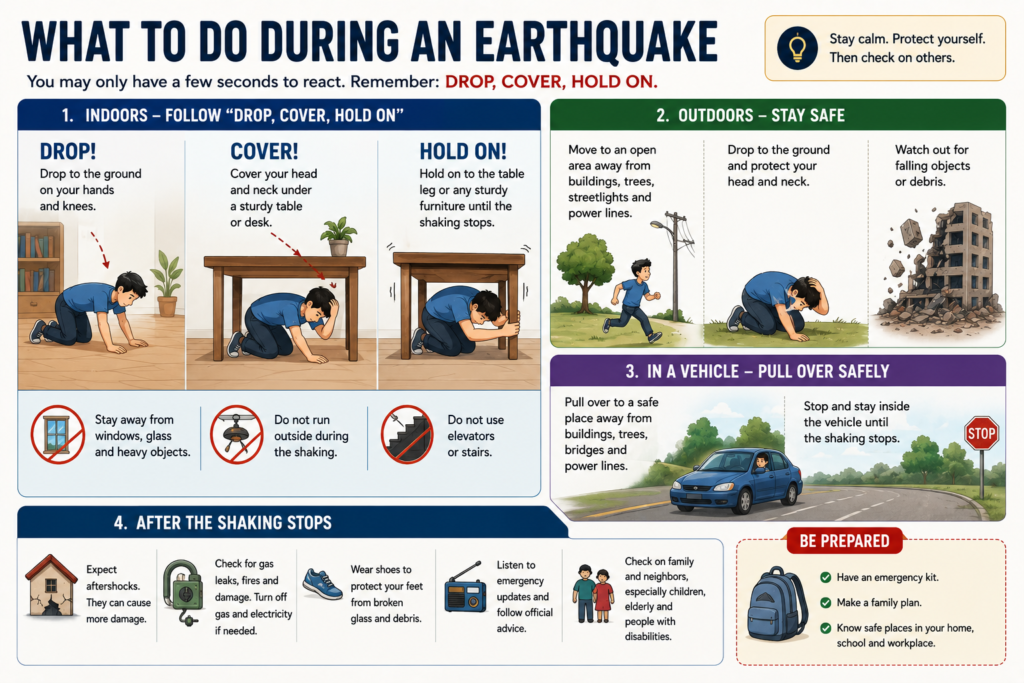
The Earth May Look Still—But It Isn't
The next time you stand outside and look at the ground, remember something strange:
The ground beneath you is part of a planet that is constantly moving.
Continents are slowly travelling.
Mountains are being pushed upward.
Oceans are opening and closing over geological time.
And deep underground, enormous stresses are continuously building and changing.
Most of this happens so slowly that we never notice.
But occasionally, a fault suddenly slips.
Energy that has been building for years, decades or even centuries can be released in seconds.
And that’s when the ground beneath our feet reminds us that the Earth was never truly still.
🌎 Did You Know? Fascinating Earthquake Facts
Earthquakes aren’t just about shaking ground. Here are some fascinating facts that show just how powerful—and surprising—our planet can be.
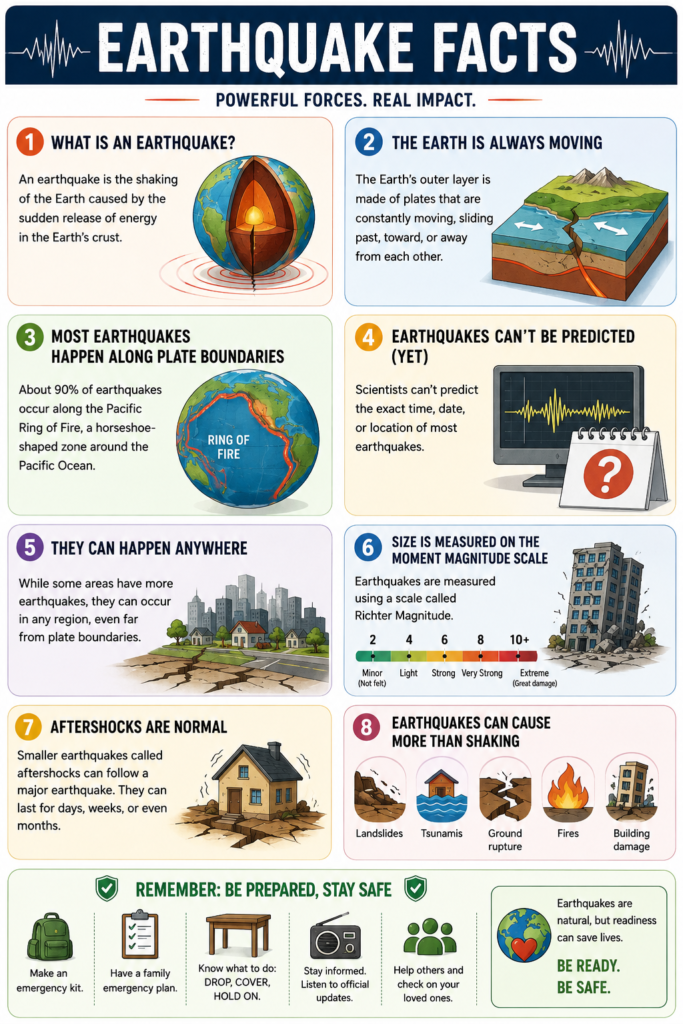
🔥 1. The Pacific Ocean Has a “Ring of Fire”
Look at a map of the Pacific Ocean and you’ll notice something fascinating: many of the world’s earthquake and volcano zones form a huge belt around it.
This is called the Pacific Ring of Fire.
It stretches along the edges of the Pacific Ocean, where several tectonic plates meet.
The region is the world’s most seismically and volcanically active zone. About 81% of the world’s largest earthquakes occur along this belt, according to the U.S. Geological Survey.
And despite its dramatic name, the “Ring of Fire” doesn’t mean the entire region is constantly erupting or shaking. It simply reflects how active this part of the planet is.
🌊 2. The Largest Earthquake Ever Recorded Was Magnitude 9.5
The largest earthquake ever recorded by modern instruments happened in Chile on May 22, 1960.
It reached a magnitude of 9.5 and is commonly known as the Great Chilean Earthquake or Valdivia Earthquake.
It was so powerful that the rupture extended for roughly 1,000 miles (about 1,600 km) along the fault zone.
And the earthquake didn’t only shake Chile.
It generated a massive tsunami that travelled across the Pacific Ocean, affecting places as far away as Hawaii and Japan.
🤯 3. A Magnitude 10 Earthquake Isn't Realistically Possible
You may have heard people talk about a “magnitude 10 earthquake.”
But according to the USGS, no fault known on Earth is large enough to produce a magnitude 10 earthquake.
The bigger the earthquake, the larger the section of fault that generally needs to rupture. A magnitude 10 earthquake would require a fault system of extraordinary size—far beyond anything known on Earth.
So the next time you see a movie promising a “magnitude 10 megaquake,” you can be skeptical!
⏱️ 4. Earthquakes Can Be Over in Seconds—But the Effects Can Last Much Longer
The intense shaking from an earthquake may last only seconds or minutes.
But that doesn’t mean everything is over when the shaking stops.
A major earthquake can be followed by aftershocks, landslides, fires, tsunamis and other hazards.
And sometimes, the most destructive consequence isn’t the shaking itself.
A powerful earthquake beneath or near the ocean can suddenly displace huge amounts of water and generate a tsunami.
That’s exactly what happened after the 1960 Chile earthquake.
🌍 5. Earthquakes Happen Every Day
Earthquakes aren’t rare events.
In fact, millions of earthquakes occur around the world each year.
Most are so small that people never feel them and sensitive instruments are needed to detect them. The USGS notes that earthquakes are occurring somewhere on Earth every day.
So while a large destructive earthquake may be unusual in any particular place, tiny earthquakes are part of the Earth’s normal activity.
🪨 6. Some Earthquakes Happen Far Away From Plate Boundaries
You might think earthquakes only happen where tectonic plates meet.
That’s where many earthquakes occur—but not all of them.
Earthquakes can also happen inside tectonic plates, when stresses travel through the Earth’s crust and cause older faults or fractures to slip.
This is one reason earthquakes can occasionally occur in places that don’t sit directly on a major plate boundary.
The Earth’s crust has a much longer and more complicated geological history than the map of today’s plate boundaries might suggest.
1 thought on “How Does an Earthquake Happen?”