
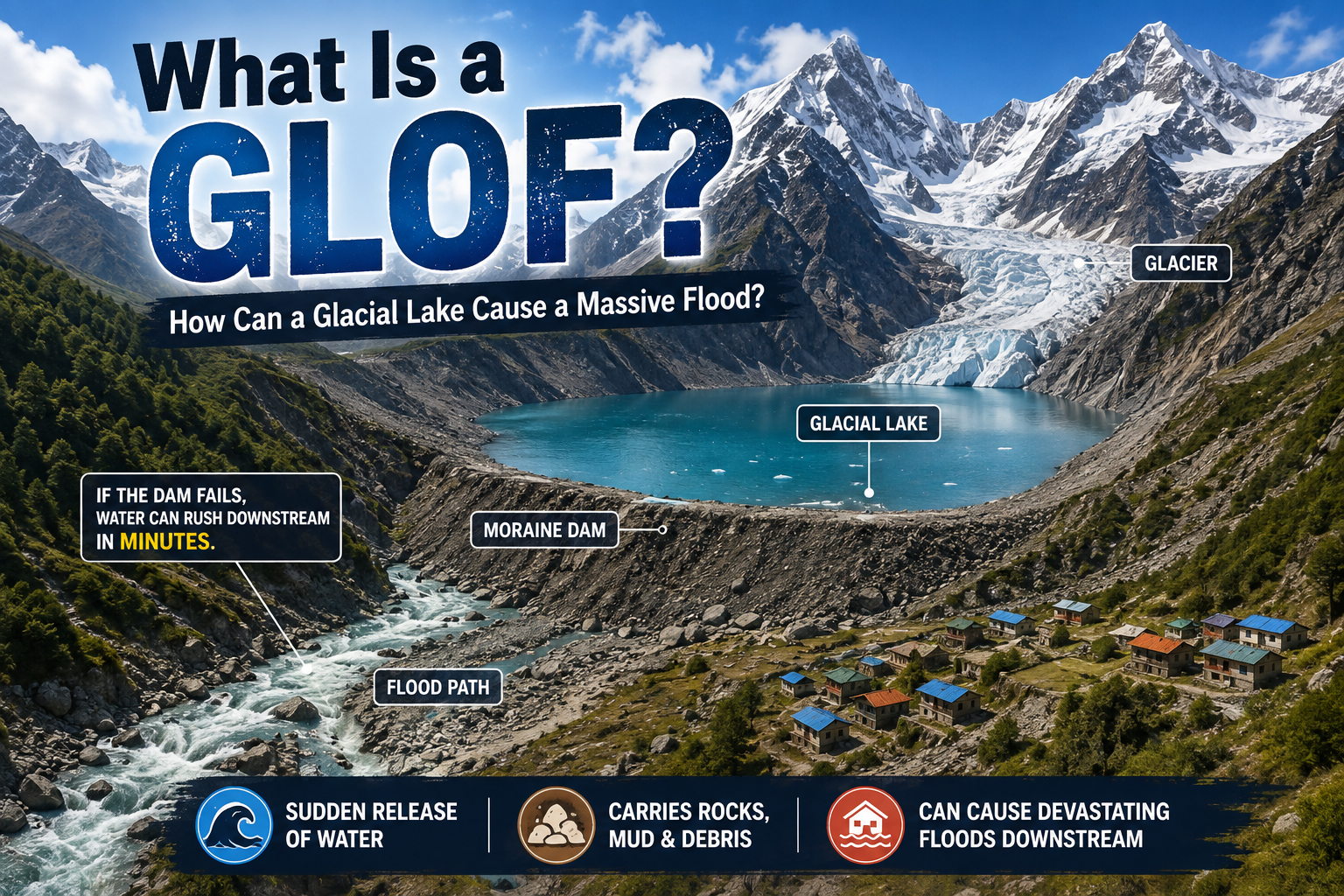
What is a GLOF? Imagine a huge lake sitting high in the mountains, surrounded by glaciers, snow and towering rocky peaks. The water may look completely peaceful. But what if the natural barrier holding that water back suddenly breaks?
Millions of cubic metres of water could rush downhill, carrying rocks, mud and debris with it.
This frightening phenomenon is called a Glacial Lake Outburst Flood, or GLOF.
GLOFs are particularly important in mountain regions such as the Himalayas, where glaciers are changing and new glacial lakes are forming or growing. A sudden release of water from one of these lakes can threaten communities, roads, bridges and other infrastructure far downstream.
But how does a glacial lake form in the first place? What makes one dangerous? And can scientists predict when a lake might burst?
Let’s understand it step by step.
What is a GLOF? What Does GLOF Stand For?
GLOF stands for Glacial Lake Outburst Flood.
The name itself tells us what happens:
- Glacial — related to a glacier
- Lake — a body of water
- Outburst — a sudden release
- Flood — a large amount of water rushing into an area
A GLOF occurs when a large amount of water stored in or around a glacier-fed lake is suddenly released.
According to the International Centre for Integrated Mountain Development (ICIMOD), glacial lakes can be held back by natural barriers made of glacial debris, ice or even bedrock. If that barrier fails, the resulting flood can become extremely destructive.
But before we understand how a lake can burst, we first need to understand how these unusual lakes are formed.
How Does a Glacial Lake Form?
A glacier is a huge mass of ice that slowly moves downhill under its own weight.
As a glacier moves, it can scrape, crush and carry rocks and soil. When the glacier retreats or melts, it can leave behind piles of rock and sediment.
These piles are called moraines.
Now imagine a glacier slowly shrinking.
As the ice melts, water collects in the low areas left behind by the glacier. A moraine or another natural barrier may hold this water in place.
Over time:
Glacier retreats → Ice melts → Water collects → A glacial lake forms
Some of these lakes can become very large.
And this is where the potential danger begins.
A lake held back by a natural dam is very different from a lake surrounded by a strong, engineered concrete dam. A moraine dam may contain loose rocks and sediment, making it vulnerable to changes in the surrounding environment.

Why Can a Glacial Lake Be Dangerous?
Think of a glacial lake as a giant container of water sitting high above a valley.
The higher the lake is, the more potential energy its water has. If the barrier holding it back fails, gravity can turn that stored energy into a rapidly moving flood.
The natural barrier may become unstable for several reasons.
For example:
🪨 A landslide can fall into the lake
A huge mass of rock, soil or debris falling into the lake can push water suddenly toward the natural dam.
🧊 An ice or glacier avalanche can enter the lake
A large piece of ice falling into the water can create a powerful wave. That wave may overtop or damage the natural barrier.
🌧️ Heavy rainfall can add huge amounts of water
Intense rainfall can rapidly increase the amount of water entering the lake.
🌡️ The surrounding glacier and landscape can change
As glaciers retreat and mountain environments warm, the shape and stability of lakes, ice and surrounding slopes can change.
Sometimes several of these processes can happen together.
That is why scientists don’t look at just the lake itself. They also study the glacier, the natural dam, nearby slopes, rainfall, earthquakes and other possible triggers.
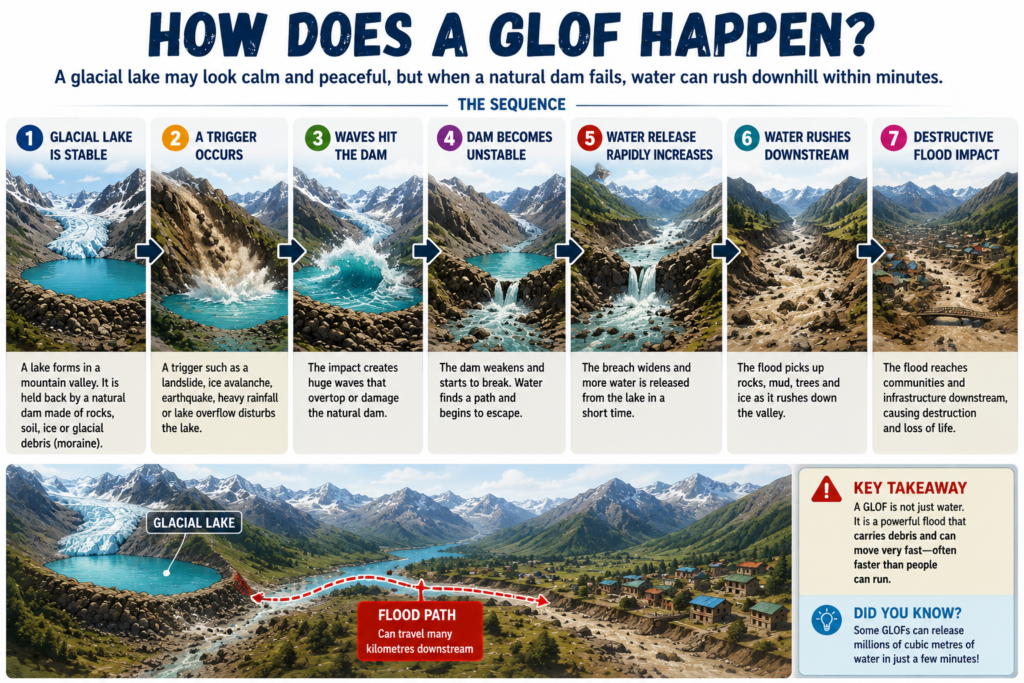
So, How Does a GLOF Actually Happen?
Let’s imagine a glacial lake held back by a moraine dam.
At first, everything is stable.
Then a large landslide occurs above the lake.
The landslide crashes into the water, creating a huge wave.
The wave reaches the natural dam.
If the dam is overtopped or damaged, water begins escaping.
The escaping water erodes the dam further.
More water escapes.
The flow becomes larger and faster.
As it races downhill, it can pick up rocks, soil, trees and other debris.
The result can be a powerful flood moving through the valley.
The sequence can look like this:
Glacial lake
↓
Trigger such as landslide or ice avalanche
↓
Natural dam becomes unstable
↓
Water escapes
↓
Dam erodes and more water is released
↓
Powerful flood rushes downstream
↓
Water carries rocks, mud and debris
This is a Glacial Lake Outburst Flood.
ICIMOD notes that landslides, fragmentation of glaciers and other processes can create displacement waves that compromise the stability of a glacial lake and its natural dam.
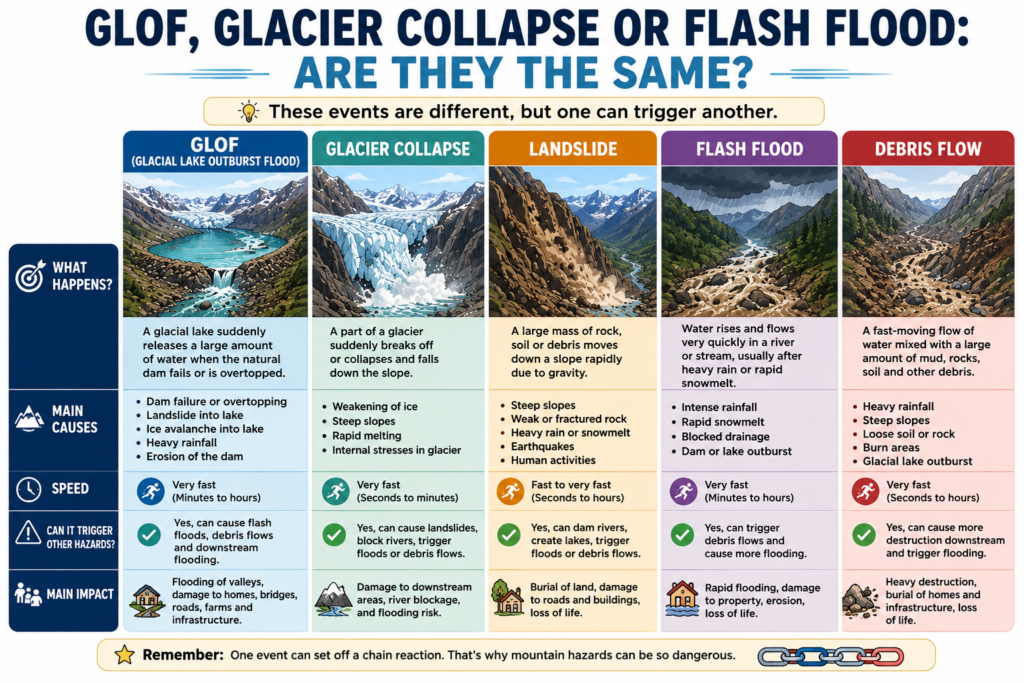
GLOF, Glacier Collapse or Flash Flood: Are They the Same?
Not quite.
These terms are sometimes used interchangeably in news reports, but they describe different things.
| Event | What happens? |
|---|---|
| GLOF | A glacial lake suddenly releases a large amount of water |
| Glacier collapse | A section of glacier suddenly breaks or collapses |
| Landslide | Rock, soil or debris rapidly moves downhill |
| Flash flood | Water rises and flows very quickly |
| Debris flow | Fast-moving water carries large amounts of mud, rocks and debris |
The important thing is that one event can trigger another.
For example:
Glacier collapse → debris enters river → temporary blockage → water builds up → sudden release → flash flood
Or:
Landslide → enters glacial lake → huge wave → natural dam fails → GLOF
This is why mountain disasters can sometimes become complicated chains of events rather than a single hazard.
A Recent Example: Why Is Nepal Watching Glacial Lake Risks?
The importance of understanding these hazards has become particularly clear after the devastating August 2026 glacier-related disaster near the Nepal–China border.
A large section of glacier and underlying bedrock collapsed. The resulting ice-and-rock avalanche entered the river system and triggered a destructive sequence of flooding and debris movement downstream. Satellite observations and expert analysis have helped scientists reconstruct the event.
It is important to make one distinction here:
The August 2026 Nepal disaster should not simply be described as a classic GLOF.
Experts have described it as a complex chain involving glacier and rock collapse, flooding and debris movement. In other words, it demonstrates that glacier-related hazards can extend beyond GLOFs.
However, the event has also drawn attention to another concern.
The collapse created unstable conditions and temporary water bodies in the region. One newly formed lake near the disaster area is being closely monitored because a sudden release of its water can create another flood threat. Authorities are using aerial surveillance and other monitoring methods to assess the the danger being posed by the lake.
This is a good example of why scientists monitor glacial lakes and other temporary mountain lakes so carefully.
A disaster doesn’t always end with the first event. One hazard can create conditions for another.
Are GLOFs Connected to Global Warming?
This is an important question.
As Earth’s climate warms, glaciers in many parts of the world are retreating and losing ice.
When glaciers retreat, they can leave behind depressions that fill with meltwater, creating or enlarging glacial lakes.
At the same time, warming can affect frozen ground, ice and the stability of mountain slopes.
This does not mean that every GLOF is directly caused by global warming.
Natural events such as landslides, avalanches and earthquakes can also trigger lake outbursts.
Instead, scientists are concerned that climate change can alter the conditions in which glaciers, glacial lakes and surrounding mountain slopes exist, potentially increasing some hazards.
The Hindu Kush Himalaya is particularly important because it contains thousands of glaciers and glacial lakes, while also being a region of steep, geologically active mountains. ICIMOD has reported that rising temperatures are contributing to changing flood risks in high-mountain Asia, including risks associated with GLOFs.
So the connection is not as simple as:
Global warming = GLOF
It is more accurately:
Warming climate → changing glaciers and mountain environments → changing glacial lakes and slope stability → potentially greater risk from some hazards
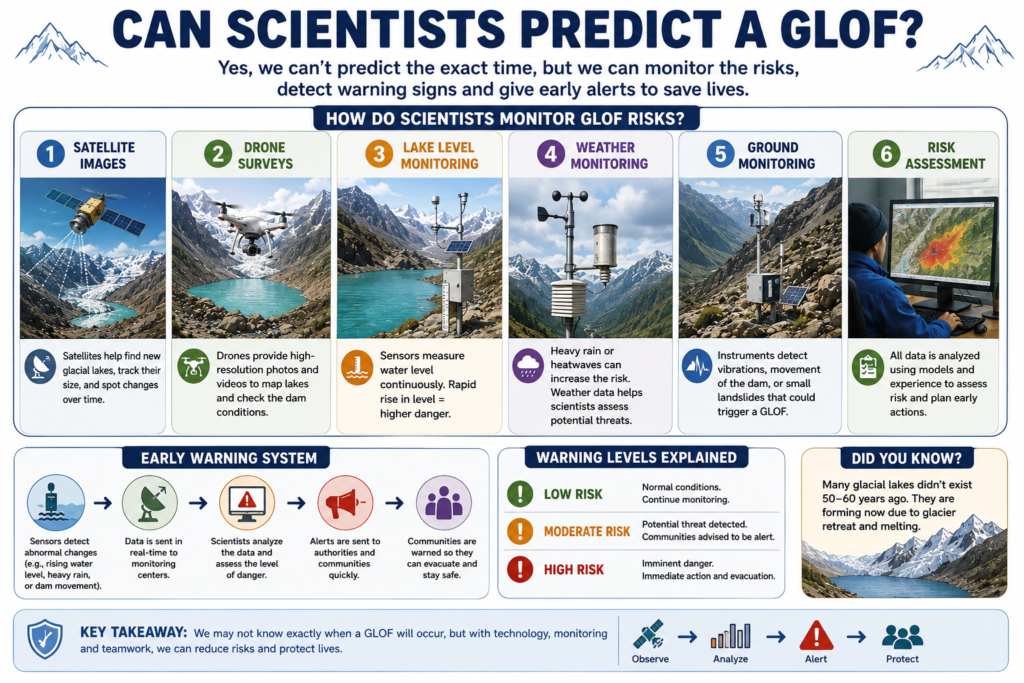
Can Scientists Predict a GLOF?
Scientists cannot simply look at a glacial lake and say, “It will burst tomorrow.”
Predicting the exact timing of a GLOF is extremely difficult.
But scientists can identify lakes that may present a higher level of risk.
They use several tools and observations, including:
🛰️ Satellite images
Satellites can show how the size of a lake or glacier changes over time.
📏 Lake measurements
Scientists can monitor the area, water level and volume of a lake.
🏔️ Slope monitoring
They can look for unstable slopes around the lake that could collapse into the water.
🧊 Glacier monitoring
Changes in glacier movement and ice conditions can provide important clues.
🌧️ Weather information
Heavy rainfall or rapid snow and ice melt can increase the amount of water entering a lake.
📡 Early-warning systems
Sensors and communication systems can provide warnings if water levels or other conditions change rapidly.
The goal is not necessarily to predict the exact minute a GLOF will happen.
Instead, scientists and authorities try to identify dangerous conditions early enough to reduce the risk to people downstream.
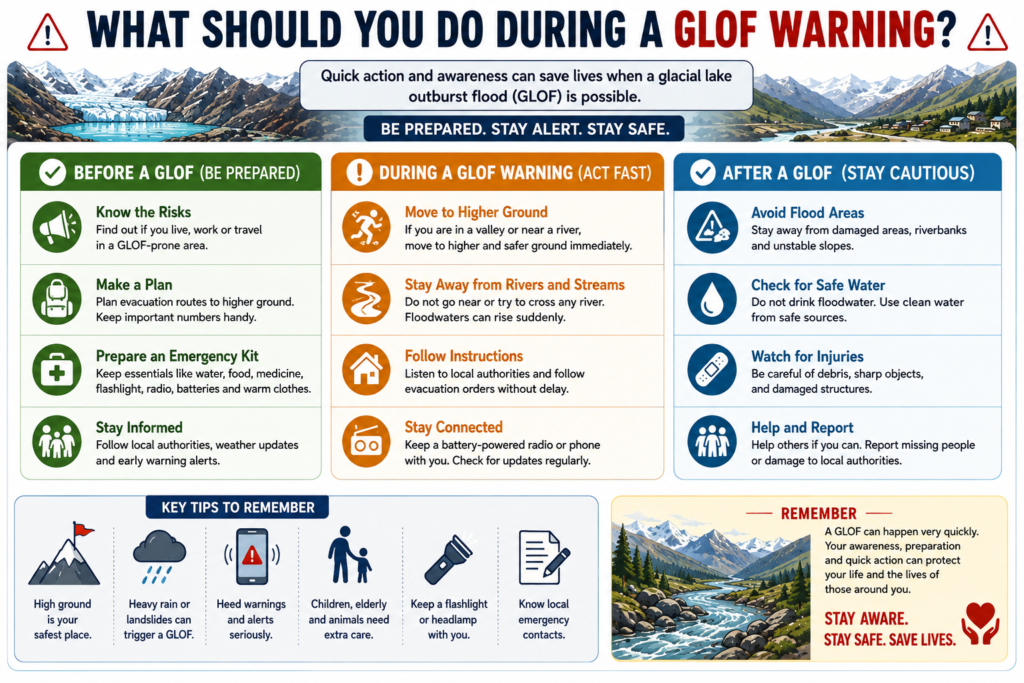
What Should You Do If There Is a GLOF Warning?
If you live or are travelling in an area that could be affected by a glacial lake outburst, an official warning should always be taken seriously.
If authorities order an evacuation:
🚶 Move to higher ground
Get away from river channels, valleys and low-lying areas.
📢 Follow official instructions
Use information from local authorities and emergency services rather than rumours or unverified social-media posts.
🌊 Never go toward the river to watch
A GLOF can arrive rapidly and may carry rocks, mud, trees and other debris.
🚫 Stay away from bridges and riverbanks
These can become extremely dangerous during sudden flooding.
🎒 Know your evacuation route
If you live in a potentially affected area, knowing where to go before an emergency occurs can save valuable time.
The most important idea is simple:
When an evacuation warning is issued, don’t wait to see the flood. Move to safety.
Can We Prevent a GLOF?
We cannot prevent every GLOF.
After all, glaciers, mountains and natural lakes are part of enormous natural systems that humans cannot completely control.
But we can reduce the risk.
Scientists and governments can:
- monitor potentially dangerous lakes
- install early-warning systems
- improve evacuation plans
- carefully manage downstream development
- strengthen or modify vulnerable natural barriers where appropriate
- improve communication with communities living downstream
In some locations, engineers have also worked to lower water levels in dangerous glacial lakes to reduce pressure on natural dams.
The aim is not to control nature completely.
It is to understand the danger early enough to protect people.
Why Should We Care About GLOFs?
We cannot prevent every GLOF.
After all, glaciers, mountains and natural lakes are part of enormous natural systems that humans cannot completely control.
But we can reduce the risk.
Scientists and governments can:
- monitor potentially dangerous lakes
- install early-warning systems
- improve evacuation plans
- carefully manage downstream development
- strengthen or modify vulnerable natural barriers where appropriate
- improve communication with communities living downstream
In some locations, engineers have also worked to lower water levels in dangerous glacial lakes to reduce pressure on natural dams.
The aim is not to control nature completely.
It is to understand the danger early enough to protect people.
🌱 The Bigger Picture
Glaciers may seem like frozen, unmoving parts of the mountains.
But they are actually part of a constantly changing system involving ice, water, rocks, weather and climate.
When glaciers retreat, new lakes can appear. When mountains become unstable, landslides and avalanches can occur. And when large amounts of water are suddenly released, the effects can travel far beyond the mountains where the event began.
Understanding GLOFs helps us understand not only one type of natural disaster, but also how different parts of Earth’s system are connected.
And that may be the most important lesson of all:
A change high in the mountains can sometimes create a chain of events that reaches all the way downstream.
1 thought on “What Is a GLOF? How Can a Glacial Lake Cause a Massive Flood?”