
Have you ever looked out of the window on a rainy day and wondered, “Where does all this water come from?”
It may seem like rain simply appears from the clouds, but every raindrop has a fascinating journey!
The water falling from the sky may have started its journey from an ocean, lake, river, or even a tiny puddle. The Sun, air, clouds and gravity all play important parts in helping turn that water into rain.
So, why does it rain?
Let’s follow the amazing journey of a raindrop and find out! 💧
☀️ Step 1: The Sun Heats the Water
The story of rain begins with the Sun.
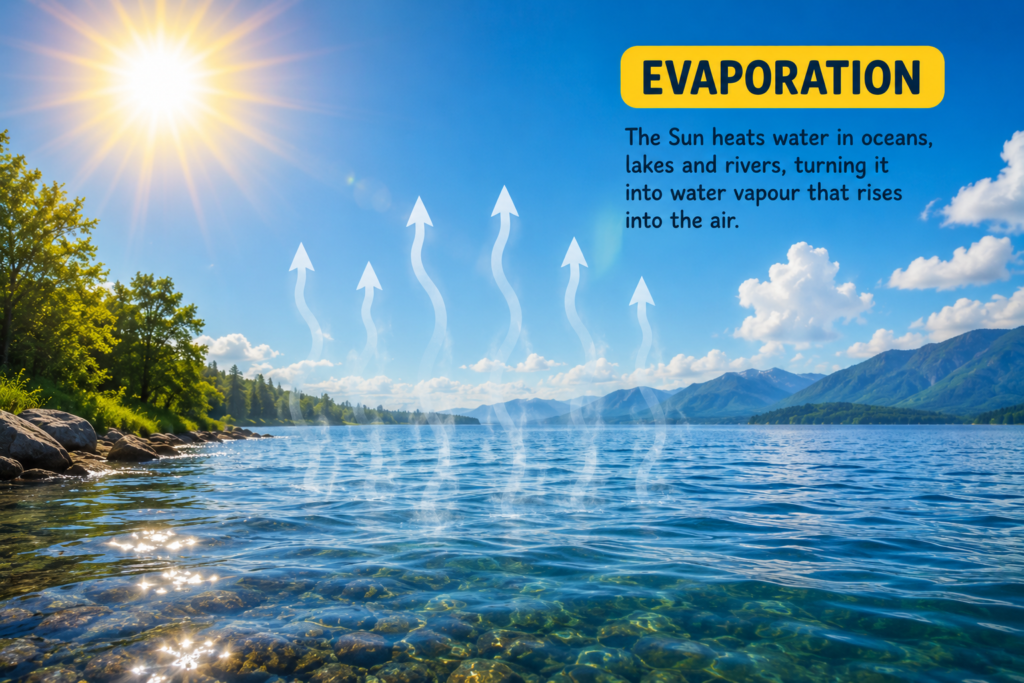
There is water almost everywhere on Earth—in oceans, seas, rivers, lakes, ponds and even in the soil. When sunlight warms this water, some of it changes into an invisible gas called water vapour.
This process is called evaporation.
You may have seen something similar happen at home. Leave a small puddle of water in the Sun, and after some time, it disappears.
The water hasn’t vanished. It has changed into water vapour and moved into the air!
💨 Step 2: Water Vapour Rises
Water vapour becomes part of the air around us.
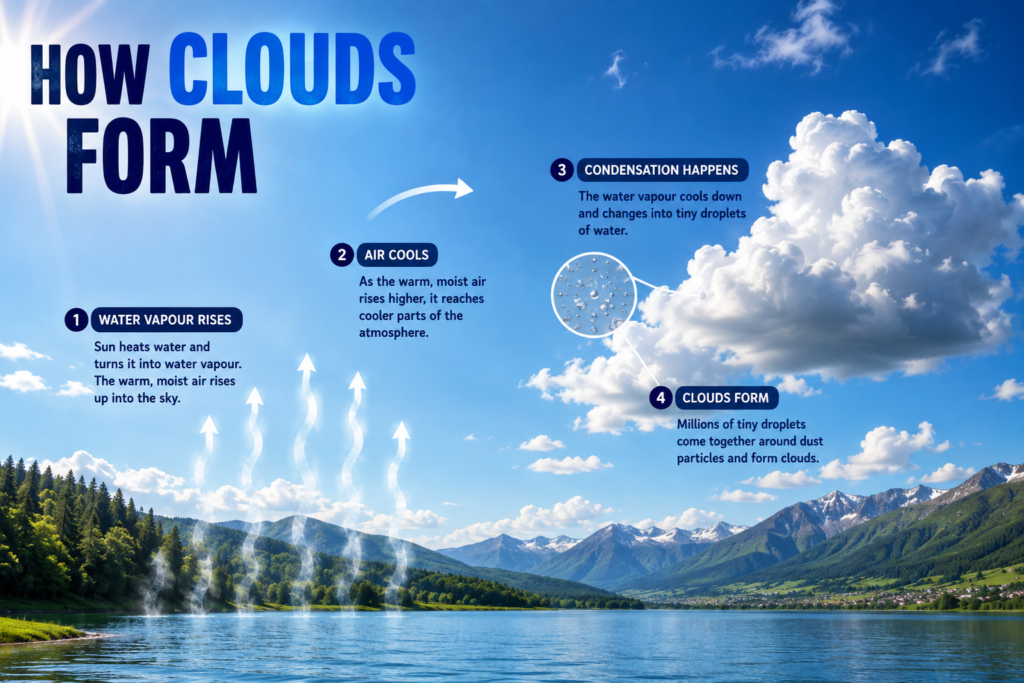
Warm, moist air can rise upward. As it travels higher into the atmosphere, it reaches cooler parts of the sky.
And this is where the next important part of the rain story begins…
☁️ Step 3: Clouds Begin to Form
The higher the water vapour travels, the cooler the air becomes.
When the water vapour cools enough, it changes back into tiny droplets of liquid water.
This process is called condensation.
These tiny droplets can gather around extremely small particles floating in the air, such as dust or tiny bits of salt.
Millions of these tiny water droplets can come together to form a cloud.
So, a cloud isn’t a fluffy ball filled with water like a bucket!
It is actually made up of huge numbers of tiny water droplets and, in colder clouds, tiny ice crystals.
💧 Step 4: Tiny Droplets Become Bigger
The tiny droplets inside a cloud are constantly moving around.
Sometimes they bump into one another and join together, forming larger and heavier droplets.
This can happen again and again.
Eventually, some droplets become large enough that the air currents inside the cloud can no longer keep them floating.
And then…
🌧️ Step 5: The Raindrop Falls!
Gravity pulls the larger water droplets downward.
They begin falling through the atmosphere as rain.
And that’s how a raindrop that may have begun its journey on the surface of Earth can eventually fall back down to Earth!
But the story doesn’t end there.
That rainwater can collect in rivers, lakes and oceans, soak into the ground, or be taken up by plants.
Later, the Sun heats the water again, and the whole journey can begin all over again.
This never-ending movement of water is called the water cycle. 🔄

Why Does It Rain From Some Clouds and Not Others?
If clouds contain water, you might wonder:
“Why doesn’t every cloud make rain?”
Good question!
Clouds contain tiny water droplets, but these droplets are usually so small and light that they can stay floating in the air.
For rain to fall, the droplets need to grow much larger and heavier.
When enough droplets join together, they become too heavy for the air currents inside the cloud to keep them up. Gravity then pulls them toward the ground as rain.
So, just because you see a cloud doesn’t necessarily mean that rain is on the way!
Some clouds are small, thin, or don’t contain enough water droplets to produce rainfall.
That’s why you can sometimes look up at a cloudy sky and still have a completely dry day. 😊
🌎 Why Do Some Places Get More Rain Than Others?
Have you ever wondered why some parts of the world get lots of rain while other places are very dry?
The answer has a lot to do with where a place is located and how air and water move around it.
Places close to oceans and seas have a large supply of water that can evaporate into the air.
Mountains can also make a big difference. When moist air reaches a mountain, the mountain can force the air upward. As the air rises, it cools, which can lead to cloud formation and rainfall.
This is one reason why some mountain areas receive plenty of rain while areas on the other side of the mountains may be much drier.
Heavy rainfall and melting ice can also contribute to changes in water levels in mountain regions. This is one reason you may find it interesting to learn [how a glacial lake can cause a massive flood].
The amount of rainfall also changes with the seasons.
So, rainfall isn’t spread evenly across Earth. Some places receive rain almost every day, while others may go for months with very little rain.
🌦️ What Factors Affect Rainfall?
Several things work together to determine when, where and how much it rains.
☀️ Temperature
Temperature affects how quickly water evaporates.
Warmer conditions can increase evaporation and put more water vapour into the atmosphere.
💧 Moisture in the Air
Air containing lots of water vapour has more moisture available for cloud formation and precipitation.
💨 Wind
Wind moves air from one place to another. It can carry moist air from oceans and seas toward land.
🏔️ Mountains
Mountains can push moist air upward. As the air rises and cools, clouds can form and rainfall may occur.
🌊 Distance From the Ocean
Oceans contain enormous amounts of water. Areas closer to large bodies of water can receive moisture carried by winds.
🌍 Location and Seasons
Different parts of Earth receive different amounts of sunlight throughout the year. This affects temperature, winds and the movement of moisture, which can all influence rainfall.
So, rainfall depends on much more than simply having clouds in the sky!
📏 How Is Rainfall Measured?
We often say things like:
“It rained 20 millimetres today.”
But what does that actually mean?
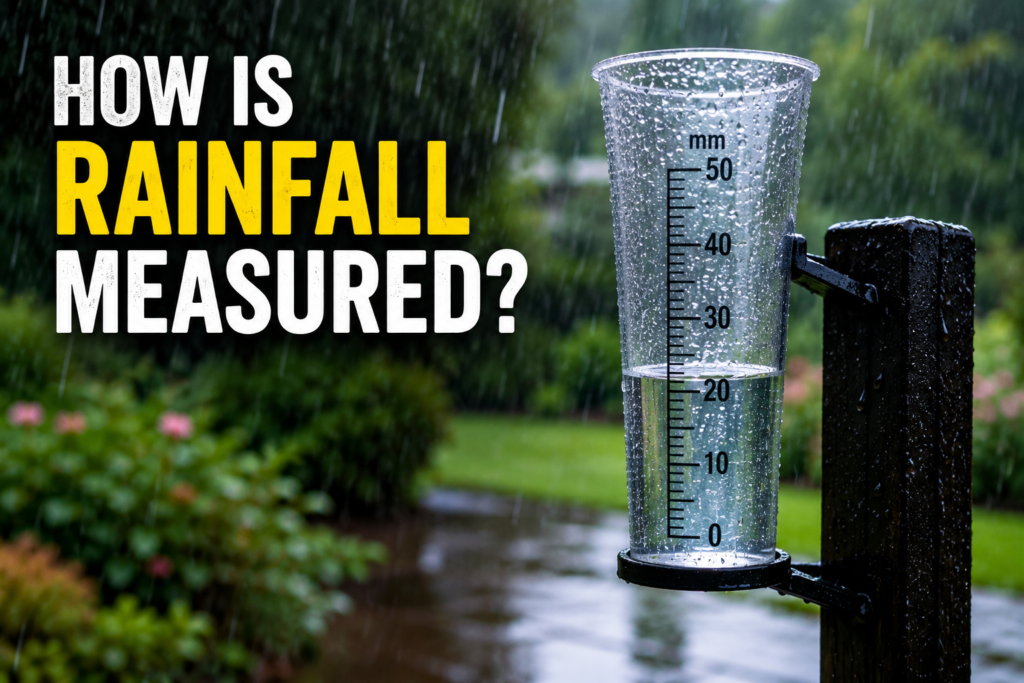
Rainfall is commonly measured using a simple instrument called a rain gauge.
A rain gauge collects rainwater that falls into it. The amount of water collected is then measured in millimetres (mm).
If a flat area receives 10 mm of rain, that means enough rain has fallen to cover the area with a layer of water 10 millimetres deep, if none of the water runs away or soaks into the ground.
Here’s another way to imagine it:
1 millimetre of rainfall is equal to about 1 litre of water falling on every square metre of surface.
So, 20 mm of rain means about 20 litres of water per square metre!
That’s a lot of water from something that began as tiny droplets inside clouds.
🔬 Make Your Own Simple Rain Gauge
You can even make a simple rain gauge at home!
Ask an adult to help you find a straight-sided transparent container. Mark measurements up the side using a ruler, place the container outside in an open area away from roofs and trees, and check it after it rains.
Remember to empty it after measuring so you can record the next rainfall.
You could keep a rainfall diary and record how much rain falls each day.
Who knows—you might become a little weather scientist! 🌦️
🌡️ How Does Global Warming Affect the Water Cycle?
The Earth’s climate is getting warmer because of the increase in greenhouse gases caused mainly by human activities.
A warmer atmosphere can hold more water vapour.
This can affect the water cycle and change rainfall patterns.
For example, in some situations, a warmer atmosphere can contribute to heavier rainfall, while changes in weather patterns can also lead to longer or more intense dry periods in some regions.
This doesn’t mean that every place on Earth will simply become wetter or drier.
Instead, a warming climate can change when, where and how much precipitation occurs.
That’s important because people, animals and plants all depend on predictable supplies of water.
🏭 How Does Pollution Affect the Water Cycle?
Rain is part of a natural cycle, but human pollution can interfere with the environment through which water moves.
Air pollution can add tiny particles and harmful substances to the atmosphere. Some of these particles can interact with water droplets in clouds and influence cloud formation and precipitation.
Pollution can also affect what happens after rain reaches the ground.
Rainwater can flow over roads, fields and other surfaces before reaching rivers, lakes and oceans. Along the way, it can pick up pollutants and carry them into water bodies.
This can harm plants, animals and ecosystems that depend on clean water.
So protecting the air, soil and water around us is also an important part of protecting the water cycle.
🥤 What Does Plastic Pollution Have to Do With Rain?
At first, plastic and rain might seem completely unrelated.
But remember—the water cycle connects the sky, land, rivers, lakes and oceans.
Plastic waste can enter rivers and eventually make its way into the oceans. As larger pieces of plastic break down, they can form tiny pieces called microplastics.
Scientists have even detected microplastics in atmospheric environments and in precipitation in some parts of the world.
This is another reminder that what we put into our environment doesn’t necessarily stay in one place.
Water keeps moving—and it can carry materials along with it.
That is why reducing plastic waste, disposing of rubbish properly and keeping rivers and other water bodies clean can help protect the environments that are part of the water cycle.
🤔 Did You Know?
💧 A cloud can contain a surprising amount of water, even though it looks light and fluffy from the ground.
☁️ Clouds aren’t made only of water droplets. Some clouds also contain tiny ice crystals.
🌊 Most of Earth’s water is in the oceans, so oceans play a huge role in the water cycle.
🌧️ Rain doesn’t always reach the ground. In very dry air, some falling water can evaporate before it gets there.
📏 Rainfall is measured in millimetres, using an instrument called a rain gauge.
🔄 The same water can travel through the water cycle again and again.
🔬 Try This at Home: Make Your Own Mini Water Cycle
You don’t need a cloud-filled sky to see part of the water cycle. You can make a tiny version at home!
You will need:
- A clear glass or transparent bowl
- Some warm water
- A plate or lid
- A few ice cubes
- An adult to help with the warm water
What to do:
- Ask an adult to pour some warm water into the glass or bowl.
- Cover the top with a plate or lid.
- Place a few ice cubes on top of the plate or lid.
- Wait for a few minutes and watch carefully.
👀 What do you see?
The warm water slowly evaporates and becomes water vapour.
When the vapour reaches the cooler surface, it condenses into tiny water droplets.
Look closely—you’ve just made a tiny model of two important steps in the water cycle!
Evaporation → Condensation → Water droplets 💧
Your mini water cycle isn’t exactly the same as what happens inside a real cloud, but it helps you see how water can change from liquid to vapour and back into liquid again.
🌧️ The Amazing Rain Journey in One Line
Now let’s put the whole story together:
☀️ Sun heats water → 💨 Water evaporates → ☁️ Water vapour rises → ❄️ Vapour cools → ☁️ Clouds form → 💧 Droplets grow → 🌧️ Rain falls → 🔄 The cycle begins again!
What looks like a simple rainy day is actually part of a giant planetary system that has been moving water around Earth for a very, very long time.

🌈 One Last Question...
The next time it rains, look outside and imagine following just one raindrop.
Where did its journey begin?
Was it once part of an ocean?
A lake?
A river?
A tiny puddle?
And where will it go next?
It might flow into a stream, soak into the soil, be taken up by a plant—or eventually evaporate and return to the sky.
That’s the amazing thing about rain—the journey of water never really ends! 💧🌍