
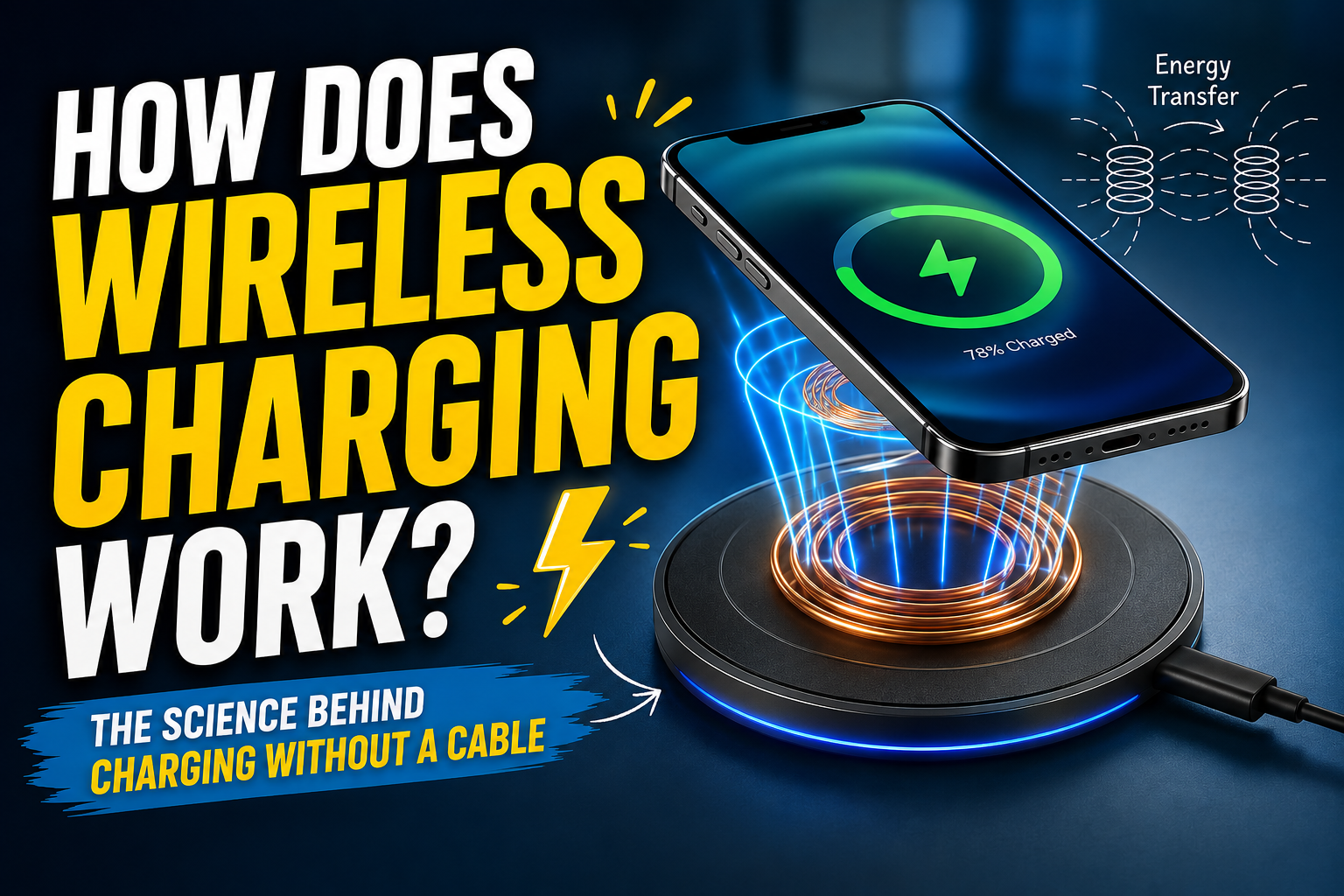
How does wireless charging work? Have you ever placed your phone on a small charging pad and watched the battery percentage start going up—without plugging a cable into the phone?
It almost feels like magic.
There is no wire connected to your phone, yet energy somehow gets from the charging pad into the battery.
So where does that energy come from?
And how can something as invisible as a magnetic field help charge your phone?
The answer involves one of the most fascinating ideas in physics: electromagnetic induction.
And the best part is that you can actually see some of this science for yourself with a couple of simple experiments at home.
🧲 First, What Is a Magnetic Field?
Before we understand wireless charging, we need to understand something about magnets.
A magnet produces an invisible region around itself called a magnetic field.
You can’t normally see a magnetic field, but you can see what it does.
For example, bring a magnet close to some paper clips and they move toward it.
That is the magnetic field at work.
But here’s something even more interesting:
Electricity can create a magnetic field too.
Whenever electric current flows through a wire, it produces a magnetic field around the wire.
And this is where our wireless charging story begins.
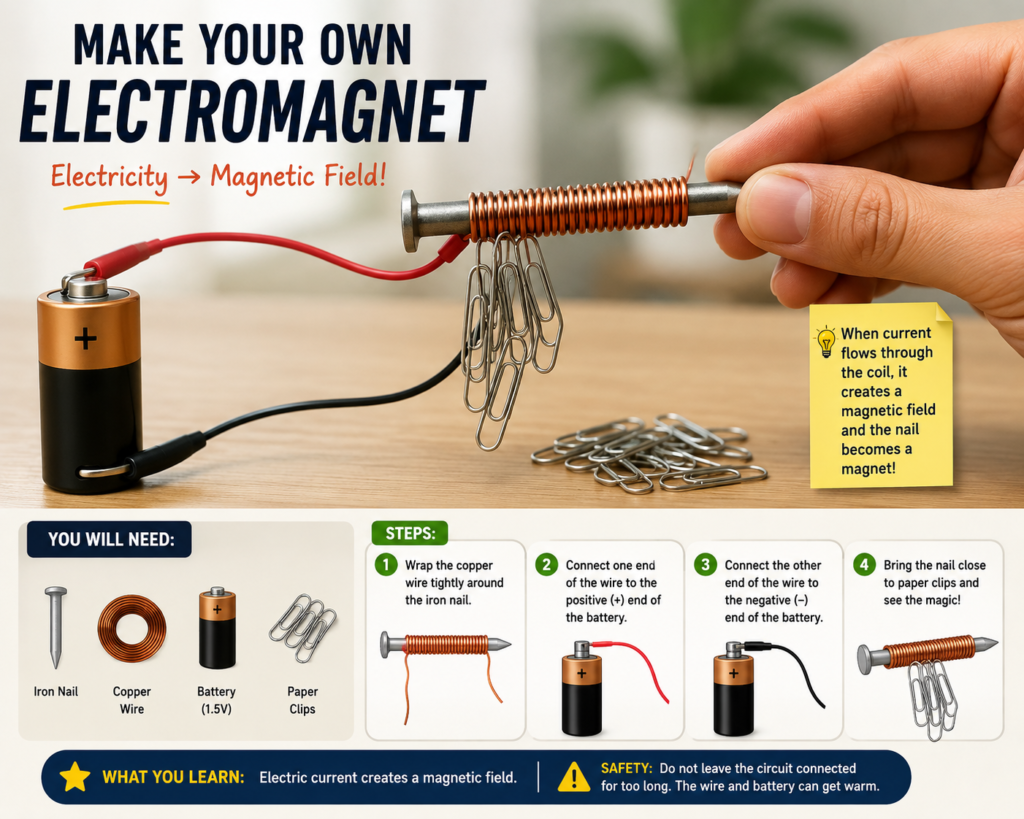
🔋 Experiment 1: Make Your Own Electromagnet
You don’t need a wireless charger to explore this idea.
You can make a simple electromagnet at home.
What you'll need
- An iron nail
- Insulated copper wire
- A small battery
- A few paper clips
What to do
Wrap the copper wire around the nail several times, leaving some wire free at both ends.
Touch the two ends of the wire to the two terminals of the battery.
Now bring the nail close to the paper clips.
They should be attracted to the nail!
Disconnect the battery and the magnetic effect disappears.
What's happening?
When electricity flows through the coiled wire, it creates a magnetic field.
The iron nail helps strengthen that magnetic effect.
So you have just demonstrated something very important:
Electricity → Magnetic field
And wireless charging depends on this relationship.
Safety: Don’t leave the wire connected to the battery for long. The wire and battery can become warm. Never use a mains electricity outlet for this experiment.
⚡ Can Magnetism Create Electricity Too?
Now comes the really fascinating part.
We’ve seen that electricity can create magnetism.
But can magnetism do the opposite?
Can a changing magnetic field create electricity?
Yes!
This discovery is known as electromagnetic induction.
It was demonstrated in the 19th century through experiments by English scientist Michael Faraday.
Faraday discovered that moving a magnet near a coil of wire could produce an electric current in the wire.
The important word here is changing.
A magnet simply sitting next to a coil doesn’t continuously produce electricity.
But when the magnetic field through the coil changes—for example, when the magnet moves—the coil can develop an electric current.
In simple terms:
Changing magnetic field → Electricity
And that is the other half of the wireless charging story.
🧲⚡ Experiment 2: Make Electricity with a Magnet
You can explore electromagnetic induction yourself.
What you'll need
- A coil of insulated copper wire
- A strong magnet
- A small LED or a multimeter
What to do
Connect the two ends of the coil to the LED or multimeter.
Now quickly move the magnet in and out of the coil.
You may see the LED flash or observe a change on the multimeter.
Try moving the magnet faster.
The effect becomes easier to detect.
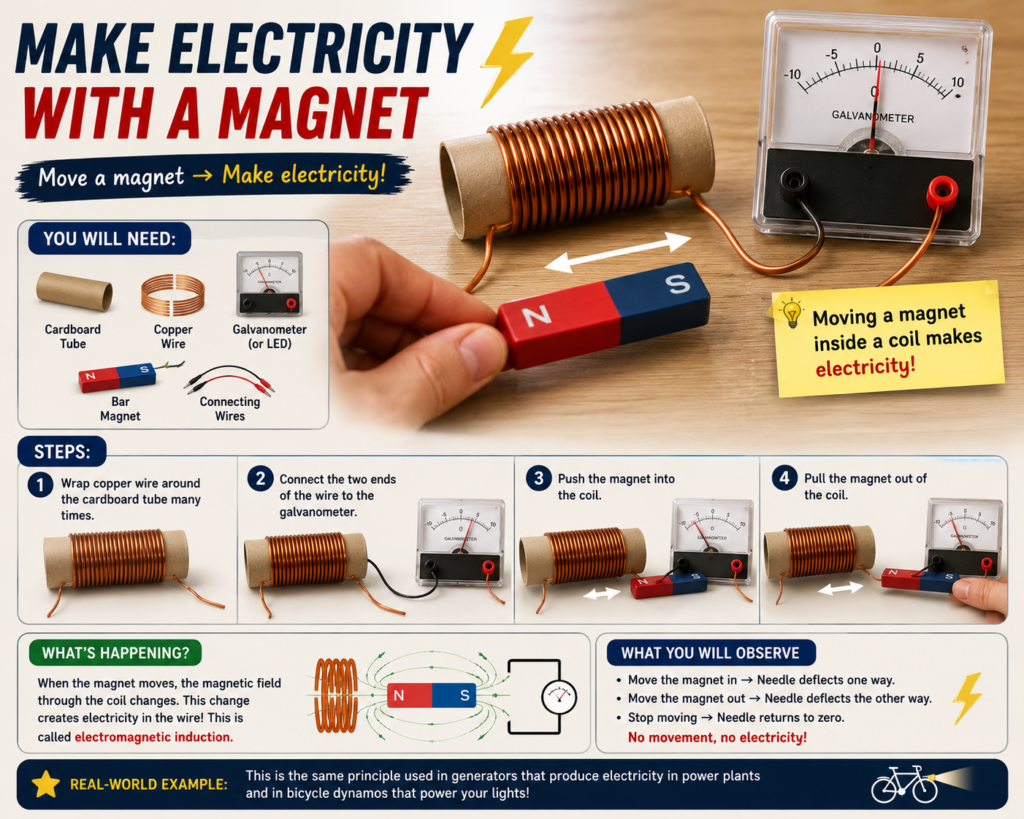
What's happening?
As the magnet moves, the magnetic field passing through the coil changes.
That changing magnetic field induces an electrical current in the wire.
You have just demonstrated:
Magnetic field → Electricity
And now we have the two ideas we need to understand wireless charging.
📜 Where Did This Idea Come From?
The science behind wireless charging is much older than smartphones.
In the 1830s, Michael Faraday carried out experiments that helped reveal the relationship between electricity and magnetism.
His work showed that a changing magnetic field could induce an electric current.
A few decades later, Nikola Tesla became famous for experimenting with electricity, magnetic fields and the possibility of transferring electrical energy without wires.
Tesla’s experiments were very different from the small wireless charging pads we use today, but they explored an important idea:
Electrical energy doesn’t always have to travel through a physical wire in the way we normally expect.
Modern wireless charging wasn’t invented by one person in one moment.
Instead, it grew from discoveries made by scientists such as Faraday and Tesla, followed much later by decades of engineering and technological development.
So when someone asks, “Who invented wireless charging?”, the answer isn’t quite as simple as naming one inventor.
Modern wireless charging is the result of many discoveries being turned into practical technology.
How Does Wireless Charging Work Inside Your Phone?
Now let’s put everything together.
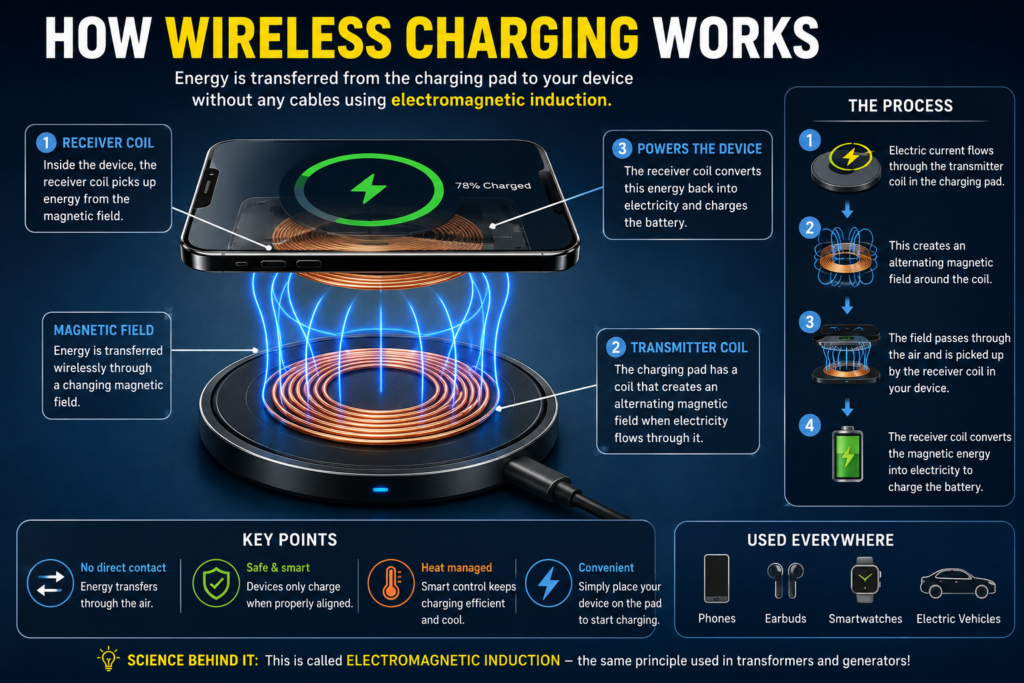
Inside a wireless charging pad is a coil of wire.
When you place the pad on its power supply, electricity flows through this coil.
The electrical current creates a changing magnetic field around the coil.
Inside your phone is another coil.
When you place the phone on the charging pad, the two coils are positioned very close to each other.
The changing magnetic field from the charging pad interacts with the coil inside the phone.
And because the magnetic field is changing, it induces an electrical current in the phone’s coil.
That electricity is then processed by the phone’s charging electronics and used to charge the battery.
So the energy transfer looks something like this:
Electricity
⬇️
Changing magnetic field
⬇️
Phone’s coil
⬇️
Electricity
⬇️
Charging electronics
⬇️
Battery 🔋
That’s wireless charging.
🔄 The Amazing Part: Electricity Goes to Magnetism and Back Again
If you remember only one thing from this article, remember this:
Electricity can create magnetism.
A changing magnetic field can create electricity.
Wireless charging brings these two ideas together.
The charging pad uses electricity to create a changing magnetic field.
The phone uses that changing magnetic field to generate electricity.
Electricity → Magnetism → Electricity
Pretty amazing for something that looks like you’re simply placing your phone on a flat piece of plastic!
📏 Why Does Your Phone Have to Be So Close?
You might now have another question.
If magnetic fields can transfer energy without wires, why can’t I charge my phone from across the room?
The answer is that wireless charging works best when the two coils are very close and properly aligned.
As the distance between the coils increases, the amount of useful energy transferred to the receiving coil generally decreases.
That’s why your phone needs to sit on or very close to the charging pad.
It also explains why moving your phone slightly can sometimes affect charging.
The two coils need to interact efficiently.
🌡️ Why Does Wireless Charging Make Your Phone Warm?
You may have noticed your phone getting a little warm while charging wirelessly.
That’s because the process isn’t perfectly efficient.
Some of the energy involved is lost, mainly as heat.
The charging pad and phone also contain electronics that manage the power transfer, and these components can produce heat as they operate.
Modern phones and chargers are designed with systems to manage temperature and charging safely.
Still, wireless charging can sometimes be less efficient than using a direct wired connection.
🤔 Is Wireless Charging Really Wireless?
Here’s a funny little secret.
The charging pad usually has a wire.
That wire connects the pad to a power source.
So electricity still reaches the charging pad through a cable.
The wireless part is what happens between the charging pad and your phone.
Instead of electricity travelling directly through a cable into the phone, energy is transferred across the small gap using electromagnetic fields.
So technically, your wireless charger isn’t completely wire-free.
It’s wireless where it matters to your phone. 😄
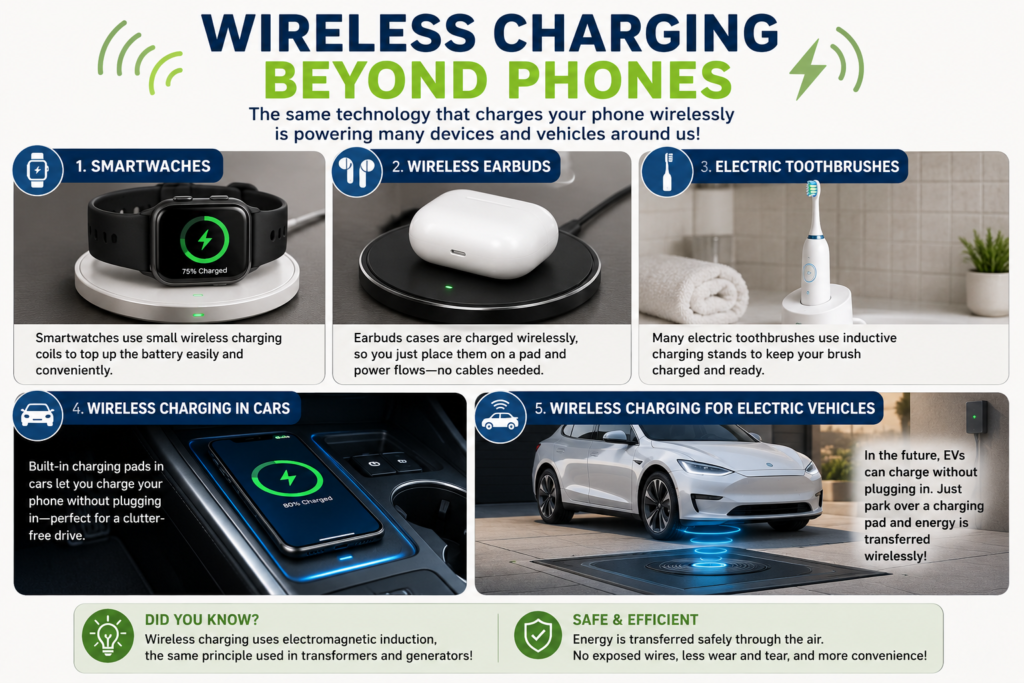
Wireless Charging Isn't Just for Phones
The same basic idea can be used in many other devices.
You’ve probably already encountered it without realizing it.
⌚ Smartwatches
Many smartwatches use small charging docks that transfer energy without a conventional charging connector.
🎧 Wireless Earbuds
The charging case can use wireless charging to receive energy from a charging pad.
🪥 Electric Toothbrushes
Some electric toothbrushes are charged without exposed electrical contacts. Electromagnetic energy can pass between coils inside the charger and toothbrush.
🚗 Electric Vehicles
Wireless charging is also being explored and used for some electric vehicles.
The scale is obviously much larger than a smartphone, but the underlying idea is related:
Use electromagnetic fields to transfer energy without a direct electrical connection.
🔬 Could We Charge a Phone From Across the Room?
This is where things get much more difficult.
Transferring a small amount of energy across a short distance is one thing.
Transferring enough energy to charge a phone efficiently from several metres away is much harder.
As the distance increases, the coupling between the transmitting and receiving coils becomes weaker.
That means much more complicated technology is needed to transfer useful amounts of power over larger distances.
So the wireless charger sitting on your desk isn’t really sending electricity flying across the room.
It’s using a carefully controlled magnetic field over a very short distance.
💡 The Science Hiding on Your Desk
The next time you place your phone on a wireless charger, think about what is happening underneath it.
There are no visible sparks.
No glowing wires.
No obvious movement.
Yet inside the charger and phone, something remarkable is happening.
Electric current creates a changing magnetic field.
That magnetic field interacts with another coil.
The second coil produces electricity.
And your battery stores that energy for later.
What looks like a simple piece of everyday technology is actually a practical demonstration of discoveries that scientists began making almost 200 years ago.
So wireless charging isn’t magic.
It’s electromagnetism at work.
The Big Idea
Electricity → Magnetic Field → Electricity → Battery
And now, whenever you see your phone charging without a cable, you’ll know the invisible science making it happen.
If you enjoyed discovering the science hidden inside your phone, you can also explore how a touchscreen knows where you touched.