

If Earth’s gravity is constantly pulling the Moon toward us, why doesn’t the Moon fall to Earth?
The surprising answer is:
The Moon is actually falling toward Earth all the time. It just keeps missing Earth.
That may sound strange, but it is one of the simplest and most fascinating ways to understand how an orbit works.
And there is another question hidden inside this one:
If gravity is pulling the Moon toward Earth, where did the Moon get the sideways motion that keeps it in orbit?
To answer that, we need to go back billions of years.
Earth’s Gravity Is Always Pulling the Moon
Earth has gravity, and gravity attracts the Moon toward Earth.
The same gravitational force is responsible for keeping us on the ground. If you throw a ball into the air, Earth’s gravity pulls it back toward the ground.
The Moon is affected by Earth’s gravity in exactly the same fundamental way.
So why doesn’t it come crashing down?
Because the Moon is also moving sideways at an enormous speed.
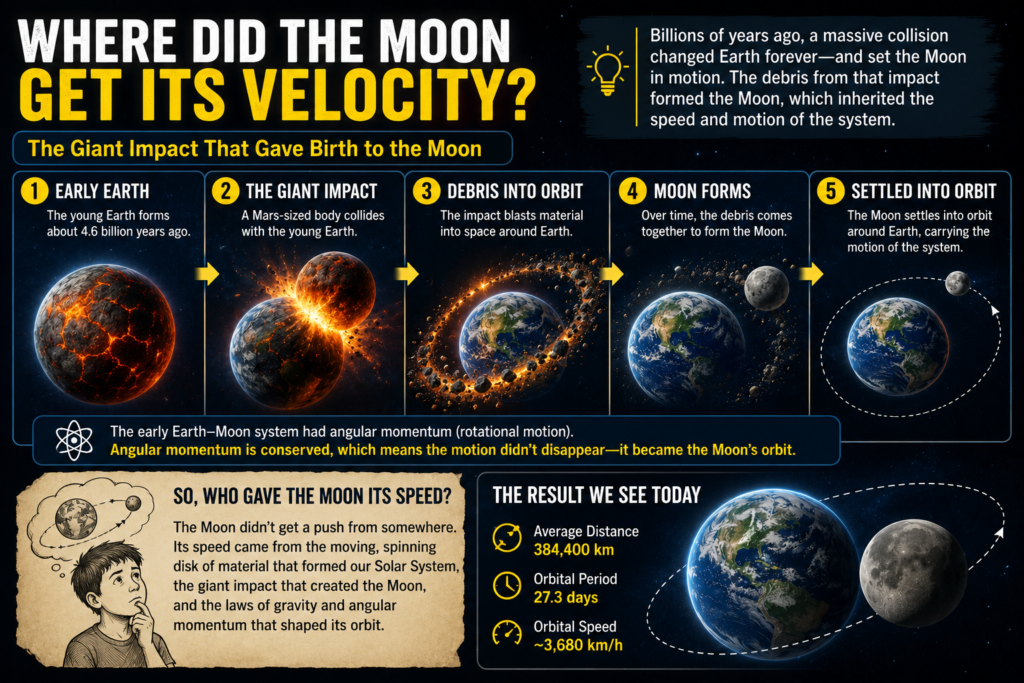
The Moon’s average orbital speed is about 3,680 kilometres per hour, and its average distance from Earth is about 384,400 kilometres.
Its motion carries it forward while Earth’s gravity continuously changes the direction of that motion.
The result is an orbit.
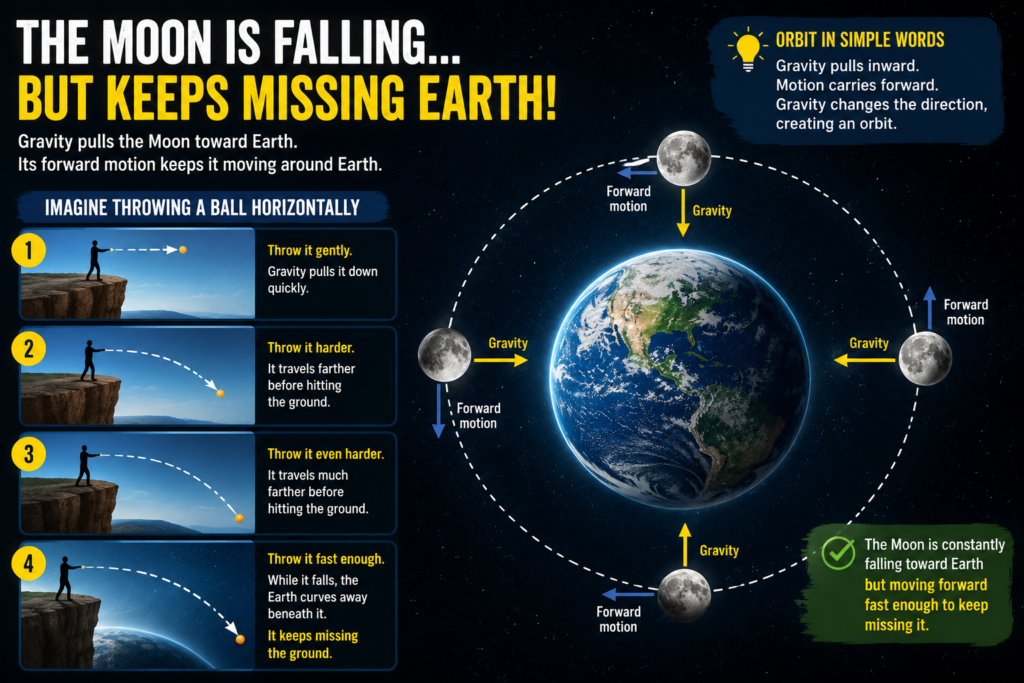
The Moon Is Constantly Falling — But Missing Earth
Imagine standing on a very tall mountain and throwing a ball horizontally.
If you throw it gently, it travels a short distance before gravity pulls it to the ground.
Throw it harder, and it travels farther before hitting the ground.
Now imagine throwing it incredibly fast.
While the ball is falling toward Earth, the Earth’s surface is also curving away underneath it.
If the ball were moving fast enough, it could keep falling toward Earth without reaching the ground.
That is essentially what happens with an object in orbit.
The Moon is constantly being pulled toward Earth by gravity, but its forward motion carries it onward.
Instead of moving in a straight line, gravity continuously bends its path.
The Moon keeps falling toward Earth while continually missing it.
NASA describes an orbit in essentially these terms: without gravity, an orbiting object would continue in a straight line; gravity continually pulls it back toward the planet while its sideways motion prevents it from hitting the planet.
So Why Doesn't the Moon Just Fly Away?
Now let’s look at the opposite question.
If the Moon is travelling so quickly, why doesn’t it simply fly away into space?
Because Earth’s gravity is constantly changing its direction.
Imagine throwing a ball.
If nothing acted on the ball after you released it, it would continue travelling in a straight line.
This is related to Newton’s First Law of Motion, which tells us that an object in motion continues in motion unless a force acts on it.
Gravity is that force.
It continually pulls the Moon toward Earth, bending the Moon’s otherwise straight-line path into a curved orbit.
So it isn’t quite right to imagine gravity and the Moon’s motion as two forces fighting each other.
Instead:
The Moon’s motion carries it forward, while gravity continuously changes the direction of that motion.
That changing direction is what keeps the Moon in orbit.
But Where Did the Moon Get Its Velocity?
This brings us to one of the most interesting parts of the story.
The Moon didn’t suddenly receive a giant push from somewhere in space.
Its motion is connected to the way the Earth-Moon system formed.
To understand that, we need to travel back about 4.6 billion years, to the formation of our Solar System.
The Solar System Was Born From a Spinning Cloud
Our Solar System began as a huge cloud of gas and dust.
This cloud was already in motion.
As gravity caused the cloud to collapse, it formed a spinning disk of material called the protoplanetary disk.
The Sun formed at the centre, while material in the surrounding disk eventually came together to form planets and other objects.
The material in this disk was not simply falling straight toward the Sun.
It was moving around the developing Solar System.
As particles collided, stuck together and formed increasingly larger objects, much of that motion remained part of the developing planetary system.
This is why the planets ended up orbiting the Sun rather than simply falling directly into it.
NASA explains that the planets formed from material in the same rotating disk and retained orbital motion as the Solar System developed.
What About the Moon?
The Moon has an even more dramatic story.
The leading explanation for the Moon’s formation is the giant-impact hypothesis.
According to this idea, the young Earth was struck by another large planetary body billions of years ago.
NASA describes this impactor as roughly Mars-sized, although scientists are still studying the exact details of the event.
The enormous collision threw material into orbit around the young Earth.
Over time, that material came together under gravity and formed the Moon.
The Moon therefore did not begin its existence as a completely stationary object sitting above Earth.
The material from which it formed was already part of a violent, moving system.
The collision also affected the motion and angular momentum of the developing Earth-Moon system.
Eventually, the Moon settled into the orbit we see today.
The giant-impact explanation is strongly supported by evidence from lunar samples, although scientists continue to refine the details of exactly how the Moon formed.
What Is Angular Momentum?
There is another important idea hiding in this story: angular momentum.
Don’t worry — you don’t need complicated mathematics to understand the basic idea.
Angular momentum is associated with rotational motion.
A familiar example is an ice skater spinning on the ice. When the skater pulls their arms closer to their body, their rotation changes because angular momentum is conserved.
Something similar happens in space.
The early Solar System had angular momentum. As the enormous cloud of gas and dust collapsed, its rotation became concentrated into a much smaller region, helping produce the spinning disk from which the Sun and planets formed.
The Earth-Moon system also has angular momentum.
The giant impact that likely formed the Moon played an important role in shaping that system’s rotation and orbital motion.
So when we ask, “Who gave the Moon its speed?”, there isn’t a simple answer like “something pushed it.”
Its motion developed from the moving material, collisions, gravity and angular momentum involved in the formation of the Earth-Moon system.
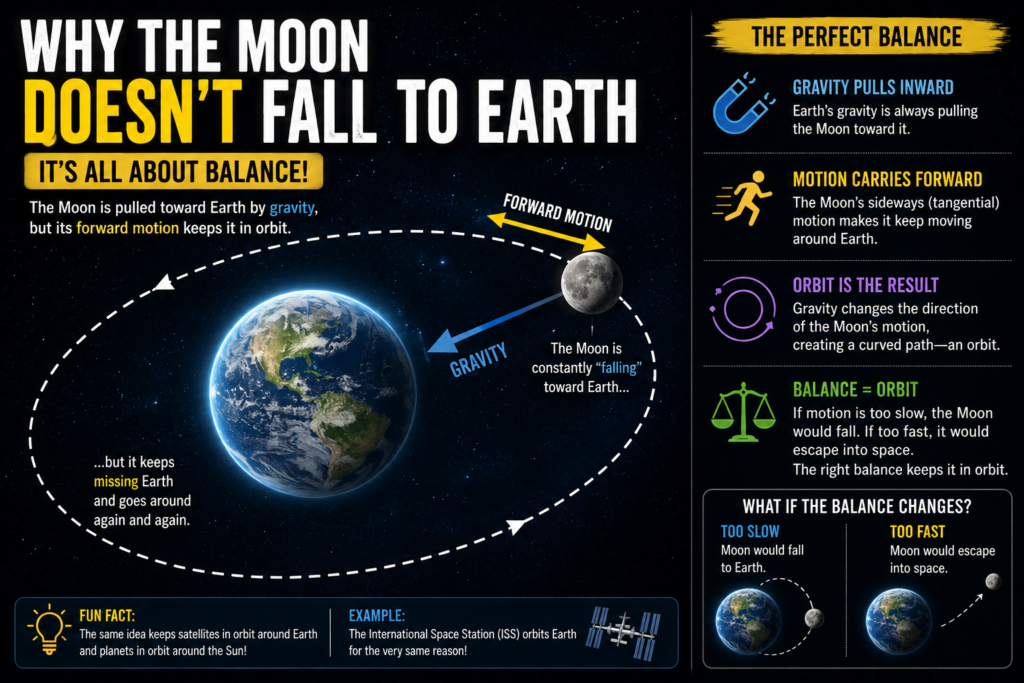
What If the Moon Suddenly Stopped Moving?
Here’s a useful thought experiment.
Imagine that, somehow, the Moon suddenly lost its orbital motion.
Earth’s gravity would still be pulling it.
Without the Moon’s sideways motion, there would be nothing to keep it following its present orbit, and it would begin moving toward Earth.
Now imagine the opposite.
Suppose Earth’s gravity suddenly disappeared while the Moon kept moving at its current velocity.
The Moon would no longer follow its curved orbit.
It would continue moving approximately along a straight-line path away from Earth.
This thought experiment shows us why both motion and gravity matter to an orbit.
The motion provides the Moon’s tendency to continue forward.
Gravity continuously changes that motion’s direction.
Is the Moon's Orbit a Perfect Circle?
No.
The Moon’s orbit is slightly oval-shaped, or elliptical.
NASA gives the Moon’s orbital eccentricity as about 0.055, meaning its orbit is noticeably but not extremely different from a perfect circle.
Because the orbit is elliptical, the Moon’s distance from Earth changes during its journey.
Its average distance is about 384,400 kilometres.
The Moon completes one orbit around Earth in about 27.3 days.
Its orbital speed also changes somewhat as its distance from Earth changes.
Earth Moves Too!
Here’s another surprising fact:
The Moon isn’t simply travelling around a completely stationary Earth.
The Moon also has gravity, and its gravity pulls on Earth.
Because Earth is much more massive than the Moon, Earth’s movement is much smaller.
Technically, Earth and Moon both orbit their shared centre of mass, called the barycenter.
So when we picture the Moon travelling around Earth, it is more accurate to imagine both bodies moving around a common point.
The Earth-Moon system is therefore more like a gravitational partnership than one object simply sitting still while the other goes around it.
The Same Physics Keeps Satellites in Orbit
The Moon isn’t special.
Artificial satellites use the same basic physics.
When a rocket launches a satellite into orbit, it doesn’t simply send the satellite straight upward and leave it there.
The satellite must be given enough sideways velocity.
Once it is moving fast enough at the appropriate altitude, Earth’s gravity continually curves its path around Earth.
The satellite is therefore also constantly falling toward Earth while moving forward fast enough to keep missing the surface.
This is why satellites can remain in orbit without continuously firing their engines.
The same basic idea applies to the International Space Station.
And What About Earth?
Earth is doing something similar around the Sun.
The Sun’s gravity pulls Earth toward it.
But Earth is also moving sideways at a tremendous speed.
If the Sun’s gravity suddenly disappeared, Earth would continue travelling approximately in a straight line.
Instead, the Sun’s gravity continually changes Earth’s direction, producing its orbit around the Sun.
And Earth’s orbital motion also has a history.
The planets formed from the rotating material of the early Solar System, so their present-day orbital motion is connected to the motion and angular momentum of that original system.
Why Doesn't the Moon Fall to Earth?
Now we can finally put everything together.
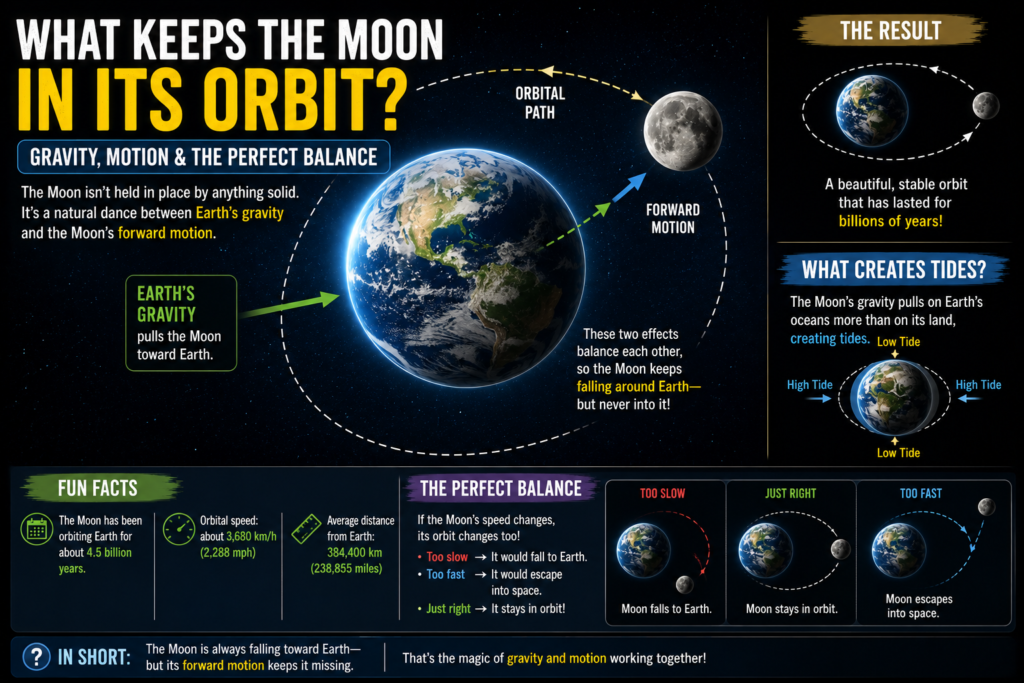
The Moon is falling toward Earth.
Earth’s gravity is constantly pulling it inward.
But the Moon also has a large sideways velocity.
As the Moon moves forward, gravity continuously bends its path toward Earth.
The Moon therefore keeps falling toward Earth without actually hitting it.
And where did that sideways motion come from?
It is part of a much bigger story.
The Solar System formed from a moving, rotating cloud of gas and dust. The young Earth formed within that system, and the Moon likely formed after a massive collision involving the young Earth. The motions and angular momentum of these early events helped shape the Earth-Moon system we see today.
So the Moon doesn’t stay in the sky because some invisible force is holding it up.
And it doesn’t stay there because gravity has somehow stopped pulling on it.
Quite the opposite.
The Moon stays in orbit because it is constantly falling toward Earth — while constantly missing it.
That same idea explains satellites orbiting Earth and Earth orbiting the Sun.
Gravity pulls.
Motion carries objects forward.
Gravity changes their direction.
And the resulting curved paths are what we call orbits.
So the next time you look at the Moon, remember:
It isn’t hanging in the sky.
It is racing through space, falling toward Earth, and missing it — over and over again.
2 thoughts on “Why Doesn’t the Moon Fall to Earth? The Amazing Science Behind Its Orbit”