
Imagine you want to tell your friend, “I’ll be home late.”
Today, you would probably pick up your phone, open a messaging app and send the message in a few seconds.
But what if you lived 100 years ago?
There was no WhatsApp, no SMS, no email and, in most places, no mobile phone. Even making a telephone call was not something everyone could simply do.
So, how did people send messages before mobile phones?
The answer depends on how far back we go.
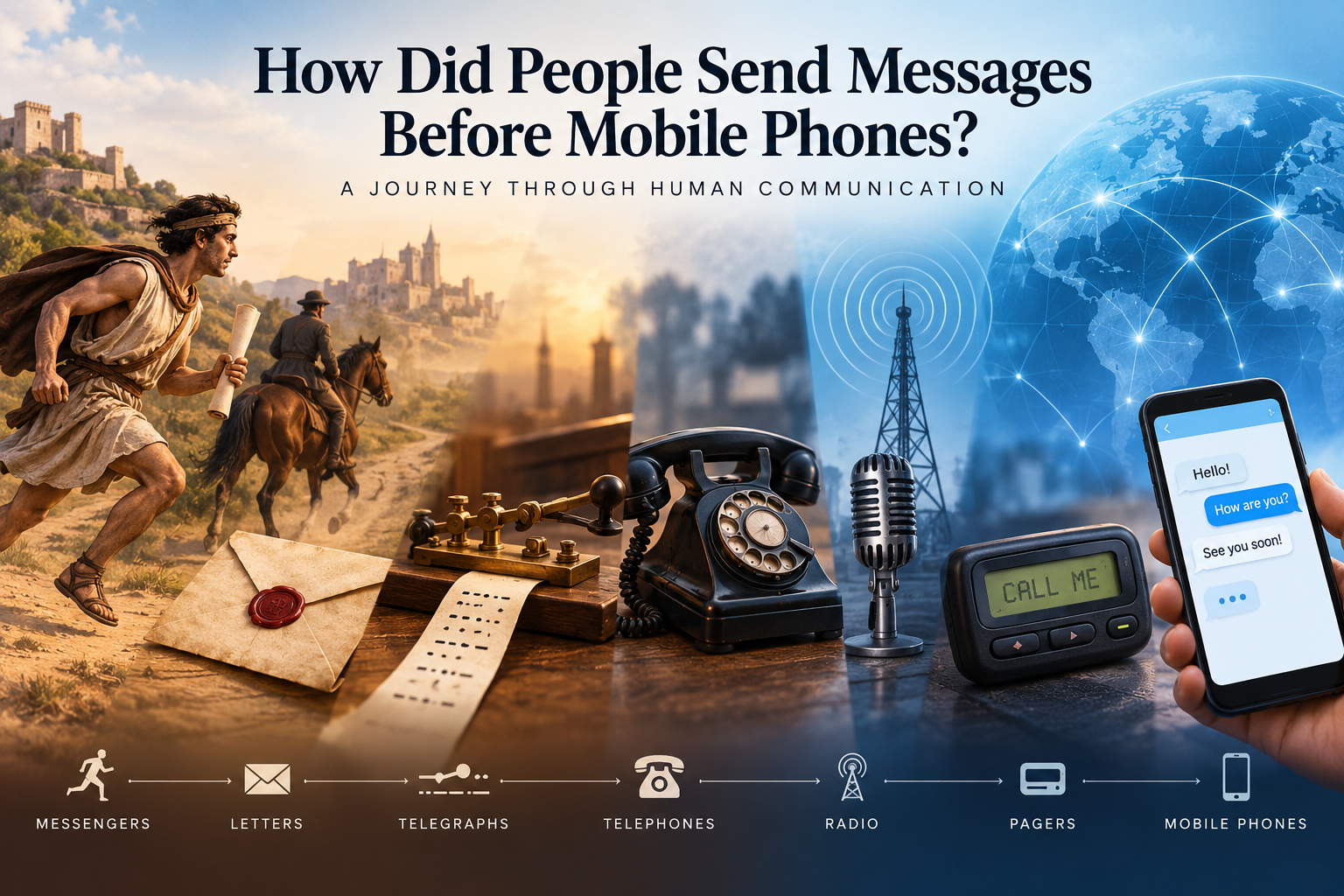
People used messengers, runners, horses, ships, letters and postal systems. Later came telegraphs and telegrams, which could send information much faster than a person could travel. Then the telephone allowed people to hear each other’s voices over long distances.
Eventually came pagers, mobile phones and smartphones.
The technology changed dramatically, but the basic goal remained the same:
How can I send my message to someone who isn’t here?
The Simplest Way: Send a Person
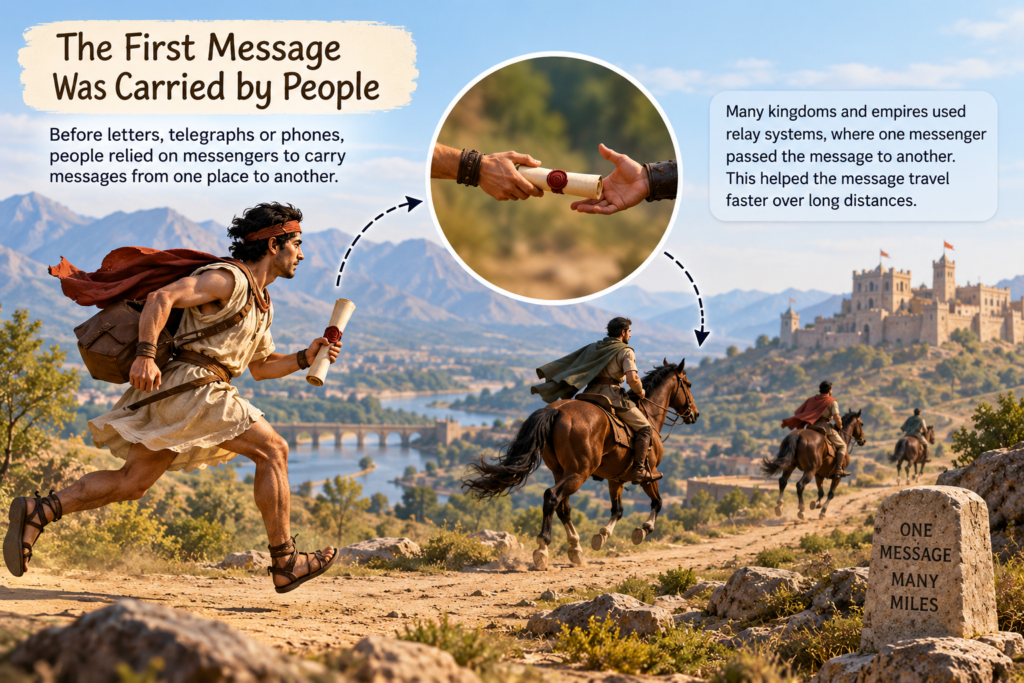
Before electronic communication existed, the most straightforward way to send a message was to send someone carrying it.
A messenger could travel from one place to another and deliver a spoken or written message.
This sounds simple, but organized messenger systems could become remarkably sophisticated.
Large kingdoms and empires developed routes, relay stations and fresh horses so that messages could travel more quickly. Instead of one messenger travelling hundreds of kilometres, several messengers could take turns.
One person would carry the message for part of the journey, then another would continue.
It was an early form of a communication network.
The network did not use wires or computers.
It used:
People + roads + horses + relay stations
Messages Could Also Be Sent Without the Messenger Speaking
As writing became more common, people could write their messages down.
This was a major improvement.
A messenger no longer had to remember everything the sender said.
Instead, the recipient could receive the sender’s exact written words.
Letters could contain:
- Personal news
- Business instructions
- Government orders
- Invitations
- Family updates
- Warnings
- Financial information
- News from distant places
The message could travel even when the sender could not.
And once it arrived, the recipient could read it whenever they wanted.
Postal Systems Made Letters More Practical
Eventually, societies developed organized postal systems.
Instead of finding your own messenger every time you wanted to send a letter, you could give the letter to a postal service.
The service would move it through a network of people, animals and transportation.
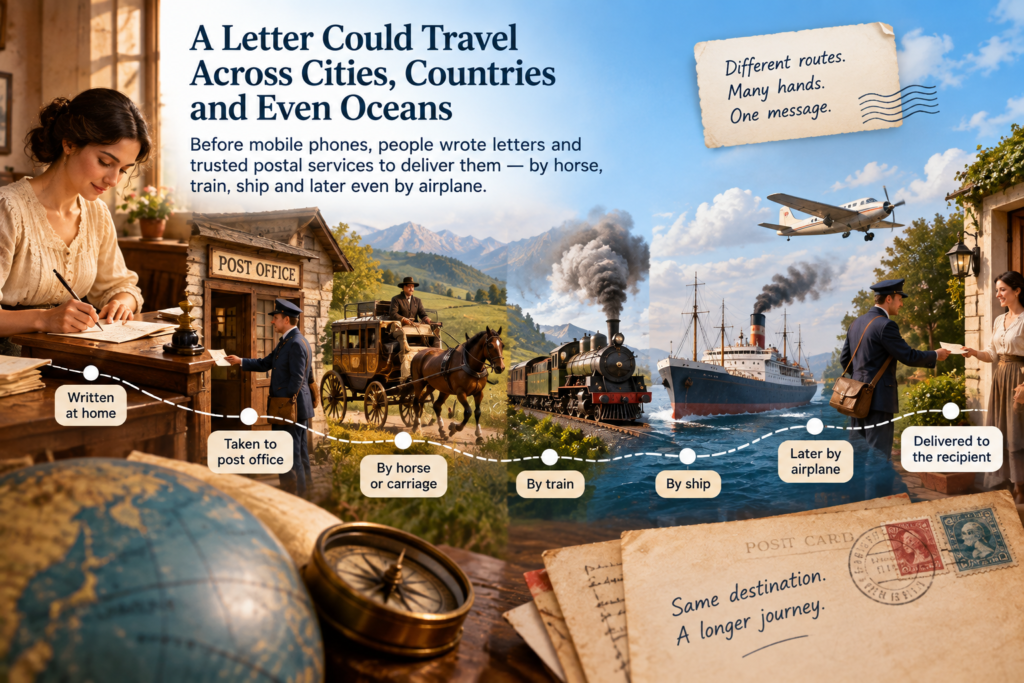
A letter might travel by:
horse → carriage → train → ship → another postal route → recipient
depending on the time and location.
This made long-distance communication much easier.
But there was one major problem:
Letters were slow.
If someone lived hundreds or thousands of kilometres away, the letter might take days, weeks or even longer to arrive.
And then you had to wait for the reply.
What If You Needed to Send an Urgent Message?
Imagine something important has happened.
You need to tell someone in another city immediately.
Sending a letter isn’t good enough.
Even if a horse or train carries it quickly, the message still has to physically travel.
For centuries, that was simply a fact of life.
Information could only move as fast as the thing carrying it.
Then technology changed that.
The Telegraph Changed Everything
The telegraph was one of the biggest turning points in the history of communication.
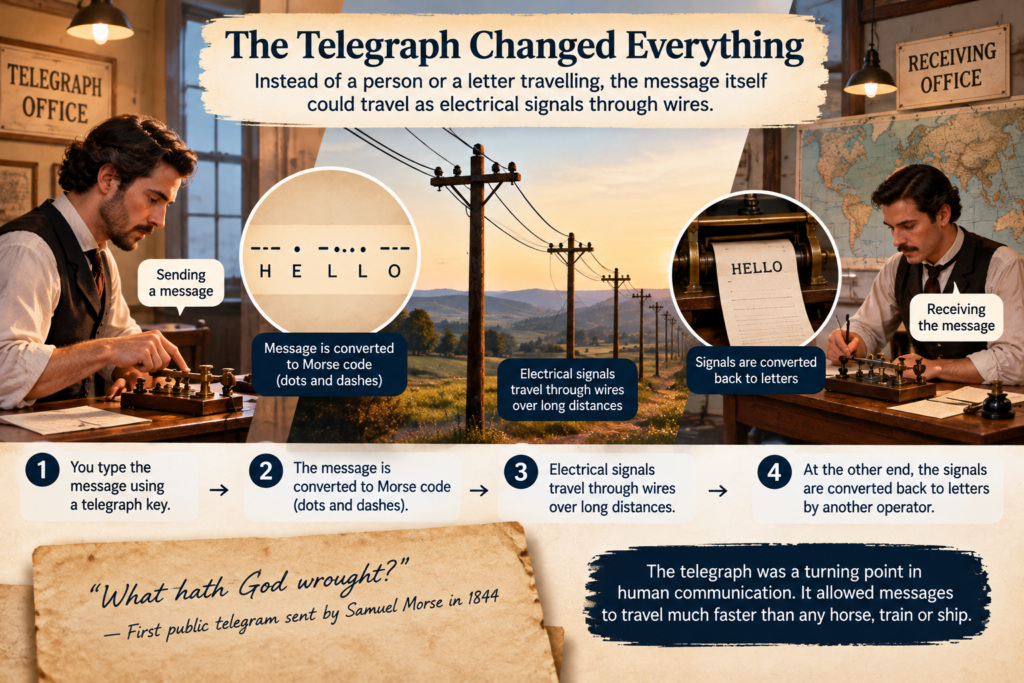
Instead of physically transporting the written message, a telegraph system could send electrical signals through wires.
The basic idea was:
Words → coded signals → electrical pulses → wire → signals → words
Suddenly, the information didn’t have to travel at the speed of a horse, ship or train.
It could travel through the network incredibly quickly.
Samuel Morse famously demonstrated an electrical telegraph by sending a message from Washington, D.C., to Baltimore on May 24, 1844. The message was:
“What hath God wrought?”
The Library of Congress identifies this as the first public telegram sent over Morse’s experimental line.
It was the beginning of a communication revolution.
How Did the Telegraph Actually Send a Message?
Suppose you wanted to send:
MEET ME TOMORROW
The telegraph operator would convert the letters into a system of dots and dashes known as Morse code.
The coded message would then be transmitted through the telegraph wire.
At the other end, another operator would receive the signals and convert them back into letters.
So the journey looked something like this:
You
↓
Telegraph operator
↓
Morse code
↓
Electrical signals
↓
Telegraph wire
↓
Electrical signals
↓
Morse code
↓
Another operator
↓
Your message
The recipient could then read the message.
The important breakthrough was not simply that the telegraph was electronic.
It was that the information could travel much faster than the person carrying it.
Telegraph Networks Spread Across the World
Once telegraph technology proved useful, networks began spreading rapidly.
Telegraph lines connected cities, businesses, government offices, newspapers and other organizations.
Undersea cables took this even further.
Instead of stopping at the edge of a continent, telegraph cables could eventually cross oceans.
The first transatlantic telegraph cable was successfully used in 1858, connecting Europe and North America. Although the first cable had a short working life, later cables made transatlantic communication increasingly practical.
Think about what that meant.
A message that once had to travel by ship could now be transmitted electrically across the Atlantic.
The world suddenly seemed much smaller.
What Was a Telegram?
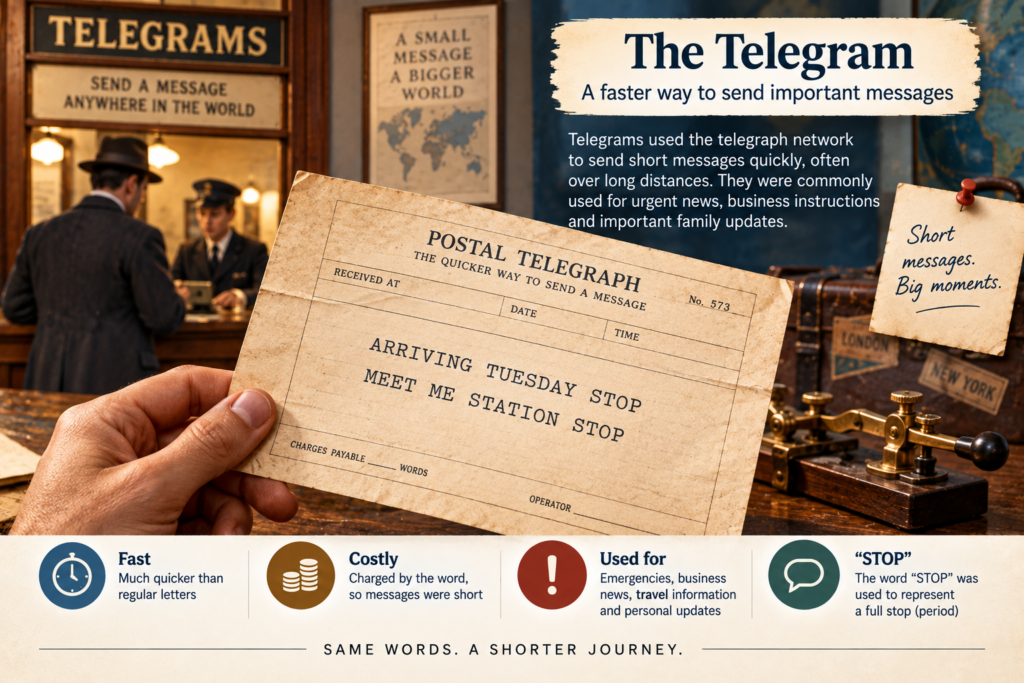
A telegram was a message transmitted through a telegraph system.
People used telegrams when they needed to send information faster than ordinary mail.
Telegram messages were usually short.
Why?
Because sending a telegram could be expensive, and charges were often based on the number of words.
So instead of writing a long letter, people tried to communicate the essential information in as few words as possible.
A message might look something like:
ARRIVING TUESDAY STOP MEET ME STATION STOP
The word “STOP” was commonly used in telegrams to represent a full stop or period.
Telegrams Were Used for Important News
Telegram services became extremely important for governments, businesses, newspapers and ordinary people.
They could be used for:
- Emergencies
- Business instructions
- Travel arrangements
- Family news
- Birth announcements
- Death announcements
- Government communication
- News reports
A telegram could deliver information across great distances much faster than traditional mail.
This was particularly important for newspapers.
Instead of waiting for a ship or train to bring news from another city or country, news organizations could receive reports by telegraph.
Communication had entered a new age.
Then Came the Telephone
The telegraph could send written information quickly.
But what if you wanted to talk to someone?
That was the problem the telephone helped solve.
In 1876, Alexander Graham Bell successfully demonstrated a telephone capable of transmitting speech electrically. The Library of Congress notes that Bell’s telephone grew out of his work on improving telegraph technology.
The difference was enormous.
With a telegraph:
You → operator → coded message → operator → recipient
With a telephone:
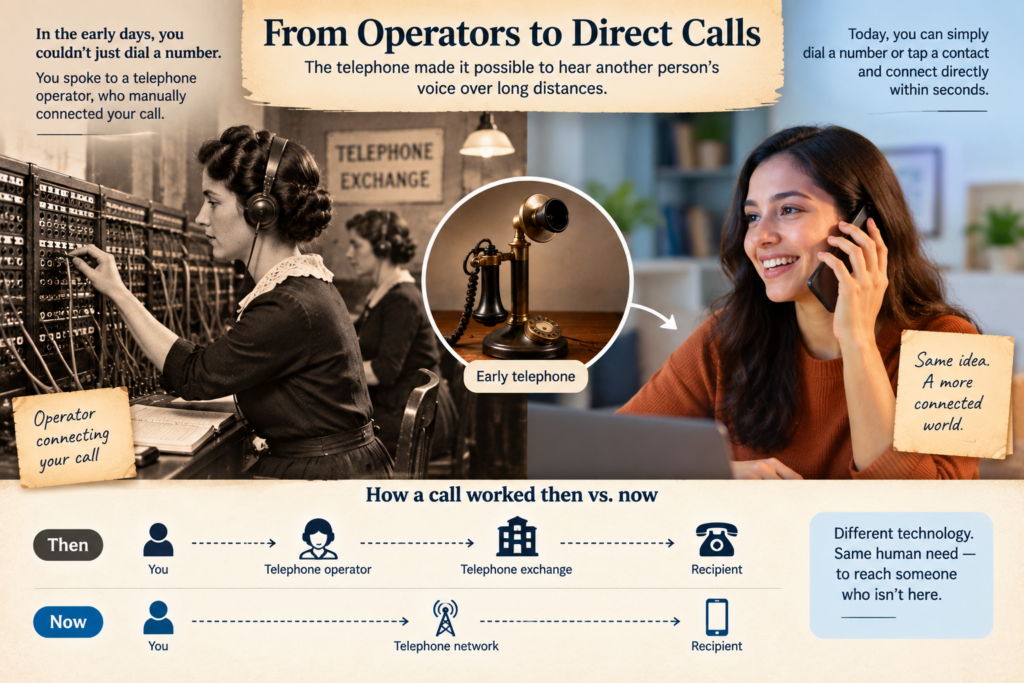
You → telephone network → another person
You could simply speak.
And they could answer.
Why Was the Telephone Such a Big Deal?
Imagine having a friend hundreds of kilometres away.
With a letter, you might have to wait days for a reply.
With a telegram, you could send a short message quickly, but you couldn’t have a normal conversation.
With a telephone, you could say:
“Hello, can you hear me?”
And hear the person answer.
For the first time, distance was no longer a complete barrier to an ordinary conversation.
But early telephone systems had limitations.
Telephones required physical networks, and access was initially concentrated in places where telephone infrastructure existed.
In many areas, people still relied heavily on letters and telegrams.
Telephone Operators Were Once Essential
Today, we simply dial a number or tap a contact.
Early telephone systems could work very differently.
A caller might pick up the telephone and speak to an operator.
The operator would connect the caller to the desired person or location.
This required human beings to physically connect calls through telephone exchanges.
Telephone exchanges therefore became an important part of communication networks.
Eventually, automatic switching systems reduced the need for operators to manually connect every call.
What About Short Messages?
Not every communication needed a long letter or a telephone conversation.
People had postcards for short written messages.
A postcard could be used for something as simple as:
“Arrived safely.”
or:
“Wish you were here.”
or:
“See you next week.”
They were particularly useful for travel and personal greetings.
In a way, postcards were an early example of a communication idea we still use today:
You don’t always need many words to say something useful.
Radio Added Another New Possibility
The development of wireless communication introduced another major change.
Instead of requiring a physical wire between the transmitter and receiver, radio could transmit signals through the air.
Guglielmo Marconi became one of the key figures in the development of practical wireless telegraphy. The Library of Congress places the emergence of radio within the broader progression from telegraphy and telephony to wireless communication.
Radio was especially important for ships, military communication and broadcasting.
It also helped make communication possible in situations where laying telephone or telegraph wires was difficult.
Then Came the Pager
Before mobile phones became widespread, another small device became important in some professions:
the pager.
A pager could receive a short alert or message.
For example, a doctor might carry a pager while working.
If the hospital needed the doctor, it could send an alert.
But there was a catch.
The pager generally didn’t allow you to have a full conversation.
You might receive:
CALL HOSPITAL
You would then find a telephone and call back.
So the pager was more like:
“Someone needs to reach you.”
It wasn’t yet:
“You can carry the entire conversation with you.”

Mobile Phones Changed the Rules
Mobile phones brought together several communication ideas.
You could:
- Make calls
- Receive calls
- Send text messages
- Receive messages
- Carry the device with you
The biggest difference was mobility.
A telephone was connected to a place.
A mobile phone was connected to a person.
You no longer had to ask:
“Where is their telephone?”
You could ask:
“Where is the person?”
And even that question eventually became less important.
Text Messaging Made Communication Even Easier
Mobile phones didn’t stop at voice calls.
Text messaging allowed people to send short written messages directly from their phones.
This brought back an idea that had existed with telegrams and postcards:
short messages can be incredibly useful.
But unlike telegrams, text messages could be sent directly from one person’s device to another without visiting a telegraph office.
And unlike letters, you didn’t need to wait days.
Messages could arrive in seconds.
Smartphones Changed It Again
Then mobile phones became smartphones.
Suddenly one small device could combine:
Telephone + camera + computer + map + newspaper + television + email + messaging service
And internet access meant that communication no longer depended entirely on traditional telephone networks.
You could send:
- Text
- Photos
- Videos
- Voice messages
- Documents
- Locations
- Links
You could even make video calls.
The phone had evolved from a device for speaking into a portable communication centre.
As mobile phones evolved into smartphones, the way we interacted with them changed too. Touchscreens made it possible to tap, swipe and type directly on the display.
But how does a phone actually know exactly where your finger touched?
Learn how it works in our guide: [How Does a Touchscreen Know Where You Touched?]
This technology allows a touchscreen to detect the position of your finger and turn that touch into an action.
How Did People send Messages Before Mobile Phones, Around the world?
There wasn’t one single worldwide path from letters to smartphones.
Different societies adopted technologies at different times.
Some regions had sophisticated courier and postal networks long before electrical communication existed. Others developed telegraph and telephone infrastructure later. Geography, economics, politics, transportation and access to infrastructure all affected how quickly new technologies spread.
But the broad pattern looked something like this:
Europe and the Mediterranean
Long-established courier and postal traditions gradually developed alongside railways, telegraph networks and telephone systems.
Asia
Large and diverse regions had their own messenger, postal and relay traditions. During the 19th and 20th centuries, telegraph and telephone networks expanded alongside modern transportation and infrastructure.
Middle East and Central Asia
Long-distance courier and relay systems were important for communication across large territories. Later, postal, telegraph and telephone networks connected cities and regions.
Africa
Many societies had established local methods of transmitting information long before modern telecommunications. Postal, telegraph and telephone infrastructure later expanded unevenly across different regions.
North and South America
Postal routes were followed by rapidly expanding telegraph and telephone networks. The Americas also became important centres in the development and commercialization of modern telecommunications.
Australia and the Pacific
Distance and geography made communication particularly challenging. Postal routes, telegraph cables, wireless communication and later telephone networks helped connect widely separated communities.
The important point is that technology did not spread everywhere at the same speed.
Even telegraph and telephone networks were initially limited by cost, infrastructure and access. The Library of Congress notes that early electrical communication networks were not automatically universal; economic and political decisions played a major role in determining who could access them.
How Did People Know If Their Message Had Arrived?
This is one of the biggest differences between communication then and now.
Today, many messaging services can tell you whether a message was:
Sent → Delivered → Read
People in the past usually didn’t have anything like that.
If you mailed a letter, you might simply have to wait.
If you sent a telegram, you could receive confirmation through the service, but you didn’t have a tiny screen showing the recipient’s status.
And if you sent a personal letter?
You waited for the reply.
Sometimes for a very long time.
What Happened If Someone Didn't Reply?
You couldn’t send:
“???”
You couldn’t ask:
“Did you see my message?”
You couldn’t check:
“Last seen 10 minutes ago.”
And there was no typing indicator.
The other person might be busy.
They might be travelling.
The letter might be delayed.
The postal service might have problems.
Or perhaps they simply hadn’t written back yet.
Waiting was not an unusual part of communication.
It was normal.
The Final Thought

Today, sending a message takes only a few seconds.
We rarely think about how extraordinary that is.
For most of human history, communicating with someone far away meant waiting for a person, animal, vehicle, ship or other physical system to carry the information.
Then technology changed the rules.
We learned how to make information itself travel.
From a messenger carrying a handwritten note to a smartphone sending a video across the planet, the goal has remained surprisingly simple:
We just want our words to reach someone who isn’t standing beside us.
And that is how the humble message went from taking days or weeks to taking just a few seconds.