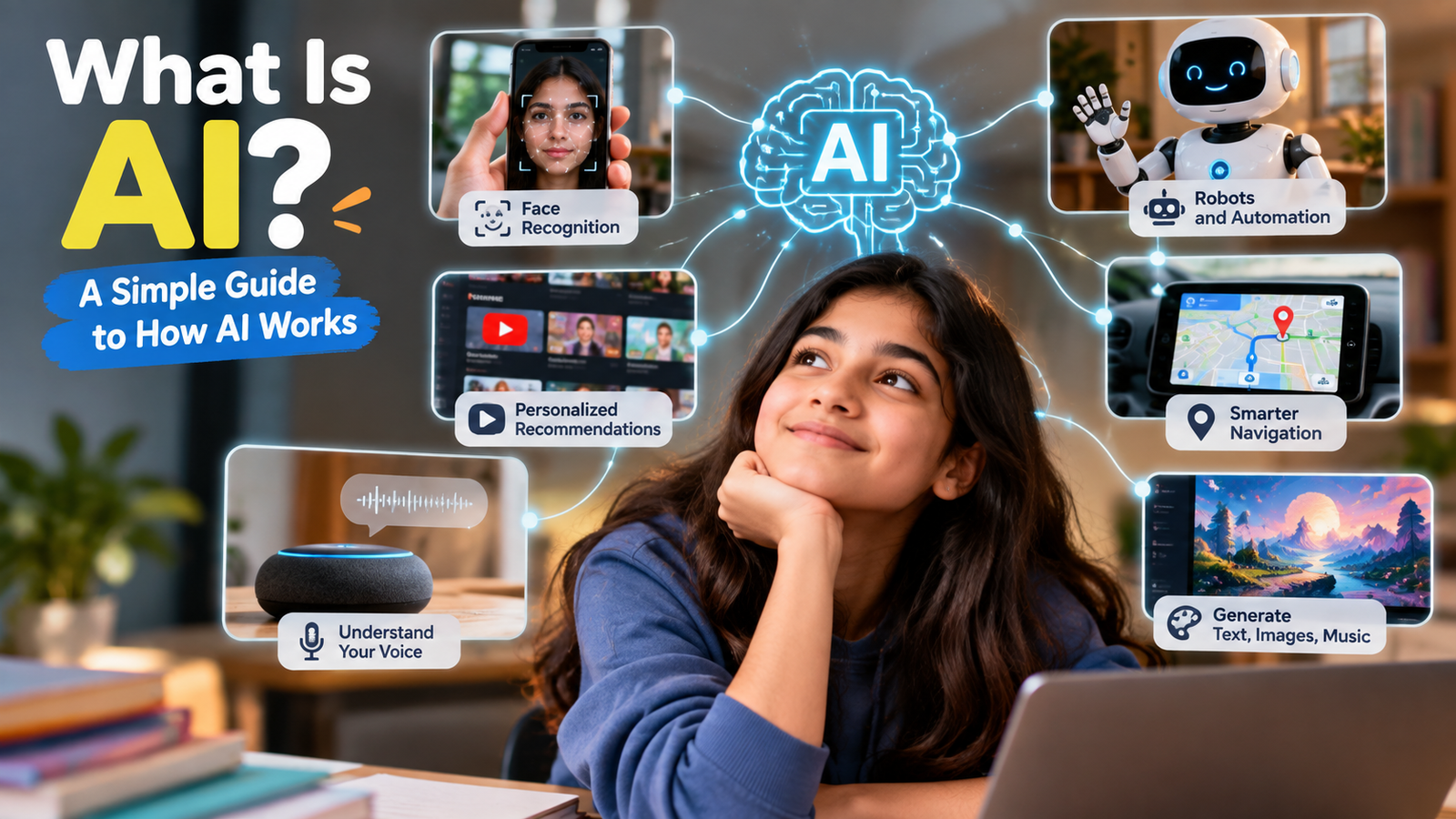
Imagine you ask your phone a question and it answers you.
You take a photo, and your phone recognizes a face.
You open YouTube, and it somehow knows which videos you might enjoy.
You type a few words into an AI tool, and it creates a paragraph, an image, or even a piece of music.
How can a machine do all of that?
The answer is Artificial Intelligence, or AI.
But AI isn’t one single machine or one magical technology. It is a huge field of computer science that includes many different techniques that allow computers to perform tasks that normally require some form of human intelligence.
So what exactly is AI, how does it learn, and what is the difference between AI, machine learning, deep learning, generative AI and AI agents?
Let’s break it down.
What Is Artificial Intelligence?
Artificial Intelligence is the technology used to make computers perform tasks that normally require human-like intelligence.
These tasks can include:
- recognizing pictures and sounds
- understanding language
- finding patterns in information
- making predictions
- solving problems
- recommending things
- generating text, images or music
- making decisions based on information
For example, when your phone recognizes your face to unlock itself, it is using AI to recognize a pattern in an image.
When a navigation app suggests a route, computer systems analyze information such as roads, traffic and distance to help choose a route.
When a video platform recommends a video you might like, AI systems can look at patterns in your activity and compare them with other information.
AI is therefore not just about robots.
Much of the AI around us is invisible.
Does AI Actually Think Like a Human?
Not quite.
When we say that a computer is “intelligent”, it doesn’t necessarily mean that it thinks, feels or understands the world in the same way a human does.
Most AI systems are designed to perform particular tasks by finding patterns in information.
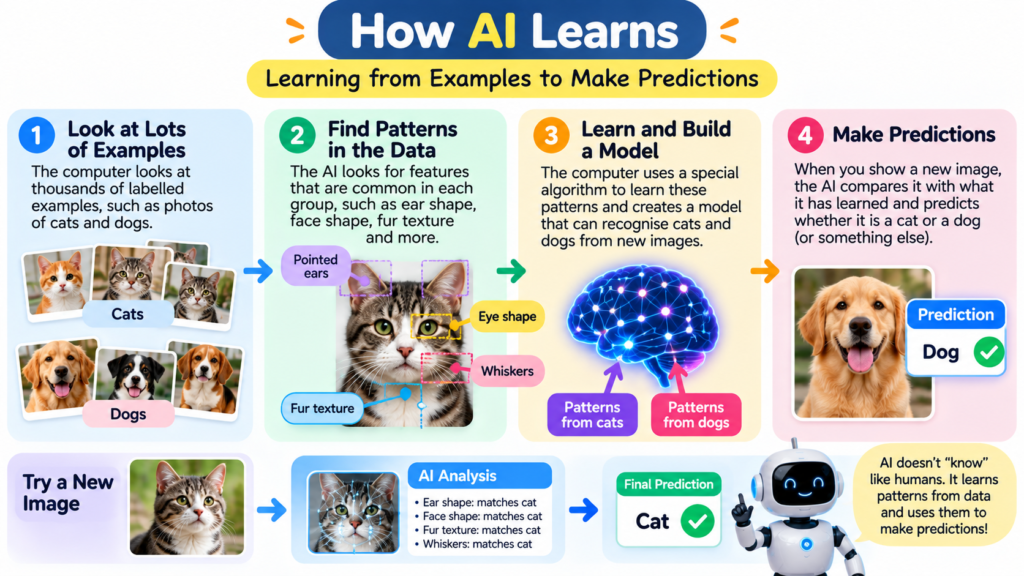
For example, imagine showing a computer thousands of pictures of cats and dogs.
During training, the computer can learn patterns that help distinguish one from the other.
Later, when it sees a new picture, it can use those learned patterns to make a prediction.
It isn’t thinking:
“Hmm… that looks like my neighbor’s cat.”
Instead, it is using mathematical patterns learned from data.
This difference is important.
AI can be extremely good at certain tasks without having human-like understanding.
How Does AI Learn?
This is where things get really interesting.
Traditional computer programs usually follow instructions written by humans.
For example:
If the temperature is above 30°C → turn on the fan.
But many AI systems work differently.
Instead of giving the computer every possible instruction, humans can provide data and a method for finding patterns in that data.
This is the basic idea behind machine learning.
Imagine teaching a computer to recognize handwritten numbers.
You could show it thousands of examples of handwritten 0s, 1s, 2s and so on.
The computer looks for patterns in those examples.
After training, you can give it a handwritten number it has never seen before.
It can then make a prediction about what number it is.
The computer has learned from examples rather than simply following one giant list of instructions.
What Is Machine Learning?
Machine learning is a part of AI in which computers learn patterns from data and use those patterns to make predictions or decisions.
Think of it like learning from practice.
A child who wants to learn to recognize different birds might look at hundreds of pictures and observe things such as:
- shape
- size
- color
- beak
- wings
- markings
After seeing enough examples, the child becomes better at recognizing birds.
Machine-learning systems also learn from examples, although they do it using mathematics and algorithms rather than human-style understanding.
Machine learning is used in things such as:
- spam filters
- recommendation systems
- speech recognition
- fraud detection
- image recognition
- weather and demand forecasting
- some medical-imaging systems
But machine learning is only one part of the much bigger AI world.
What Is Deep Learning?
You may also hear the term deep learning.
Deep learning is a type of machine learning that uses large artificial neural networks with many layers.
These networks are loosely inspired by the way networks of neurons in the human brain process information, although artificial neural networks are much simpler than real brains.
Deep-learning systems have become especially powerful for tasks involving huge amounts of complex data.
For example, they can be used for:
- recognizing objects in photographs
- understanding speech
- processing language
- analyzing video
- generating content
You don’t need to understand all the mathematics behind neural networks to understand the basic idea.
Think of it this way:
AI → a broad field
Machine learning → one important way of building AI systems
Deep learning → a powerful type of machine learning
And then there is another term you will hear everywhere today:
Generative AI.
What Is Generative AI?
Most AI systems analyze information, recognize patterns or make predictions.
Generative AI can create new content.
It can generate things such as:
- text
- images
- music
- audio
- video
- computer code
Chatbots that generate written answers are examples of generative AI.
Image-generation tools are another example.
But how can a computer “create” something it has never seen before?
Generative AI models are trained using very large amounts of data. During training, they learn patterns and relationships within that data.
For example, a language model learns patterns in language — how words relate to one another, how sentences are structured and how different pieces of information are connected.
When you give it a prompt, the model uses what it has learned to generate an output.
It isn’t simply searching a giant database and copying a ready-made answer.
It is generating an answer based on patterns learned during training.
This is why two people can ask an AI system similar questions and receive different responses.
What Are Large Language Models?
If you’ve heard of ChatGPT, you’ve probably also heard the term LLM.
LLM stands for Large Language Model.
A large language model is an AI model designed to work with human language.
It can be trained on huge collections of text and learn patterns that help it understand and generate language.
When you type:
“Why is the sky blue?”
the model doesn’t look at the sentence exactly as a human does.
It processes the text mathematically and uses patterns learned during training to generate a response.
That’s why an LLM can write stories, explain science, summarize information, translate text and help with computer code.
But it can also make mistakes.
An AI-generated answer can sound extremely confident while still being incorrect.
AI can be useful, but it still needs human judgment.
What Are AI Agents?
Here’s where AI is becoming even more interesting.
A traditional chatbot might answer a question.
But an AI agent is designed to go further.
Instead of simply responding to:
“What is the weather like?”
an AI agent could potentially be given a larger goal and then determine the steps needed to accomplish it.
For example, a task might involve:
understanding a goal → planning steps → using tools → checking results → taking the next action
An AI agent might use tools such as web search, software applications, databases or other computer systems, depending on what it has been designed and allowed to do.
This is why you may hear the term agentic AI.
It describes AI systems designed to perform multi-step tasks rather than simply respond with a single answer.
We’re going to explore AI agents in much more detail in a separate KyunAurKaise article.
Are All AI Systems the Same?
No.
This is one of the most important things to understand about AI.
An AI system designed to recognize faces does not work exactly like an AI system that generates text.
A recommendation system doesn’t work exactly like a self-driving vehicle’s perception system.
A language model isn’t the same thing as an image-recognition model.
They can use some similar underlying techniques, but they can be trained for very different purposes.
You can think of AI as a huge toolbox.
Different AI technologies are different tools designed for different jobs.
Where Do We Use AI in Everyday Life?
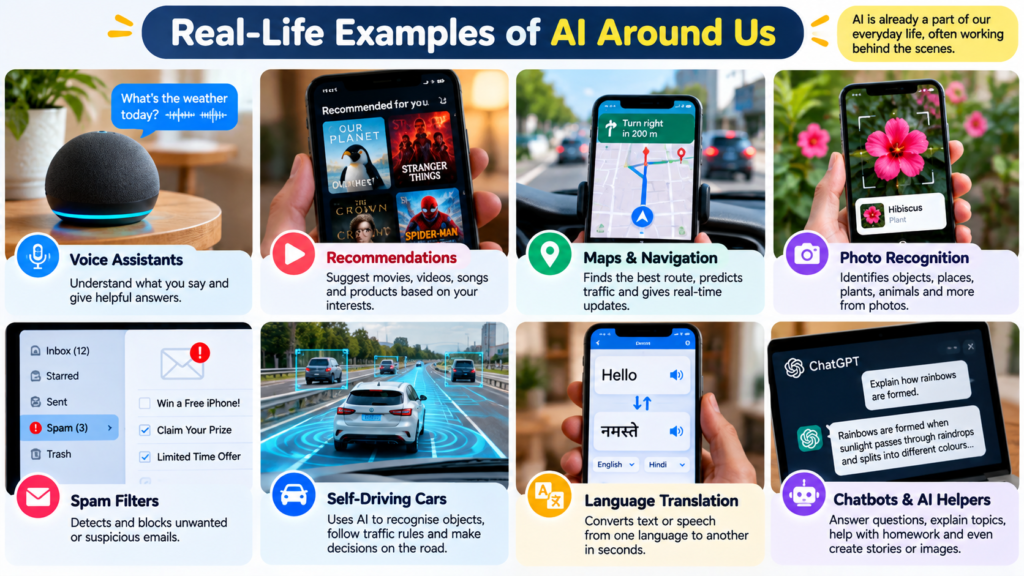
You may be surprised by how much AI you already encounter.
📱 Your smartphone
AI can help with:
- face recognition
- voice assistants
- camera processing
- photo organization
- spam detection
- predictive text
🎬 Streaming and video platforms
AI can analyze patterns in what people watch and interact with to help generate recommendations.
🗺️ Maps and navigation
AI and other computer algorithms can help analyze traffic, routes and enormous amounts of location data.
AI-powered systems can help identify spam and potentially suspicious messages.
🛒 Online shopping
Recommendation systems can suggest products based on patterns in searches, browsing and purchases.
🎮 Video games
AI can control computer-controlled characters and help create more responsive game environments.
🏥 Medicine
AI techniques are being researched and used in areas such as medical-image analysis, drug discovery and other healthcare applications.
So AI isn’t something that suddenly appeared with chatbots.
It has been quietly becoming part of everyday technology for years.
What Are the Different Areas of AI?
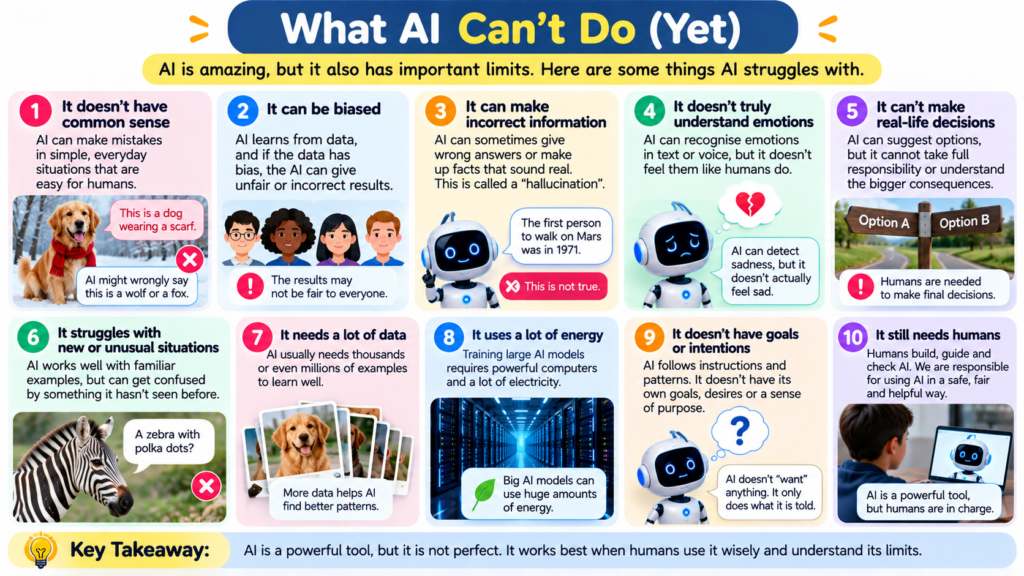
There are many ways to classify AI, and the boundaries aren’t always neat.
But some important areas you will encounter are:
Artificial Intelligence
The broad field of creating systems capable of performing tasks associated with intelligence.
Machine Learning
Systems that learn patterns from data.
Deep Learning
Machine learning based on large, multi-layer neural networks.
Generative AI
AI that generates new content such as text, images, audio, video or code.
Large Language Models
Models designed to process and generate human language.
Computer Vision
AI systems that process and interpret images and video.
Speech and Language AI
Systems that recognize, process or generate human speech and language.
AI Agents
Systems designed to pursue goals through multiple steps and, in some cases, interact with tools.
These areas can overlap.
For example, a generative AI system may use deep learning, while a language model can be part of an AI agent.
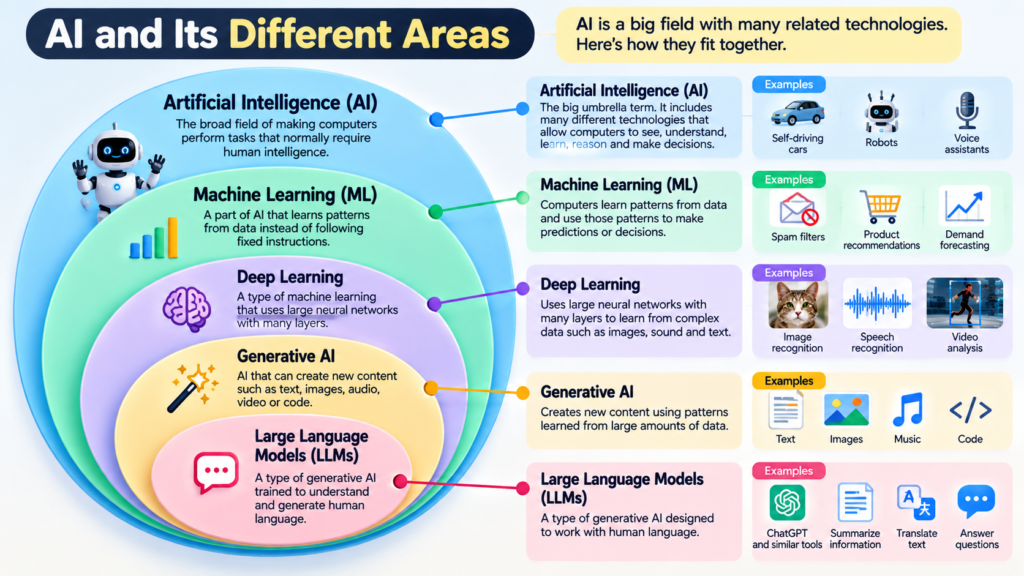
What Are the Limitations of AI?
AI can do some remarkable things, but it isn’t perfect.
AI systems can:
- make incorrect predictions
- misunderstand a question
- produce inaccurate information
- learn unwanted patterns from their training data
- behave differently when given slightly different inputs
And because AI systems learn from data created by humans, the quality and limitations of that data matter.
That’s why people are still important.
Humans decide what problems to solve, what data to use, how systems should be tested and how their results should be used.
AI is a tool. It isn’t a replacement for human judgment in every situation.
So, How Does AI Actually Work?
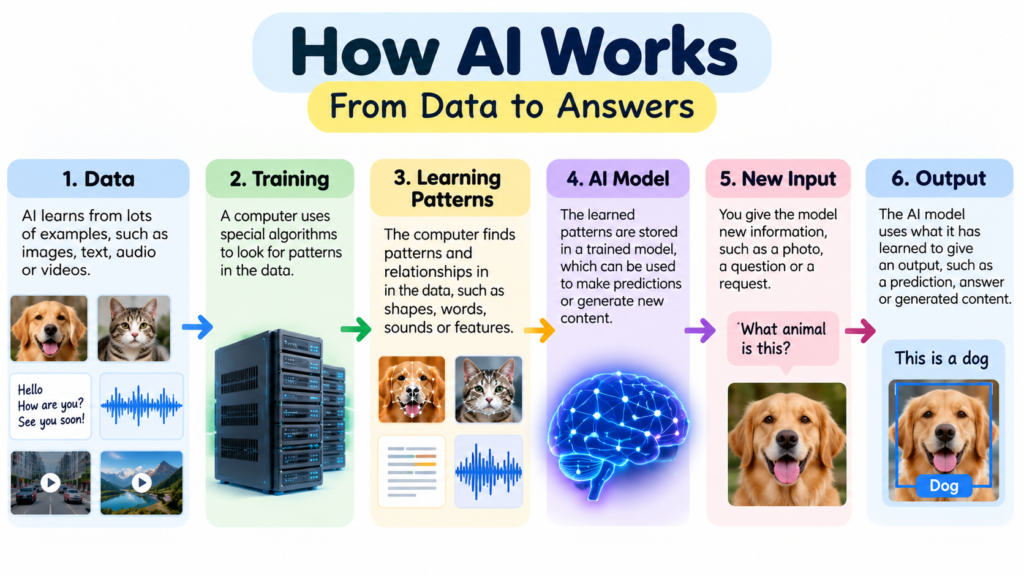
At a very simple level, many AI systems follow a process like this:
Data → Training → Learning patterns → Model → New information → Prediction or output
For generative AI, the process can look more like:
Training data → Learning patterns → AI model → Your prompt → Generated output
And for an AI agent:
Goal → Plan → Use tools → Check results → Take another step → Complete the task
The details can become incredibly complicated.
But the basic idea is surprisingly simple:
AI systems use data, algorithms and trained models to perform tasks that would otherwise require certain kinds of human intelligence.
The AI Around Us Is Just Getting Started
AI is no longer something found only in science-fiction movies.
It is already inside phones, cars, websites, cameras, search engines, games and many other technologies we use every day.
And AI itself is changing rapidly.
We’ve moved from computers following simple instructions to systems that can recognize patterns, understand language, generate content and increasingly carry out multi-step tasks.
But the most interesting question isn’t simply:
“What can AI do?”
It’s:
“How does it do it?”
That’s what we’re going to explore next.
From machine learning and generative AI to AI agents, deepfakes and AI-powered search, each technology has its own fascinating story.
And once you understand the basics of AI, those stories become much easier to understand.
The world of AI is huge. Let’s explore it one “How?” at a time.
4 thoughts on “What Is Artificial Intelligence? A Simple Guide to How AI Works”